
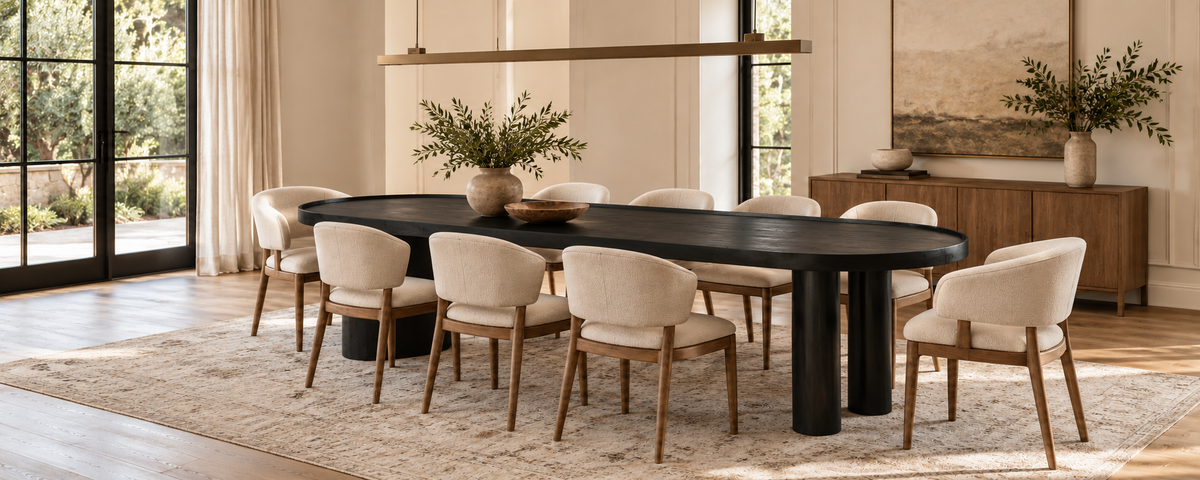
The usual advice for a big table is to measure the room. That matters, but it answers only one question. A table that fits the dining room can still fail at the front door, crowd the people seated at its ends, or leave you with a table far bigger than your ordinary Tuesday needs. This guide covers the questions that come after "will it fit?"
Quick Answer
Before buying a large dining table, confirm it can reach the room through the doors, turns, and stairs; check how the top is supported over its length; decide between a fixed or extendable table; and make sure the base leaves enough legroom for end seats. Also consider everyday use, lighting, and flooring. For seat counts and clearance, use Oak & Loom's dining table seating guide.
Why This Matters
A large table is among the most expensive and difficult-to-return pieces in a home. It arrives long, heavy, and awkward, and it can dominate the room for years. Small oversights, such as a tight stair turn or a leg in the wrong place, can be hard and costly to fix after delivery.
The Key Question
Ask "how often will this table be full?" A table for ten that seats two on most days is a different purchase from one that hosts every weekend. Your answer decides whether to buy fixed size, an extension, or a size down.
What Actually Matters
Can It Get Into the Room?
Measure the table's length and width against every doorway, hallway turn, and staircase between the delivery vehicle and the room, not only the dining room door. Oak & Loom's Bloomington dining table, for example, lists sizes of 72 × 38 in, 96 × 38 in, and 108 × 42 in, all 30 in high. A 108-inch top is nine feet long.
Check whether the top comes in one piece or whether the legs and base are separate. The Bloomington listing says assembly is required, which can make access easier, but the page does not state its weight or how it ships. Also ask whether the tabletop ships fully assembled, in sections, or with the base removed. Ask for these details before ordering any large table, because they are not always listed.

How the Top Is Supported Over a Long Span
A longer top carries its own weight across more distance, so how it is supported matters more as length grows. Look at what holds the top up: the legs, any aprons or stretchers under the edges, and how those connect. Be wary of a long top resting on slim legs with little visible structure.
There is no single thickness or leg count that guarantees a table won't sag, so be cautious of universal rules based on either measurement alone. Instead, check the middle of the top for noticeable flex or creaking in person. For online buying, ask the seller how the top is attached and supported.
A large solid wood dining table also responds to changes in humidity, mostly across the grain and very little along its length, according to the USDA Forest Products Laboratory's Wood Handbook. On a wide top, that means a well-made table is built to let the wood move rather than lock it rigidly in place. A very large tabletop in a room with big seasonal humidity swings is worth asking about specifically.
Quick Tip: Ask how the top is fastened to the base. A good answer explains how the wood is allowed to move.
Fixed Size or Extendable?
A fixed large table looks best and is simplest, but it commits your room to that footprint every day. An extendable table gives a smaller everyday size and a larger hosting size, at the cost of more moving parts and a place to store the leaves.
Ask these before choosing extendable: how many leaves, where they are stored, whether the top aligns flush when extended, and whether the legs or aprons change the legroom at the ends. For more on choosing a dining table for everyday family use, see Oak & Loom's family dining table guide. If you host rarely, a fixed table of moderate size plus a bench or extra chairs for peak days is often simpler.

|
Fixed Large Table |
Extendable Table |
|
|
Everyday footprint |
Always large |
Smaller until extended |
|
Moving parts |
None |
Slides, leaves, locks |
|
Leaf storage |
Not needed |
Needs a place to keep leaves |
|
Best for |
Frequent large gatherings |
Occasional hosting |
Legroom and the Ends of the Table
On a large table, the end seats are where the base often interferes. Chunky end legs, deep aprons, or a pedestal can leave less knee room than the table's length suggests. Sit in each position, including the corners, if you can. Check seat-to-top clearance too; Oak & Loom's family dining table guide gives 10 to 12 inches of vertical clearance between the seat and tabletop as a comfort range.
For chairs and benches at this scale, see Oak & Loom's guide to choosing dining chairs for a solid wood table.
Lighting and the Room Around It
A long table suits a long light, such as a linear fixture or several pendants spaced along the length, rather than one small fixture in the middle. A single pendant can leave the ends dim. The goal is even coverage across the full table rather than simply matching the fixture to the table's length. Plan wiring before the table arrives if you want a ceiling change.
Under the table, consider a rug large enough that chairs stay on it when pulled back; Oak & Loom's rug size guide covers that.
Common Mistakes
-
Measuring only the dining room. The route to the room is where large tables can get stuck.
-
Buying for the busiest day. Size for ordinary use and plan flexibility for peak days.
-
Ignoring the base at the ends. Legs and aprons can make end seats uncomfortable.
-
Assuming length guarantees sturdiness. Check the support structure and look for noticeable flex.
-
Forgetting lighting and flooring. Plan lighting for the full table length, and use appropriate felt pads to help protect the floor.
Practical Checklist
-
Measure doors, hallway turns, and stairs along the full delivery route
-
Ask for the table's weight and whether it ships assembled
-
Check the tabletop for noticeable flex or creaking
-
Ask how the top is fastened and allowed to move
-
Decide between fixed or extendable based on how often it will be full
-
Sit at the ends and corners to check legroom
-
Plan lighting that covers the full length
-
Use the seating guide for seat counts and wall clearance
Conclusion
A large dining table rewards planning at the unglamorous stage: the route in, the structure underneath, and the spaces where people actually sit. If a standard size doesn't suit your room, Oak & Loom's Personalize Your Furnitur page describes made-to-measure options.
Frequently Asked Questions
How big is a large dining table?
There is no universal size that defines a large dining table. Tables around 84 inches and longer can accommodate larger seating capacities, depending on the table's width and design. For exact sizes by seat count, see Oak & Loom's seating guide.
How do I know a large table will get through my house?
Measure its length and width against every doorway, hallway turn, and stair on the route, and ask the seller whether the legs or base can be removed.
Do large solid wood tables sag?
Support design matters more than length alone. Look at the legs and aprons, ask how the top is supported, and check for noticeable flex in person where possible.
Is an extendable table better than a fixed one?
It depends on how often you host. Extendable tables save everyday space but add moving parts and need leaf storage.
Share:
Dresser vs. Chest of Drawers: Which One Is Better for Your Bedroom?