
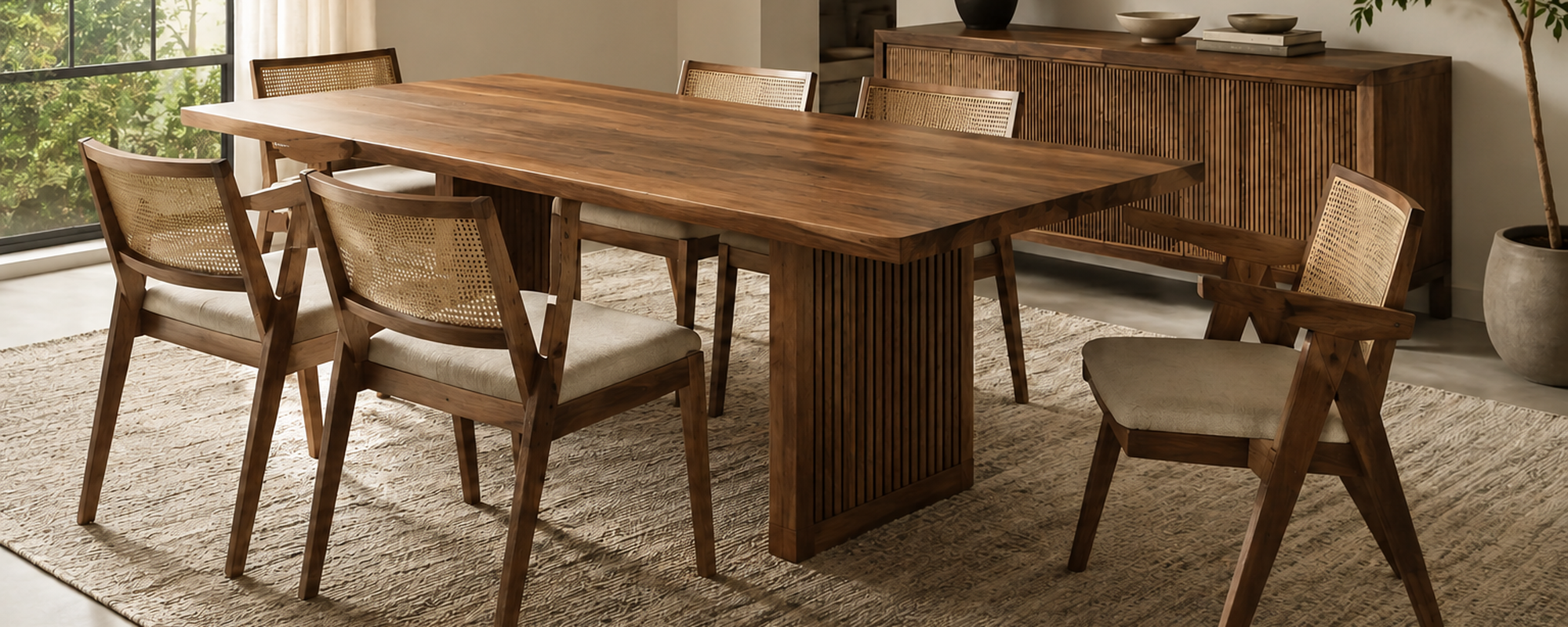
A rug that looks perfectly sized in a showroom photo often turns out too small once it's under an actual dining table - a chair leg catching the edge every time someone scoots back, or the front two legs landing on hardwood while the back two stay on the rug. The fix isn't a bigger room, it's choosing a rug that's larger than most people initially guess.
Dining room rugs are sized around the table and its pulled-out chairs, not the table alone, which is why the right size is almost always larger than intuition suggests. Here's exactly how to calculate it for your table, whatever its shape or seat count:

Quick answer: A dining room rug should extend at least 24 inches beyond the table's edge on all sides, giving chairs enough room to stay fully on the rug when pulled out to sit or stand. For most 6-seat rectangular tables, that means an 8×10 ft rug; for 8-seat tables, a 9×12 ft rug. Round tables generally pair best with a round or square rug that provides the same 24-inch minimum clearance.
Why This Matters - Improvement needed
An undersized rug is one of the most common dining room mistakes, and it's rarely obvious until the room is furnished. Chair legs catch the rug's edge, back legs slip onto bare floor, and the whole area can look slightly off even when every other element is right.
Sizing correctly the first time helps avoid buying twice - dining-room rugs are a significant purchase, and returning one that's already been placed and used isn't always straightforward.
How to Size a Dining Room Rug
The 24-Inch Rule
The standard rule: a dining rug should extend at least 24 inches beyond the table's edge on every side, with 30 inches providing additional clearance where your room and budget allow. That extra margin isn't decorative - it gives chairs enough room to move back from the table while keeping all legs on the rug.
The basic formula is simple: add 48 inches to both the length and width of your table to allow 24 inches of rug clearance on each side. If you have the room, adding 60 inches instead provides a more generous 30-inch clearance. Because rugs come in standard sizes, use this calculation as your minimum target and choose the closest larger standard size that fits comfortably in the room.
Sizing by Table Shape
Rug shape should generally complement table shape. A rectangular table pairs well with a rectangular or oval rug, while a round table pairs well with a round or square rug. Mismatching shapes - such as a round rug under a rectangular table - can leave the table's corners extending beyond the rug's usable area.
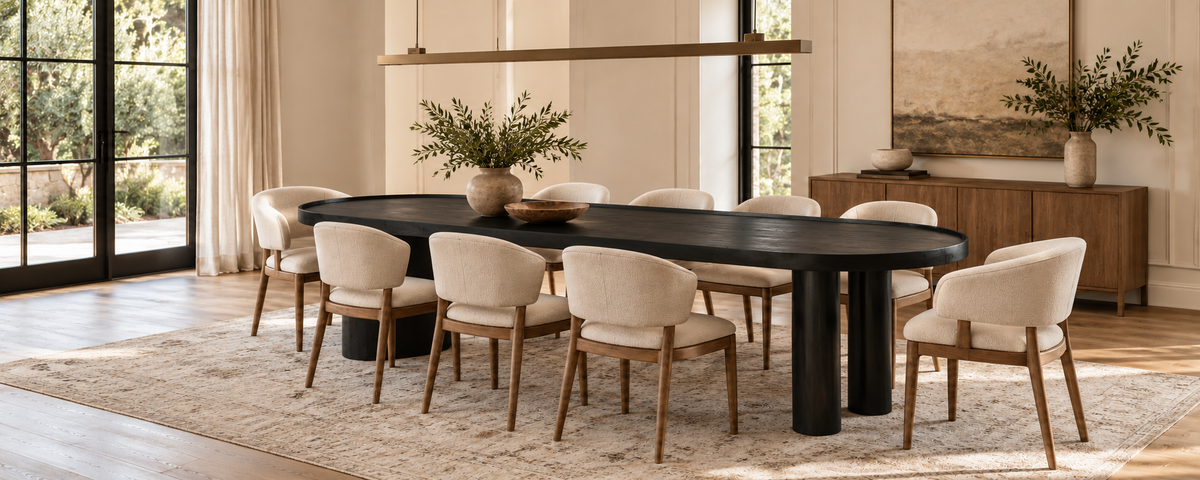
Here's what that 24-inch clearance actually looks like measured out:

Sizing by Seating Capacity
Because table dimensions determine how much rug coverage you need, seat count is best used as a quick starting point rather than the final sizing rule. A 4-seat rectangular table typically pairs with a 6×9 ft rug; 6-seat tables with 8×10 ft; 8-seat tables with 9×12 ft; and larger tables seating 10 or more may need 10×14 ft or a custom size. These are starting points, not fixed rules - always measure your actual table before finalizing a rug, since dimensions vary by table style.
If you're still deciding how large your table needs to be, our guide to how many people your dining table can comfortably seat can help you match table dimensions to your everyday seating needs.
Here's how to work through the decision for your own table:

Comparison Tables
|
Table Seats |
Typical Table Size |
Recommended Rectangular Rug |
Recommended Round Rug (round tables) |
|
4 seats |
36–48 in round / ~60 in rect |
6×9 ft |
8 ft round |
|
6 seats |
60–72 in rect |
8×10 ft |
- |
|
8 seats |
78–96 in rect |
9×12 ft |
- |
|
10+ seats |
96 in+ rect |
10×14 ft or custom |
- |
These sizes are practical starting points, not fixed rules. Always measure your table's actual dimensions and allow at least 24 inches of clearance on each side for chairs.
The same chart, in a faster reference format:
Expert Advice: Rug Material and Pile for Under a Dining Table
A dining room rug needs to handle moving chair legs and occasional spills, which makes very high-pile or shag styles less practical - chairs can catch on longer fibers, making them harder to push in and out. A low-pile, flat-weave, or tightly looped rug is generally easier to move chairs across and simpler to clean underneath.
If you're still choosing seating for the table, our guide to choosing dining chairs that work with a solid wood table covers the practical dimensions and spacing to consider.

Designer Tips
Designer Tip: When in doubt between two rug sizes, choose the larger one - an oversized dining rug can feel more intentional, while an undersized one can make the dining area feel visually cramped.
Worth Considering: Leave roughly 12–18 inches of visible floor between the rug and the room's walls where possible, while also accounting for nearby furniture, so the rug doesn't feel like wall-to-wall carpet.
Did You Know? A rug pad is strongly recommended under a dining table because it helps keep the rug stable as chairs move and can reduce wear on both the rug and the floor beneath it.
Common Mistakes
|
Mistake |
Reality |
|
Sizing the rug to the room instead of the table |
The table and its pulled-out chairs are what actually need coverage |
|
Choosing a round rug for a rectangular table |
The table's corners can extend beyond the rug, making the proportions feel unbalanced |
|
Skipping the rug pad |
A rug pad can help keep the rug stable as chairs move and reduce wear over time |
|
Choosing exactly 24 inches when more space is available |
A 30-inch clearance can provide more generous chair clearance and a more spacious look |
|
Choosing high-pile rugs for dining use |
Chair legs can snag and drag, making everyday movement harder than it needs to be |
The rug isn't there to fill floor space - it's there to comfortably hold the table and every chair through the full range of chair movement.
Buying Checklist
-
Measure your table's exact length and width, or diameter.
-
Add at least 24 inches, ideally 30 inches, to each side for chair clearance.
-
Match the rug shape to the table shape.
-
Choose a low-pile or flat-weave rug for easier chair movement.
-
Add a rug pad for grip and cushioning.
-
Leave roughly 12–18 inches of visible floor between the rug and the walls where possible.
-
Round up to the nearest standard size rather than down.
The same seven checks, condensed into one saveable graphic:

Frequently Asked Questions
Q1: What size rug do I need for a 6-person dining table?
Most 6-person rectangular dining tables, typically 60 to 72 inches long, pair well with an 8×10 ft rug, which provides the recommended 24-inch clearance on all sides for chairs to stay on the rug when pulled out.
Q2: How far should a rug extend beyond the dining table?
A dining room rug should extend at least 24 inches beyond the table's edge on every side, with 30 inches providing additional clearance where space and budget allow, so chair legs stay on the rug through their full range of motion.
Q3: What shape rug should I use under a round dining table?
A round or square rug generally works best under a round table, since it avoids the exposed corners that can occur when a rectangular rug is paired with a round table.
Q4: What size rug goes under an 8-seat dining table?
An 8-seat table, typically 78 to 96 inches long, usually needs a 9×12 ft rug to maintain the recommended 24-inch clearance around the table's full perimeter.
Q5: Should I use a high-pile or low-pile rug under a dining table?
A low-pile or flat-weave rug is generally better under a dining table, since chair legs move across it constantly and higher-pile rugs can snag or drag, making chairs harder to move.
Q6: Do I need a rug pad under a dining room rug?
A rug pad is strongly recommended under a dining room rug because it helps keep the rug stable as chairs move, adds cushioning, and can reduce wear on the rug and floor over time.
Q7: What size rug should I use under an extendable dining table?
If you regularly use your dining table in its extended configuration, size the rug for the table at its largest everyday length so the chairs can remain on the rug when pulled out. If you only extend it occasionally, base your choice on the configuration you use most often and make sure the rug still provides adequate clearance.
If you're also choosing an extendable table, our guide to choosing a dining table for your family can help you think through size and long-term flexibility.
Final Summary
Rug sizing under a dining table comes down to a simple rule: measure the table, add enough clearance for the chairs, and round up rather than down. Get that right, and the rug will frame the dining area comfortably while keeping the table and chairs properly grounded in the space.
A well-sized dining rug should feel effortless - giving the table and chairs enough room to move without competing with the rest of the room.
Pairing a Rug With a New Table?
If you're choosing a rug to go with a new dining table, our design team can help confirm the right size once you've picked your table, or you can explore our dining tables collection and complete dining sets to compare dimensions and styles. If you need help choosing the right size, reach out through our contact page.
Share:
Modern Rustic Interior Design
Coffee Table Decor Ideas: How to Style Trays, Books, Centerpieces & More