
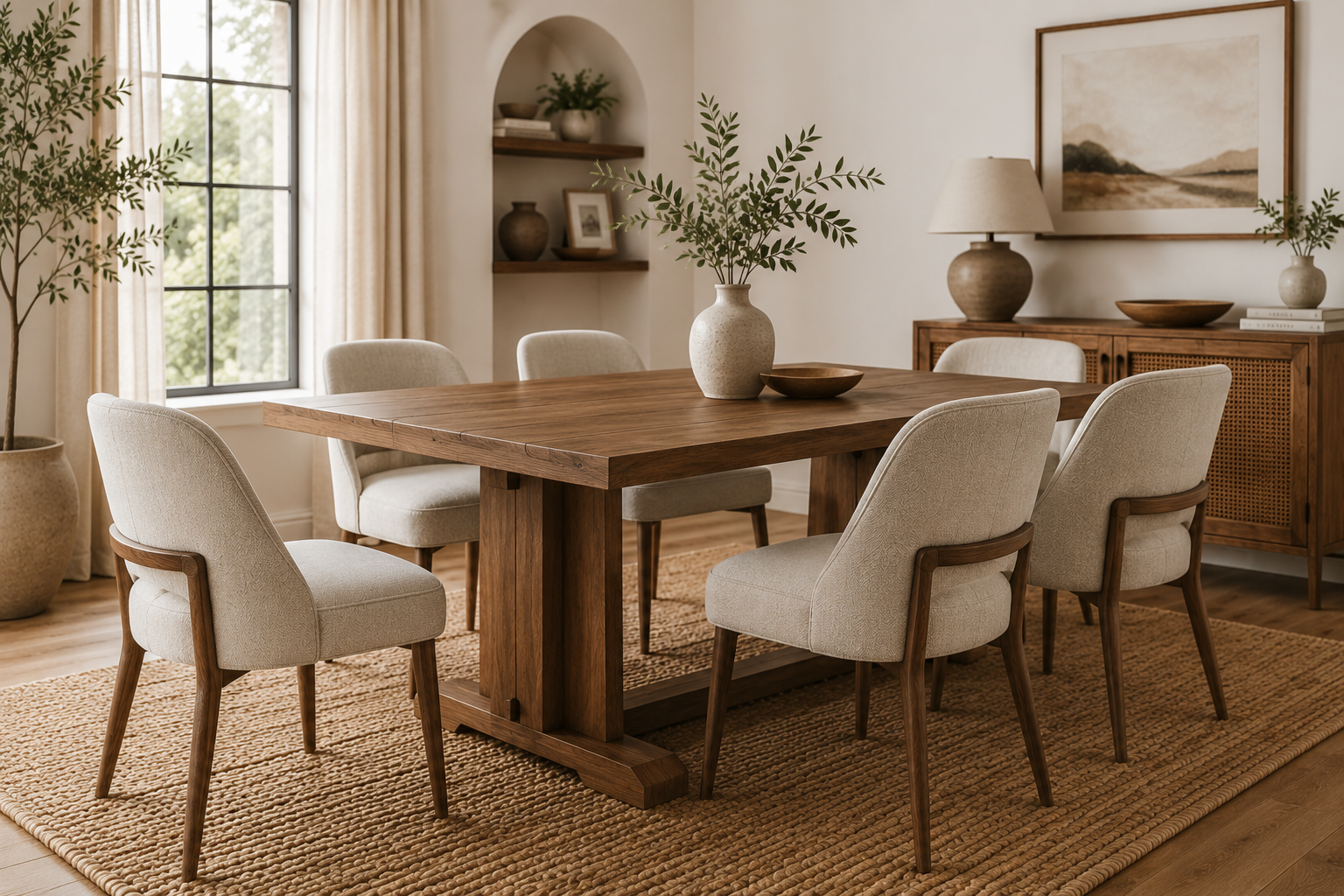
You found the table. Solid wood, the right size, the right finish, the right presence for your dining room. You ordered it, it arrived, it looked exactly as you hoped - and then came the chair question. The question that most dining room guides treat as a footnote but that determines, more than almost any other decision, whether the dining room feels genuinely composed or simply furnished.
Dining chairs are the most used pieces of furniture in a dining room. They are used at every meal, pushed back and pulled forward dozens of times a week, leaned on, stacked against, and occasionally dragged across floors.They need to work ergonomically - at the right height, with the right depth, with enough back support for a two-hour dinner. They need to work visually - relating to the table without copying it, adding something to the room without fighting with everything already in it. And they need to work practically - fitting around the table with enough clearance for comfortable movement, fitting through doorways on delivery day, fitting into a budget that has already been stretched by the table itself.
This guide covers everything you need to choose dining chairs that work beautifully with a solid wood table-dimension by dimension, material by material, and decision by decision. As you read, browse Oak & Loom's full collection of dining chairs and solid wood dining tables to see these principles in practice.
"Choose chairs for the meals for the room. The chairs determine whether anyone wants to stay at it."
The Height Calculation: Where Every Chair Decision Starts
Dining chair height is not a style decision. It is a dimensional requirement - and getting it wrong produces a dining experience that is uncomfortable regardless of how beautiful the chair looks.
The critical measurement is the distance between the chair seat and the underside of the dining table - the clearance that determines whether someone can sit comfortably beneath the table. The industry standard is 10 to 12 inches of clearance between the top of the seat cushion and the underside of the tabletop.
Most solid wood dining tables sit at a standard height of 29 to 31 inches from floor to tabletop surface. Most standard dining chairs have seat heights of 17 to 19 inches. The arithmetic: 30-inch table minus 18-inch seat height leaves 12 inches of clearance — right in the comfortable zone. This is why most standard dining tables and dining chairs work together without any special calculations.
Where the calculation becomes important is when one variable deviates from standard. A counter-height dining table - 34 to 36 inches - requires counter-height chairs with seat heights of 24 to 26 inches. A low dining table at 28 inches needs a chair with a seat height of 16 to 17 inches to maintain adequate clearance. A very thick upholstered chair seat - which may add 2 to 3 inches above the stated seat height - needs to be factored into the clearance calculation before purchase.
Always confirm two measurements before buying dining chairs: the underside height of your dining table and the seat height of the chair. Subtract one from the other. Aim for 10 to 12 inches of clearance for comfortable everyday dining.
Chair Seat Depth and Dining Comfort
Seat height gets most of the attention in dining chair dimensions. Seat depth - the front-to-back measurement of the seating surface - gets almost none, despite being equally important for sustained dining comfort.
A dining chair seat that is too shallow - less than 15 inches front to back - leaves the thighs unsupported beyond the front edge of the seat, which becomes uncomfortable within 20 to 30 minutes of sitting. This matters more for dining chairs than for desk or living room chairs because dining chairs are used for extended periods - dinner parties, holiday meals, long Sunday lunches - where the discomfort of a shallow seat becomes increasingly noticeable over time.
A seat depth of 16 to 18 inches serves most adults comfortably for extended dining. A seat depth of 19 to 20 inches begins to feel generous rather than simply adequate - suitable for chairs that will be used for longer meals and gatherings where comfort is a priority over compactness.
The tradeoff is that deeper seats push the seated diner further from the table. A chair with an 18-inch seat depth positions the diner roughly 4 to 6 inches farther from the table edge than a chair with a 15-inch seat depth. This can make it slightly harder to comfortably reach the center of the table and reduce the feeling of sitting closely together. For family dining rooms where children and shorter adults are regular diners, a shallower seat depth - 16 to 17 inches - often works better than a generous 19-inch depth that leaves shorter legs dangling from a position too far from the table.

Wood Chairs vs. Upholstered Chairs: The Real Comparison
The choice between wooden dining chairs and upholstered dining chairs is almost always framed as a style decision. It is more accurately a use decision - and the right answer depends entirely on how the dining room is actually used.
Wooden dining chairs - solid wood throughout, with no upholstery - are more durable, easier to clean, and more visually cohesive alongside a solid wood dining table. They wipe clean from spills in seconds. They do not accumulate food debris in fabric folds the way upholstered chairs can. They do not fade, pill, or require reupholstering over time. For households with young children, dining rooms that see daily heavy use, or homeowners who value low-maintenance furniture above all else, wooden dining chairs make genuine practical sense.
The honest tradeoff is comfort over extended periods. A solid wood chair seat - even a well-shaped one - becomes uncomfortable for most adults after 60 to 90 minutes of continuous sitting. For a family whose weeknight dinners last 20 to 30 minutes, this is rarely a meaningful concern. For households that host long dinner parties or use the dining room as a secondary work or social space, the added comfort of an upholstered seat is often worth the extra maintenance.
Upholstered dining chairs - with padded seats in fabric or similar material on a solid wood frame - provide meaningfully better long-term comfort while introducing a softness that balances the natural hardness of a solid wood table. A solid wood table paired with upholstered chairs in a neutral fabric is one of the most enduring combinations in US interior design because it balances hard and soft surfaces, structure and comfort, and natural wood with textured fabric.
The maintenance reality of upholstered dining chairs also deserves consideration. Fabric absorbs spills rather than repelling them, and upholstery naturally shows wear over time in ways that solid wood does not. For dining rooms with young children or frequent messy meals, choose upholstered chairs with removable, washable covers or performance fabrics that are easier to clean and maintain.
How to Match Chair Style to a Solid Wood Table
This is where most dining room guides become unhelpfully vague - advising readers to "choose chairs that complement the table" without explaining what that actually means in practice. Here is a simple framework that works consistently.
Match the Leg Language
The most reliable way to create visual cohesion between a dining table and dining chairs is to match their leg design language - not their finish or exact dimensions, but the overall character of their leg design. A dining table with tapered, clean-lined legs pairs most naturally with chairs that share the same clean, tapered profile. A dining table with turned or carved legs works best with chairs that echo those decorative details. Likewise, a chunky farmhouse table with block legs pairs better with chairs that have similar visual weight than with slender, delicate legs that feel out of proportion.
This principle works even across different materials. A solid mango wood table with clean tapered legs, for example, can pair beautifully with upholstered chairs that feature solid wood legs in a similar tapered style. The shared leg design creates visual harmony even when the seat materials are completely different.
Contrast the Seat
If the table and chairs share the same material and finish throughout - all solid wood in the same color and finish - the dining room can feel heavy and lacking in visual contrast. A more balanced approach is to vary the seat material while keeping the overall design cohesive. An upholstered seat in warm cream or natural linen beside a dark-stained solid wood table introduces softness and creates a layered, thoughtfully designed look. A woven or cane seat paired with a mid-tone natural wood table adds texture as well as tonal variation.
The seat is the easiest place to introduce a different material - fabric, cane, or rattan - without disrupting the visual harmony created by matching the chair and table leg styles.
Relate the Finish - Don't Match It
One of the most common dining room mistakes is buying chairs in the exact same finish as the table. In theory, this creates cohesion. In practice, however, no two manufacturers produce identical wood stains, and even slight differences in tone can make the combination look unintentionally mismatched rather than deliberately coordinated.
A more confident approach is to relate finishes instead of matching them exactly. A warm walnut table, for example, pairs beautifully with chairs in a slightly lighter or darker warm wood tone. The shared undertone creates harmony, while the variation adds depth and makes the room feel intentionally layered rather than perfectly matched.
"A dining room where the chairs exactly match the table looks like it came from a catalogue. A dining room where the chairs relate to the table looks like it came from a mind."
Armchairs vs. Side Chairs: How to Mix Them
The question of whether to use armchairs, side chairs, or a combination of both is one of the most practical decisions you'll make when choosing dining chairs. It affects not only the look of your dining set but also its comfort, seating capacity, and everyday usability.
Side chairs - without arms - are the most space-efficient dining chair option. Typically measuring 17 to 20 inches wide, they allow more chairs to fit comfortably around the table without the extra width that armrests require. If maximizing seating capacity is your priority, or if you want chairs to tuck neatly beneath the table when not in use, side chairs are the most practical choice.
Armchairs provide additional support and a greater sense of comfort while adding visual presence around the table. Rather than using them at every seat, the most balanced approach is to place armchairs at the two head positions of a rectangular dining table and side chairs along the longer sides. This creates a natural visual hierarchy, gives the host seats more presence, and avoids the extra space requirements and visual weight of using armchairs throughout.
The additional width of armchairs is worth considering before you buy. An armchair typically requires 24 to 28 inches of table edge, compared with 17 to 20 inches for a side chair. On a 72-inch rectangular dining table, replacing side chairs with wider armchairs can reduce the number of seats that fit comfortably around the table. Always plan your seating layout using the actual outside width of each chair rather than relying on the table's advertised seating capacity.
Chair Back Height: Visual Impact and Practical Considerations
Chair back height is primarily a visual decision, but it also has practical implications that are worth considering alongside the aesthetic ones.
Low-back chairs - with backs that end at or just below shoulder height when seated — create a lighter visual profile around the dining table. They allow the table and the people gathered around it to remain the main visual focus, with the chairs playing a supporting role rather than dominating the space. Low-back chairs work particularly well in dining rooms with strong architectural features - such as crown molding, wainscoting, or large feature windows - where taller chair backs could compete for attention.
High-back chairs - with backs that extend well above shoulder height - create a stronger visual presence and a greater sense of enclosure around the dining table. They add formality, photograph beautifully, and can make a dining room feel more refined. The tradeoff is that they require more clearance when pulled away from the table, reduce sightlines across the room when occupied, and can make smaller dining spaces feel more enclosed than open.
For most US dining rooms - particularly open-plan layouts where the dining area connects to the kitchen or living room - chair backs measuring 36 to 40 inches from the floor offer the best balance. They provide enough visual presence to define the dining area without overwhelming the surrounding space or interrupting views across the room.

The Seating Capacity Calculation With Real Chair Dimensions
One of the most common dining room planning mistakes is estimating seating capacity based only on the table's dimensions, without considering the actual width of the chairs. In reality, chair width plays just as important a role in determining how many people can sit comfortably. Here's how to calculate it correctly.
Start by measuring the usable seating space along your dining table. For a rectangular table, this means measuring the two long sides where most chairs will be placed. Divide that measurement by the overall outside width of your chosen chair - not just the seat width, but the chair's full width, including any arms. This gives you a realistic estimate of how many chairs can fit comfortably along those sides.
For example, a 72-inch rectangular table has 144 inches of usable seating space across its two long sides. If your side chairs measure 19 inches wide, six chairs fit comfortably along those sides, with the two end positions bringing the total seating capacity to eight people.
If you choose wider armchairs measuring around 26 inches, fewer chairs will fit comfortably. In most cases, four armchairs along the long sides, plus two chairs at the ends, create a comfortable six-seat arrangement. This is why chair width should always be considered alongside table dimensions.
Taking a few minutes to calculate seating capacity with your actual chair dimensions helps ensure your dining set works for your household, not just on paper. Before committing to a table or chairs, check the measurements carefully. For more detailed sizing advice, explore our Dining Table Sizing Guide, which explains seating capacity, room clearance, and table dimensions in greater detail.
The Complete Chair Selection Checklist
Work through this checklist before finalising your dining chair purchase:
-
Confirm the clearance calculation. Subtract the chair seat height from the underside height of your dining table. Aim for 10 to 12 inches of clearance for comfortable everyday dining.
-
Check the seat depth. Choose 16 to 18 inches for everyday dining comfort, or 19 to 20 inches if your household regularly enjoys long meals and gatherings.
-
Decide between wood and upholstery. Base your choice on how your dining room is actually used, not just on what looks best in a product photo.
-
Match the leg language. Look at your table's leg design and choose chairs with a similar visual style - tapered with tapered, turned with turned, and block legs with block legs.
-
Contrast the seat material. If your table has a solid wood top and legs, consider upholstered, cane, or rattan seats to introduce texture and visual contrast. If the table has a dark finish, a lighter seat fabric can help balance the overall look.
-
Relate the finish-don't match it exactly. Choose chairs in the same tonal family as the table-warm with warm, cool with cool-while allowing slight variation for a more natural, layered appearance.
-
Plan your armchair and side chair layout. For rectangular tables, armchairs at the head positions and side chairs along the long sides create the most balanced and practical arrangement.
-
Calculate seating capacity using actual chair widths. Measure the chair's outside width-not just the seat-and make sure your chosen layout comfortably accommodates your household.
-
Check room clearance. Leave 30 to 36 inches of space behind each chair so people can pull it out and stand comfortably. Measure the distance from the chair to the nearest wall or fixed furniture before ordering.
-
Explore complete dining sets. Oak & Loom's solid wood dining sets pair tables and chairs that have already been designed to work together, making them a useful reference even if you ultimately choose individual pieces.
Conclusion
A solid wood dining table may anchor the room, but the chairs determine how comfortably and naturally that space is used every day. From quick weekday dinners to long family gatherings, the right dining chairs shape how people experience the table long after its style has made a first impression.
Start with the fundamentals: get the height calculation right, then choose the appropriate seat depth. Next, decide between wood and upholstery based on how your dining room is actually used-not just how you want it to look. Finally, focus on style by matching the table's leg design, introducing material contrast through the seat, relating rather than matching wood finishes, and confirming that your chosen chairs fit comfortably around the table.
Approached in this order, choosing dining chairs becomes far less overwhelming. Instead of relying on guesswork, you'll make a series of practical decisions that result in a dining set that looks cohesive, feels comfortable, and works beautifully for everyday life.
"Choose chairs for the meals you actually eat, not the ones you imagine having. The right chair for Tuesday dinner is the same chair that will welcome family and friends for Sunday gatherings-and one you'll still enjoy sitting in years from now."
Ready to complete your dining space?
-
Browse All Dining Chairs - Explore solid wood and upholstered designs to find the right fit for your table.
-
Browse All Solid Wood Dining Tables - Discover handcrafted tables designed for everyday living.
-
Talk to the Oak & Loom Team - Get expert advice on chair pairings, sizing, and finding the perfect combination for your home.
Frequently Asked Questions
What height dining chair works with a standard solid wood dining table?
A standard solid wood dining table is typically 29 to 31 inches high. A dining chair with a seat height of 17 to 19 inches provides the recommended 10 to 12 inches of clearance between the seat and the underside of the table for comfortable everyday dining. Always measure your table's underside height and compare it with the chair's seat height before ordering. Browse Oak & Loom's dining chairs to view seat height specifications for each model.
Should dining chairs match the dining table exactly?
No. A coordinated look is usually more successful than an exact match. Choose chairs that share the same leg design language—tapered with tapered or turned with turned—and keep the wood finishes in the same tonal family rather than trying to match them perfectly. Introducing a different seat material, such as upholstery or cane, also adds texture and creates a more layered, professionally designed look. Explore Oak & Loom's solid wood dining sets for table and chair combinations designed to work beautifully together.
How many dining chairs fit around a 72-inch dining table?
A 72-inch rectangular dining table comfortably seats six to eight people, depending on the width of your chairs. With standard side chairs measuring around 19 inches wide, you can typically seat six chairs along the sides and two at the ends. Wider armchairs require more space, so the overall seating capacity may be reduced. Always calculate seating capacity using the actual outside width of your chairs rather than relying only on the table's advertised capacity.
Are upholstered or wooden dining chairs better with a solid wood table?
Both pair beautifully with a solid wood dining table—the right choice depends on how you use your dining room. Wooden chairs are more durable, easier to clean, and ideal for busy family homes. Upholstered chairs provide greater comfort during longer meals while introducing a softer texture that balances the natural warmth of solid wood. If you have young children, wooden chairs are generally the lower-maintenance option, while upholstered chairs are often worth the extra care for households that frequently entertain. Browse Oak & Loom's dining chair collection to compare both styles.
Should I use armchairs or side chairs with a dining table?
For most rectangular dining tables, the most practical arrangement is armchairs at the two head positions and side chairs along the longer sides. This layout creates visual balance while maximizing seating capacity. Because armchairs are wider than side chairs, using them at every position can reduce the number of people your table can seat comfortably. For round tables, side chairs usually provide the most consistent spacing and balanced appearance. Contact the Oak & Loom team for personalised pairing advice based on your table dimensions.
How much space should be between dining chairs and the wall?
Allow at least 36 inches of clearance between the back of a pulled-out dining chair and the nearest wall or fixed furniture so people can sit down and stand up comfortably. If someone will regularly walk or serve behind seated diners, 48 inches of clearance provides a more comfortable layout. Measure your room carefully before purchasing a dining table or chairs, and refer to our Dining Table Sizing Guide for detailed room planning advice.

Share:
How to Choose the Right Nightstand Height for Your Bed
How to Choose the Right Size Chest of Drawers for Your Bedroom