
Most furniture shoppers check the price tag, the finish color, and whether it fits the room - and skip the thirty seconds of hands-on checking that can actually tell them whether the piece is well built. "Solid wood" and "well made" get used interchangeably, but they're not the same thing. A solid wood piece with sloppy joints and stamped hardware can be worse-built than a modest piece that was actually put together with care.
This guide isn't about identifying what furniture is made of - it's about checking how well it was made, with tests you can genuinely run yourself in a showroom or questions you can ask before buying online.
Quick Answer
Good-quality wooden furniture shows in how it handles, not just what it's made of: joints that stay tight when you gently rock a corner, drawers and doors that move smoothly without binding, hardware that feels substantial rather than light and stamped, and finish applied as carefully on hidden surfaces as visible ones. Material alone doesn't guarantee any of this - construction does.
Why This Matters
Buying furniture based on material labeling alone can still leave you with a piece that loosens, squeaks, or sticks within a year - because "solid wood" describes what it's made of, not how carefully it was assembled and finished. Learning to check construction directly means you're evaluating the actual piece in front of you, not trusting a label or a sales pitch.
The Key Question
Before asking what a piece is made of, ask a more useful question: can I check, right now, with my own hands, how carefully this was put together? If a showroom piece resists simple hands-on checks, or an online listing doesn't offer photos or details that let you assess this, that's worth noticing on its own.
What Actually Matters
The Gentle Rock Test for Joints
With the piece on a flat floor, place a hand on a top corner and apply light, steady pressure diagonally - not a hard shove, just enough to test for give. A well-jointed piece stays essentially still. Noticeable rocking, creaking, or flex at the joints suggests loose or poorly fitted joinery, regardless of whether the wood underneath is solid or engineered.
This test works on seating, tables, and case pieces alike, and it takes about ten seconds - most shoppers never try it because it feels like an odd thing to do in a showroom, but it's one of the quickest quality checks available to a non-expert.
Quick Tip: If you can't test a piece in person because you're buying online, ask the retailer directly what joinery methods are used and how the joints are reinforced. A specific answer is a good sign; a vague one isn't.
If you want to understand the different ways furniture joints affect strength, see our guide to quality furniture joinery.
Opening Drawers and Doors - Slowly, All the Way
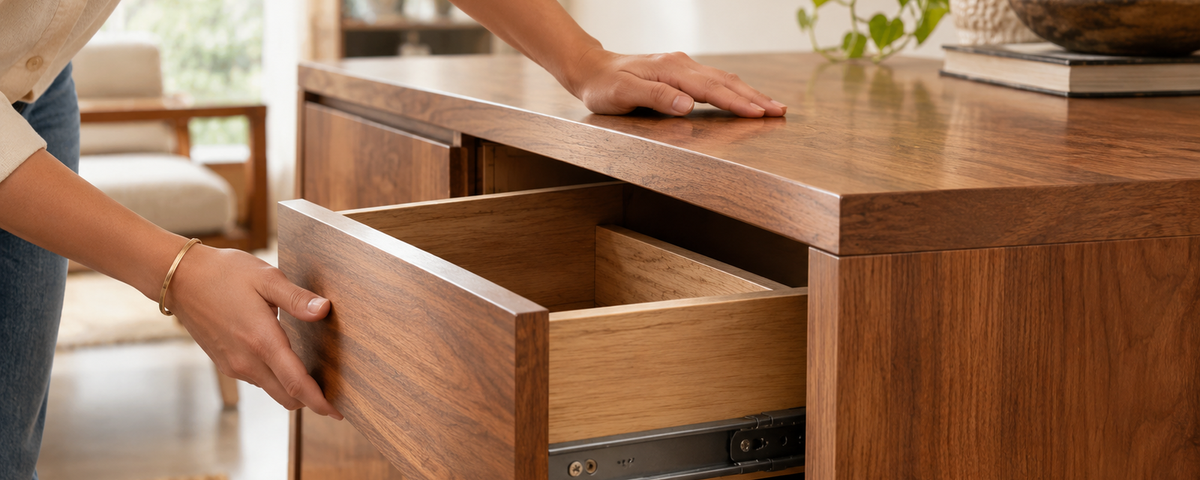
Pull a drawer open its full length, then close it, paying attention to how evenly it moves. It should glide with consistent resistance from start to finish, without catching, binding, or wobbling side to side. Do the same with any doors - hinges should hold the door at any angle without drifting open or slamming shut on their own.
Uneven resistance or side-to-side play usually points to lower-quality drawer slides or hinges, even on a piece that's otherwise attractively finished.

Checking the Surfaces You're Not Supposed to Check
Look at the back panel, the underside, and the inside of drawers - not to identify the material, but to see whether those less-visible areas show evidence of careful sanding and assembly. A well-made piece should still show attention to detail on hidden surfaces, even when they use a simpler finish than the visible areas. A rough, unfinished, or carelessly assembled back or underside, next to a flawless front, can be a sign that more attention went into appearance than construction throughout.
Hardware Weight and Feel
Pick up a handle, pull on a hinge, or test a drawer pull if it's loose enough to handle. Quality hardware often feels substantial and solid, while very light, flimsy hardware - even when painted or plated to look like something heavier - can feel hollow or thin by comparison. Hardware is a small detail, but it's one manufacturers may cut on when reducing cost, which makes it a useful thing to check.
If you're evaluating a sideboard specifically, our guide to choosing a durable wooden sideboard covers the construction, hardware, and finish details worth che
Finish Evenness - and What Your Nose Tells You
Step back and look at the finish across the whole piece, not just one angle. Color and sheen should be reasonably consistent across panels and legs, without obvious blotching or patchy absorption, which can signal an uneven or rushed finishing process. A strong, persistent chemical smell right out of the box - beyond a faint, temporary new-furniture scent - doesn't automatically indicate poor construction, but it may be worth asking what finish was used.
Worth Considering: Weight is a useful clue when comparing materials, but it isn't proof of good construction by itself. A heavy piece can still have loose joints or sloppy hardware - check both, don't let weight alone settle the question.
Checking for Internal Movement
If the design allows, gently press or handle accessible panels and shelves to check for rattling or unwanted movement. A well-built piece feels like a single, coordinated structure. Rattling panels, shifting internal shelving, or a sense that components are moving loosely can indicate internal construction issues that aren't visible from the outside.
Reading an Online Listing Like You'd Check It in Person
When you can't test a piece by hand, the listing itself is the next best signal. Specific details - named wood species, stated joinery method, hardware material, drawer construction - suggest the seller is confident enough in the construction to describe it precisely. Vague language like "rich wood finish" or "sturdy design" without any specifics is worth treating as a gap, not a guarantee, and it's reasonable to ask the retailer directly for the details a confident listing would already include.
Comparing Construction Signals
|
What to Check |
What Good Construction Feels Like |
What to Watch For |
|
Joints |
Stays still under gentle diagonal pressure |
Rocking, creaking, visible flex |
|
Drawers/doors |
Smooth, even resistance throughout |
Binding, sticking, side-to-side play |
|
Hidden surfaces |
Carefully sanded and assembled, even when less visible |
Rough, unfinished, or poorly assembled areas |
|
Hardware |
Secure, substantial feel and smooth operation |
Loose, flimsy, hollow, or stamped feel |
|
Finish |
Even color and sheen across the piece |
Blotching, patchy absorption |
|
Internal structure |
Feels stable with no unwanted movement |
Rattling, shifting, loose panels |

Expert Advice
A showroom can make almost anything look finished. To assess whether a piece is actually well built, handle it the way you'd use it - open the drawer, gently test the corner, and look at the back.
Sales staff can usually tell you what a piece is made of; fewer can walk you through exactly how it's joined and why that matters. If a retailer can answer specific construction questions confidently, that's generally a good sign about the piece itself, not just the salesperson.
Common Mistakes
-
Assuming "solid wood" settles the question. Material and construction quality are different things - a solid wood piece can still be poorly joined or finished.
-
Judging quality by weight alone. Heavy can mean solid wood, but it doesn't guarantee tight joints or good hardware - check both.
-
Only inspecting the front-facing surfaces. Backs, undersides, and drawer interiors often reveal more about actual care taken than the side facing the showroom floor.
-
Buying online without asking for construction specifics. A listing's silence on joinery, hardware, or finish is worth a direct question before you buy, not an assumption in the seller's favor.
-
Mistaking superficial distressing for genuine hand-finishing. A rustic or distressed look should still sit on top of solid, careful construction - ask rather than assume the aged look reflects the build quality underneath.
Practical Checklist
-
Gently rock a top corner diagonally - it should stay essentially still
-
Open every drawer and door fully - check for smooth, even resistance
-
Look at the back panel, underside, and drawer interiors, not just the front
-
Test the hardware - handles, pulls, and hinges should feel secure and operate smoothly
-
Step back and check finish evenness across the whole piece
-
Gently press or handle accessible panels and shelves - listen and feel for rattling or unwanted movement
-
For online listings, look for specific construction details, not just general marketing language
Conclusion
Material tells you what a piece is made of; these checks tell you whether it was actually built well. Running through them takes a few minutes and doesn't require any special expertise - just a willingness to open the drawers, check the back, and push gently on a corner before you decide. If you also want to understand how to confirm a piece is genuinely solid wood in the first place, our guide on [identifying solid wood furniture] covers that question directly.
Frequently Asked Questions
Does heavy furniture always mean good quality?
Not by itself. Weight can be a useful clue when comparing materials, but a heavy piece can still have loose joints or weak hardware. Check construction directly rather than relying on weight alone.
What's the fastest way to check furniture quality in a showroom?
Gently rock a top corner diagonally to check joint stability, then open every drawer and door fully to check for smooth, even movement. Both take seconds and reveal more than visual inspection alone.
Can I tell furniture quality from online photos?
Not fully, but a listing's level of detail is a useful proxy - specific information about joinery, hardware, and finish suggests more confidence in the construction than vague descriptive language. It's reasonable to ask a retailer directly for details a listing doesn't include.
Is solid wood furniture always better built than engineered wood?
Not automatically. Solid wood and engineered wood can both be used in well-made furniture. If you're comparing the two materials themselves, our guide to Hardwood vs. Engineered Wood explains the differences in more detail. Construction quality still depends on factors such as joinery, hardware, structural design, and finishing.


Share:
How to Choose Furniture for Aging in Place