
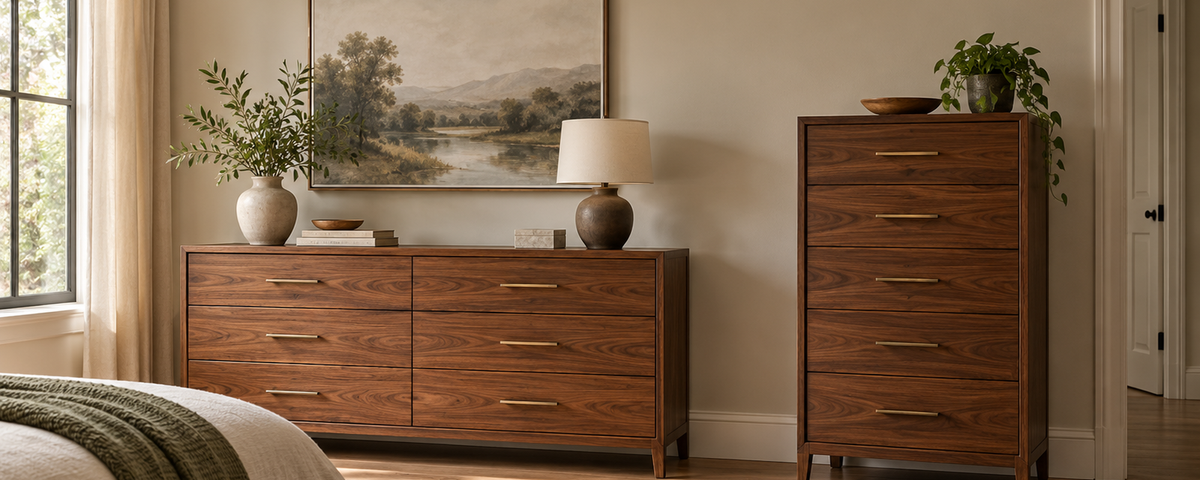
Ask three furniture retailers what separates a dresser from a chest of drawers and you may get three answers, or a shrug. The terms are often used interchangeably, but the furniture itself can take two distinctly different forms: one generally wide and low, the other narrower and more vertically oriented. That difference in shape affects which wall the piece suits, how much floor space it uses, and how easily you can reach your clothes.
Quick Answer
By common convention, a dresser is generally wider and lower with multiple drawers, while a chest of drawers is usually narrower and more vertically oriented. Choose a wide dresser if you have a long wall and lots of folded clothing. Choose a narrower chest if floor space is tight. Retailers' naming varies, so compare width, depth, height, and drawer layout rather than relying on the label alone.
Why This Matters
Bedroom storage is bought once and lived with daily. A wide piece on a short wall crowds the bed. A taller one can leave the top drawer awkward to reach and the bottom one a stoop. Checking the footprint and drawer heights first avoids returns and awkward rearranging.
The Key Question
Don't ask "which is better?" Ask "which wall do I have, and what goes in the drawers?" A long, free wall points to one answer. A short wall beside the door points to another.
What Actually Matters
The Names Overlap. The Shapes Don't.
"Dresser," "chest of drawers," "bureau," and "tallboy" are used loosely, and there is no single regulated definition. The distinction below is a widely used convention, not a rule, so a piece sold under one label may match the other description.

|
Dresser (wide, low) |
Chest of Drawers (narrow, tall) |
|
|
General shape |
Wider and lower |
Narrower and taller |
|
Footprint |
Uses more wall width |
Uses less wall width |
|
Drawer layout |
Often multiple drawers across the width |
Often a vertical stack of drawers |
|
Wall it suits |
A long, uninterrupted wall |
A short wall or narrow gap |
|
Top surface |
Larger; can hold a mirror or other items |
Smaller; useful for a lamp or tray |
Exact dimensions and drawer configurations vary by maker, so compare the actual measurements and layout of each piece rather than relying on the furniture label alone.
Wall Space and Footprint
A wide dresser needs a clear stretch of wall, plus room in front for drawers to open fully and for you to stand. A taller chest takes less floor space but pushes storage upward. In a small bedroom, using vertical space can help keep the walkway clear. For more layout detail, see Oak & Loom's guide on arranging bedroom furniture in a rectangular room.
Reach and Everyday Use
Height changes how you use the piece. On a taller chest, the upper drawers may sit higher while the bottom drawer is closer to the floor, so the middle drawers often become the most convenient for daily use. A low, wide dresser keeps its drawers within a more consistent reach, at the cost of using more wall space.
Quick Tip: Put what you grab daily (socks, underwear, tees) in the middle drawers, and keep rarely used items in the highest and lowest ones.
What You Fold, Hang and Store
Folded knits, jeans and gym clothes suit either shape. Bulky items like sweaters want deeper drawers, so check drawer depth, not only drawer count. If you mostly hang clothes, neither piece replaces a wardrobe. Oak & Loom's small bedroom wardrobe guide covers that side.
Weight, Stability and Anchoring
Taller, narrower furniture can present a greater tip-over risk than lower, wider pieces, particularly when drawers are extended. A tall chest should be anchored to the wall, especially in homes with children. Anchoring is a sensible precaution for tall drawer units regardless of whether they are made from solid wood or other materials. The U.S. Consumer Product Safety Commission's Anchor It! campaign explains the risk and how to reduce it.
A Real Example of a Compact Chest
Oak & Loom's Crestora Modern Two-Tone 4 Drawer Chest measures 35 inches wide, 16 inches deep, and 33 inches high, giving it a relatively compact footprint. Its listing describes mango and acacia wood with an engineered black frame, which is a useful reminder to check a piece's actual materials rather than assume its construction from the appearance alone. With four drawers in a 35-inch-wide frame, it shows how a compact chest can provide useful bedroom storage without requiring a wide wall.

Which Should You Choose?
|
If your situation is... |
Lean toward |
|
Long free wall, lots of folded clothes |
Wide dresser |
|
Short wall, narrow gap, small room |
Narrower chest of drawers |
|
Want a surface for a mirror or TV |
Wide dresser |
|
Want to save floor space |
Narrower chest |
|
Need easy reach to every drawer |
Wide, lower piece |
|
Have children at home |
Either, with appropriate anchoring |
Common Mistakes
-
Trusting the label. Compare width, depth, and height rather than relying on the name.
-
Ignoring drawer pull-out space. Measure the room with drawers fully open, not just the cabinet footprint.
-
Ignoring clearance around nearby furniture. Make sure open drawers won't hit the bed, nightstand, or another piece.
-
Counting drawers, not depth. Shallow drawers may hold less than the drawer count suggests.
-
Skipping anchoring on a tall chest. Taller, narrower furniture can carry a greater tip-over risk, particularly when drawers are extended.
-
Forgetting the doorway. Check that the piece will fit through doors, hallways, and stairs.
Practical Checklist
-
Measure the wall and the space in front with drawers fully open
-
Check clearance from the bed, nightstand, and other nearby furniture
-
Decide what goes in the drawers and how bulky it is
-
Check drawer depth as well as drawer count
-
Choose a height that keeps frequently used drawers within a comfortable reach
-
Plan to anchor any tall chest to the wall
-
Confirm the piece clears doorways, hallways, and stairs
Conclusion
Neither shape wins outright. A wide dresser works well when you have a long wall and plenty of folded clothing to store, while a narrower chest can make better use of limited floor space. Measure the wall, check drawer clearance, and consider what you need to store before choosing the shape. If standard dimensions don't suit your room, Oak & Loom's Personalize Your Furniture page offers made-to-measure options, while the bedroom furniture collection lets you compare real pieces and dimensions.
Frequently Asked Questions
What is the main difference between a dresser and a chest of drawers?
A dresser is generally wider and lower, while a chest of drawers is usually narrower and more vertically oriented. Because furniture terminology varies by retailer, compare the actual width, depth, height, and drawer layout rather than relying on the label.
Is a dresser the same as a chest of drawers?
Not strictly, though many sellers use the terms interchangeably. By common convention, a dresser is wide and low, while a chest of drawers is narrower and taller. Compare dimensions rather than relying on the name alone.
Which is better for a small bedroom?
A narrower chest of drawers can take up less floor space and help keep the walkway clearer. Check its height and make sure the upper drawers remain comfortable to reach.
Do I need to anchor a chest of drawers?
Taller, narrower chests can present a greater tip-over risk, particularly when drawers are extended. Anchoring is a sensible precaution, especially in homes with children. The CPSC's Anchor It! campaign explains the risk and how to reduce it.
Can a dresser go in a living room or hallway?
Yes. A low, wide dresser can work as a console or media stand when its proportions suit the room. Check the depth and drawer clearance to make sure it works comfortably in the space.

Share:
How to Tell If Wooden Furniture Is Actually Good Quality