
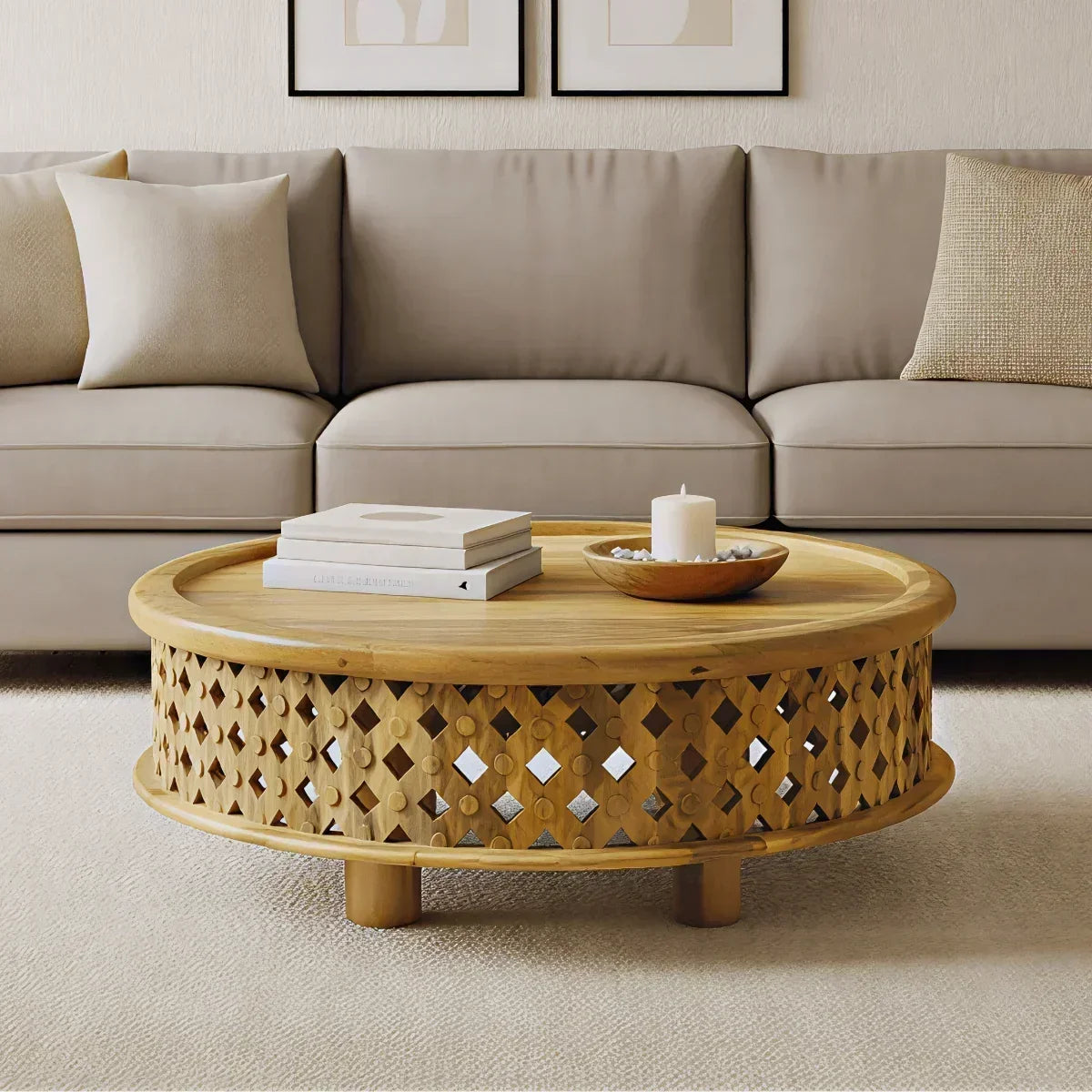
The coffee table is one of the hardest-working surfaces in a home - it holds your coffee, your remote, your feet on a lazy Sunday, and somehow also has to look intentional the rest of the time. That double duty is exactly why "add some books and a candle" isn't enough advice to actually get it right. Good coffee table styling is really about a handful of principles - scale, height, grouping, and leaving enough usable surface - that work regardless of what specific objects end up on the table.
Start with Scale and Shape, Not Objects
Before picking a single item to put on your coffee table, look at the table itself. Shape and size change what kind of styling actually works. If you're still deciding what size works best for your room, our guide to choosing the right coffee table covers sizing and layout in more detail.
Round and oval tables read best with an asymmetrical, loosely grouped arrangement rather than a rigid grid - a stack of books to one side, a small vase or plant off-center, and enough open space that the table doesn't feel crowded from every angle, since round tables get viewed from all sides rather than just one.
Square and rectangular tables can handle either symmetry or asymmetry, but rectangular tables in particular benefit from a visual anchor at each end - a stack of books on one side and a tray on the other, for instance - rather than everything clustered in the middle, which tends to leave the ends looking neglected.
Oversized or extra-long tables need more than one grouping to avoid looking sparse. Treat a long table as two or three zones rather than one: a tray with functional items near where people actually sit, a decorative grouping at the far end, and enough negative space between them that it doesn't read as clutter spread thin.
Small tables are the easiest to overdo. On a compact table, one well-chosen grouping - a tray with a candle and a small object, nothing more - usually looks more finished than an attempt to fit in everything a larger table could hold.

Height Variation Does More Than People Expect
A coffee table styled entirely with objects of the same height reads as flat, even if every individual item is attractive. The fix is simple but easy to forget in the moment: build in at least two or three different heights.
A common, reliable combination is a stack of two or three books as the tallest element, something mid-height next to it (a small vase, a candle, a sculptural object), and something low and horizontal (a tray, a low bowl) to anchor the grouping. For more ideas on creating a balanced tabletop arrangement, see our guide on how to style a solid wood coffee table.
Grouping: Odd Numbers, Mixed Shapes
Objects styled in twos tend to look accidental; objects styled in threes tend to look intentional. This isn't a hard rule, but it holds up often enough to be a useful default when you're not sure where to start.
Within a grouping, mix rounded, organic shapes (a vase, a bowl, a plant) with more geometric ones (a stack of square-cornered books, a rectangular tray). A grouping made entirely of round objects or entirely of angular ones tends to feel monotonous; the contrast between the two is part of what makes a small tabletop vignette feel put-together.
The Core Building Blocks
Trays are the most functional styling tool on this list - they corral small items (remotes, coasters, a candle) into one visual unit instead of letting them scatter across the table, and they give you a defined "zone" to build a grouping around.
Books add height, color, and a sense of personality - the subjects and cover colors of the books you choose say something about the room even before anyone opens one. Stacking three or four at slightly different heights, rather than in one perfectly even pile, generally looks more natural.
Objects and small sculptural pieces - a bowl, a small carved object, anything with texture - fill the role that pure decoration plays: nothing to layer books onto, nothing to catch loose items, just something that makes the table feel curated rather than purely functional.
Plants and greenery bring in the one element nothing else on this list can - actual life and a bit of organic irregularity, which tends to soften an otherwise fairly rigid arrangement of books, trays, and objects.
Don't Forget the Table Still Needs to Work
This is the part styling guides skip most often, and it's the difference between a table that looks good in photos and one that actually functions in daily life. A coffee table isn't a shelf - people put drinks down, rest their feet, and set a laptop on it. As a general guide, keeping roughly a third to half of the tabletop clear of decor gives you enough functional space without the table looking empty. If every square inch is covered in styled objects, the table stops being usable, and styled objects tend to get shoved aside (and knocked over) the first time someone actually needs the space.
A tray is one of the better solutions here, since it can hold both the styled objects and the everyday ones (a remote, a coaster) without making the table look cluttered - the tray itself reads as one clean object, even though it's doing double duty.
Small Coffee Tables vs. Large Ones
The core principles are the same, but the execution shifts with size.
On a small coffee table, restraint matters more than variety. One grouping - a tray, a short stack of books, one small object - is usually enough, and adding a second full grouping tends to make a small table look crowded rather than styled.
On a large coffee table, the opposite problem shows up: a single small grouping in the center can look lost. Larger tables generally look better with either one larger, more substantial grouping, or two smaller groupings positioned toward each end, with genuine open space between them rather than filled in with more objects.

Common Coffee Table Styling Mistakes
Matching everything too closely. A tray, books, and objects that are all the same color or material read as a set rather than a curated collection. A little variation in tone and material - wood, ceramic, glass, textile - is what makes a table feel gathered over time rather than bought as a bundle.
Covering the entire surface. As covered above, a fully covered table stops being functional and starts looking cluttered the moment it's actually used.
Ignoring the table's shape. Styling a round table the same way you'd style a rectangular one - or vice versa - is one of the more common reasons an arrangement feels slightly wrong without an obvious cause.
Skipping height variation. A table styled with everything at roughly the same height, even if nicely chosen, tends to read as flat rather than intentional.
Forgetting the room around it. A coffee table doesn't style itself in isolation - the objects on it should generally echo a material, color, or tone already present elsewhere in the room (the wood of the table itself, a color from a nearby rug or cushion) rather than introducing something completely unrelated.
Refreshing Your Coffee Table Through the Seasons
You don't need to buy new furniture to keep a coffee table feeling current - swapping a handful of small elements does most of the work, and it's a genuinely low-cost way to change the feel of a room several times a year.
What to swap: the plant or greenery, the color of a candle or vase, and the subject matter of the books on top are usually enough on their own. A room can shift from warm and cozy to bright and fresh without touching the tray, the table, or the overall arrangement structure.
What to leave alone: the underlying structure - the grouping, the height variation, the amount of open space - doesn't need to change with the seasons. Once you've found an arrangement that works for your table's shape and size, reuse that structure and just refresh what's inside it.
This also solves a practical problem: most people don't want to fully re-style a coffee table every few months, and they don't need to. Two or three small swaps take a few minutes and keep the table from feeling static, without requiring a full restyle each time.
Coffee Table Decor Ideas FAQ
What should I put on my coffee table?
A workable starting point is one tray for functional items, a short stack of books for height, and one or two small decorative objects or a plant - enough for visual interest without covering the whole surface. From there, adjust based on your table's size and shape.
How much of my coffee table should stay empty?
As a general guide, leaving roughly a third to half of the surface clear keeps the table genuinely usable for drinks, laptops, and everyday items, rather than purely decorative.
Does coffee table styling change based on the table's shape?
Yes. Round tables generally suit a single asymmetrical grouping viewed from multiple angles; rectangular tables often look better with an anchor at each end; oversized tables usually need more than one grouping to avoid looking sparse in the middle.
What's the easiest way to style a small coffee table?
Keep it to one restrained grouping - a tray, a short stack of books, and a single small object. Small tables tend to look better with less rather than more. Once you've styled your coffee table, the same principles of scale and balance can help with other living-room surfaces too. See our guide on how to decorate a TV console.
Share:
What Size Rug Goes Under a Dining Table?
How to Anchor Tall Furniture Without Damaging the Wood