
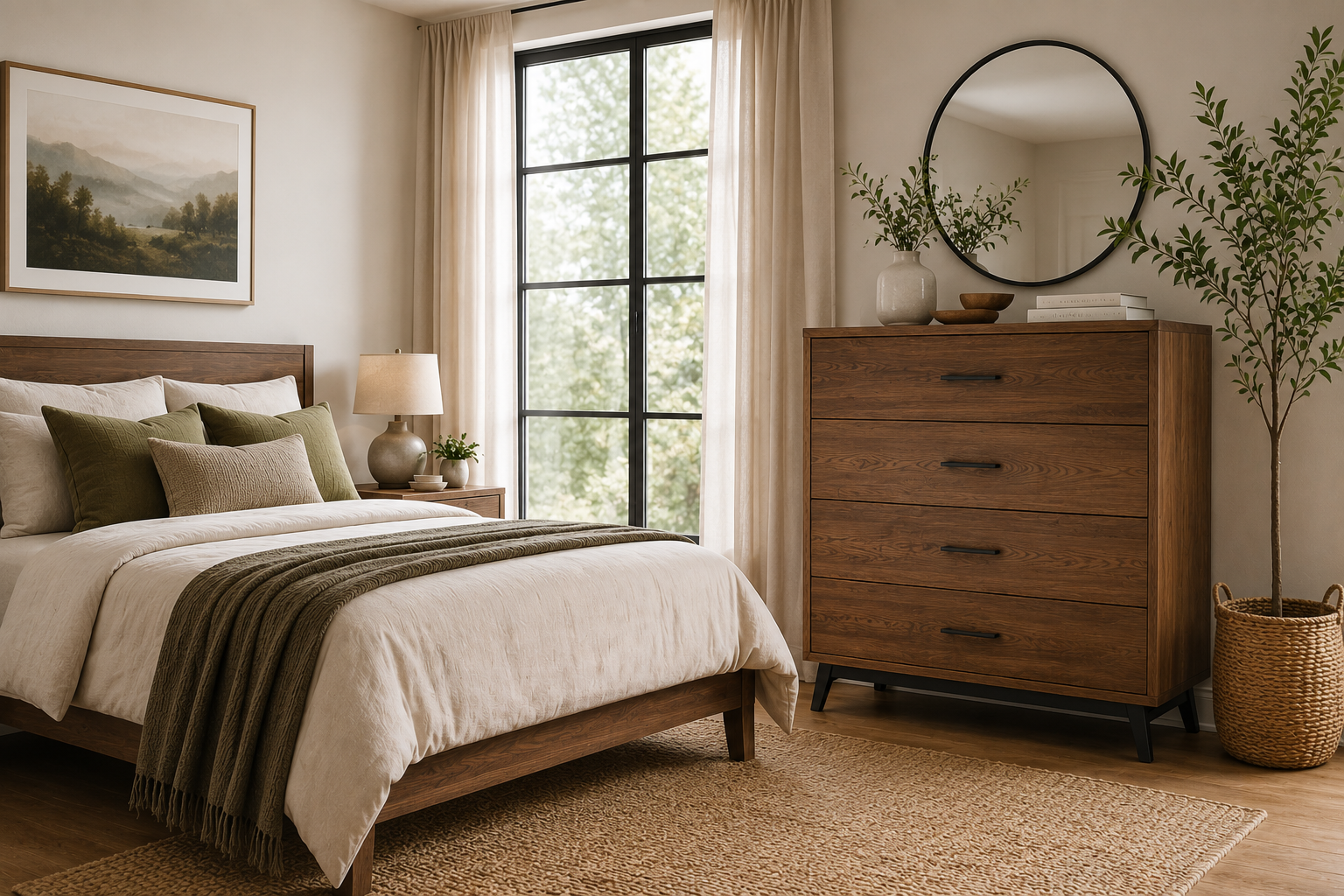
It's one of the most common bedroom furniture mistakes, and one of the hardest to fix after the fact: choosing a chest of drawers that's either too bulky for the wall it sits against or too small to comfortably hold a season's worth of clothing. Unlike a nightstand or a bed, where the wrong size is usually a minor inconvenience, a poorly sized chest of drawers creates problems you'll notice every day - drawers that scrape a door frame when opened, a piece that visually overwhelms a small bedroom, or a "compact" dresser that leaves half your clothing without a home.
The good news is that choosing the right size chest of drawers isn't guesswork. It comes down to taking the right measurements, understanding how the piece will function in your room, and matching its dimensions to your storage needs. This guide walks you through the process step by step, helping you choose a chest that fits your space comfortably while showing how those principles apply to real solid wood designs from Oak & Loom's collection.
Browse Oak & Loom's chest of drawers collection to explore handcrafted solid wood designs with detailed dimensions and free shipping across the US.
"A chest of drawers is furniture you open twenty times a day. Getting the size right isn't a style preference - it's the difference between a bedroom that works and one that quietly frustrates you every morning."
Step 1 - Measure Your Available Wall Space
Start with the wall where the chest of drawers will actually live - not the room as a whole. Measure the full width of that wall, then subtract anything that already occupies it: a doorway swing, a window, a light switch panel, or the corner of another piece of furniture like a wardrobe or bed.
The remaining number is your maximum width. As a rule, leave at least 4 to 6 inches of breathing room on either side of the chest rather than pushing it wall-to-wall - a chest of drawers that spans the entire available width reads as cramped, even when it technically fits.
For most US bedrooms, a chest of drawers between 24 and 42 inches wide works well, depending on the room size, furniture layout, and available wall space.
Step 2 - Account for Drawer Clearance, Not Just Footprint
This is the step most people skip, and it's the one that causes the most regret. A chest of drawers needs open floor space in front of it for the drawers to fully extend - not just enough room to walk past the closed piece.
As a working rule, allow clearance in front of the chest equal to the drawer depth plus 6 to 8 inches for comfortable, unobstructed opening. Most solid wood chests have a drawer depth of 14 to 18 inches, which means you need roughly 20 to 26 inches of clear floor space in front of the piece - not counting the walking path beyond that.
If the chest sits directly across from a bed, measure from the face of the chest to the nearest edge of the bed frame. Less than 20 inches, and you'll find yourself opening drawers only partway to avoid bumping the bed - which defeats the purpose of the storage in the first place.
Step 3 - Match Height to the Room, Not Just the Style
Chest of drawers height can vary more than most people expect-anywhere from 30 inches for a low, wide dresser to over 50 inches for a tall, narrow chest. The right height depends on two things: how you plan to use the top surface and how much vertical storage you need without taking up extra floor space.
Low-profile chests (28–34 inches tall) work well as a surface for a mirror, a lamp, or a TV, and pair naturally with a lower bed or a room with a lower ceiling. They read as furniture you can see over - which keeps a smaller room feeling open.
Tall chests (38–48+ inches tall) trade surface usability for floor-space efficiency. Because they build storage vertically rather than horizontally, tall chests often provide similar storage capacity to wider dressers while occupying significantly less wall space. They're an excellent choice for apartments, smaller bedrooms, or rooms where a bed and wardrobe already dominate the layout.

Step 4 - Match Depth to the Room Type
Depth is one of the most overlooked dimensions when buying a chest of drawers-and one of the biggest causes of delivery and layout problems. A standard bedroom chest typically measures 15 to 18 inches deep, which works well in most bedrooms but may feel oversized in narrow hallways or compact guest rooms.
For rooms where every inch matters - studio apartments, small guest rooms, or a chest placed at the foot of a bed rather than against a side wall - look specifically for a shallow-depth chest in the 14 to 16 inch range. It sacrifices a small amount of drawer capacity for a meaningfully smaller footprint.
Step 5 - Size Storage Capacity to Your Household
Once width, clearance, and depth are settled, the last variable is drawer count - and this is where a lot of buyers default to "more is better" without checking whether it actually solves their storage problem.
As a general guide, a single adult with an average wardrobe is usually well served by 4 to 5 drawers. Couples sharing a bedroom-or anyone with a larger seasonal wardrobe-typically benefit from 6 to 8 drawers, either in one larger chest or two smaller pieces. If your bedroom already includes a wardrobe or armoire for hanging clothes, your chest of drawers only needs to store folded items, meaning a smaller unit is often sufficient.
A chest of drawers with a hybrid layout - a few smaller drawers up top for delicates and accessories, paired with deeper drawers below for bulkier folded items like sweaters - tends to serve real-world storage habits better than uniform drawer sizing, regardless of total drawer count.

The Quick Reference Guide: Chest of Drawers Sizing by Room
Use this quick-reference table to compare recommended chest of drawers dimensions based on your room size and layout.
|
Room Type |
Recommended Width |
Recommended Depth |
Recommended Height |
Front Clearance Needed |
|
Small apartment / studio |
18–24 inches |
14–16 inches |
38–44 inches (tall) |
20–24 inches |
|
Standard bedroom (single) |
28–35 inches |
16–18 inches |
30–36 inches |
22–26 inches |
|
Shared / master bedroom |
35–42 inches |
17–18 inches |
30–34 inches |
24–28 inches |
|
Walk-in closet addition |
18–24 inches |
14–16 inches |
38–48 inches (tall) |
20–24 inches |
|
Hallway / entryway placement |
24–30 inches |
14–15 inches |
32–36 inches |
20–22 inches |
Front clearance is the minimum open floor space needed for drawers to extend fully, measured from the front of the chest to the nearest obstruction, such as a bed, wall, or door.
What to Do When Two Storage Pieces Are Better Than One
If your storage needs exceed what one chest of drawers can comfortably hold, resist the urge to simply buy the largest single piece available. Two mid-sized chests - one for each person sharing a room, or one for folded clothing and one for linens - often solve the problem more elegantly than a single oversized dresser that dominates a wall.
This approach works particularly well in rooms where a single wide chest simply won't fit the available wall space. Combining a tall, narrow chest in one corner with a lower, wider piece along the main wall creates more flexible storage while maintaining a balanced layout. For example, pairing the Briventa with the Crestora gives you two practical storage zones without either piece overwhelming the room.
Common Chest of Drawers Sizing Mistakes - And How to Avoid Them
Measuring the wall, but not the swing space. A chest of drawers that fits the wall perfectly is still a problem if opening the top drawer means it collides with a door swinging open or a closet door mid-arc. Check every moving element in the room, not just the static furniture.
Ignoring drawer clearance in front. As covered above, this is the single most common oversight - and the hardest one to notice on a showroom floor or a product photo, since nothing is in front of the piece to demonstrate the problem.
Choosing height based on style alone. A tall chest may look striking in photos, but if your bedroom has sloped ceilings, low windows, or artwork already mounted at a certain height, it can make the room feel crowded. Always consider the room's proportions as well as the furniture's dimensions.
Underestimating how much a "compact" dresser actually holds. Drawer count alone doesn't tell the full story - a 4-drawer chest with deep drawers can outstore a 6-drawer chest with shallow ones. Check drawer depth, not just quantity, when comparing storage capacity.
Buying before measuring the delivery path. Solid wood chests of drawers are substantial pieces. Before ordering, confirm the piece will fit through your doorways, stairwells, hallways, and any tight corners on delivery day-not just inside the bedroom itself.
The Practical Checklist: Before You Buy a Chest of Drawers
-
Measure your available wall width - subtract doors, windows, and switch plates, and leave 4–6 inches of breathing room on each side.
-
Calculate front clearance - drawer depth plus 6–8 inches, checked against the nearest bed, door swing, or wall.
-
Choose height based on room proportions - low and wide for smaller rooms or lower ceilings, tall and narrow for space-constrained rooms.
-
Match depth to the room type - standard 16–18 inches for most bedrooms, 14–16 inches for tight spaces.
-
Size drawer count to your storage needs - 4–5 drawers for a single person, 6–8 for a shared room or larger wardrobe.
-
Check drawer depth, not just count - deeper drawers on a smaller chest can outperform shallow drawers on a larger one.
-
Confirm the delivery path - check doorways, stairways, hallways, and tight corners before the piece arrives.
-
Coordinate with your existing bedroom furniture - browse Oak & Loom's solid wood bedroom furniture to find a chest that complements your bed frame and nightstands with matching materials and finishes.
Conclusion
A chest of drawers is one of the few pieces of furniture you interact with every single day-opening drawers, putting clothes away, and getting ready each morning. Getting the size right isn't about following trends or simply filling an empty wall; it's about choosing a piece that opens fully, stores what you actually own, and fits comfortably within your space.
Measure your wall. Account for drawer clearance. Match the height and depth to your room. Then choose a well-built solid hardwood chest, so the piece you size correctly today continues to serve you smoothly and reliably for decades to come.
"The best storage furniture is the kind you stop noticing - because it fits the room, holds what you need, and never gets in its own way."
Browse Oak & Loom's Solid Wood Chest of Drawers Collection - handcrafted designs with detailed dimensions and free shipping across the US.
→ Need help choosing the right size? Talk to the Oak & Loom team for personalised sizing guidance, furniture pairing advice, and custom enquiries.
Frequently Asked Questions
Q1: What is the standard size of a bedroom chest of drawers?
Most standard bedroom chests of drawers are 28 to 42 inches wide, 15 to 18 inches deep, and 30 to 36 inches tall. Tall, narrow models designed for smaller spaces are typically 18 to 24 inches wide and 38 to 48 inches tall, making better use of vertical space. Browse Oak & Loom's chest of drawers collection for the exact dimensions of each design.
Q2: How much clearance space does a chest of drawers need in front of it?
Allow clearance equal to the drawer depth plus 6 to 8 inches for the drawers to open fully without obstruction. For a chest with 16-inch-deep drawers, that means roughly 22 to 24 inches of clear floor space in front of the piece, measured to the nearest bed, wall, or door swing.
Q3: Should I choose a tall chest or a wide chest for a small bedroom?
For most small bedrooms, a tall, narrow chest is the more space-efficient choice because it builds storage vertically instead of taking up valuable wall space. For example, a design like the Briventa Rustic Solid Wood Tall 5 Drawer Chest offers generous storage while maintaining a compact footprint.
Q4: How many drawers do I actually need in a bedroom chest?
A single adult with a standard wardrobe is typically well served by 4 to 5 drawers. A couple sharing a room, or anyone with a larger seasonal wardrobe, usually needs 6 to 8 drawers total - either from one larger chest or two smaller pieces used together. If a wardrobe or armoire is already handling hanging clothes, a smaller chest is often sufficient.
Q5: Can a chest of drawers be used outside the bedroom?
Yes. A chest of drawers can work well in entryways, hallways, living rooms, or even home offices, provided its depth suits the available space. For hallway or entryway placement, look for a shallower depth of 14 to 15 inches to avoid narrowing the walkway. See Oak & Loom's solid wood bedroom furniture for pieces versatile enough for multiple rooms.
Q6: What's the difference between a chest of drawers and a dresser?
In the US, the terms are often used interchangeably, but they can describe slightly different furniture styles. A chest of drawers (sometimes called a tallboy) is usually taller and narrower, while a dresser is generally wider and lower, offering more surface space for a mirror, décor, or everyday essentials.
Share:
How to Choose Dining Chairs That Work With a Solid Wood Table
How to Choose a Wood Finish or Stain Colour for Your Room