
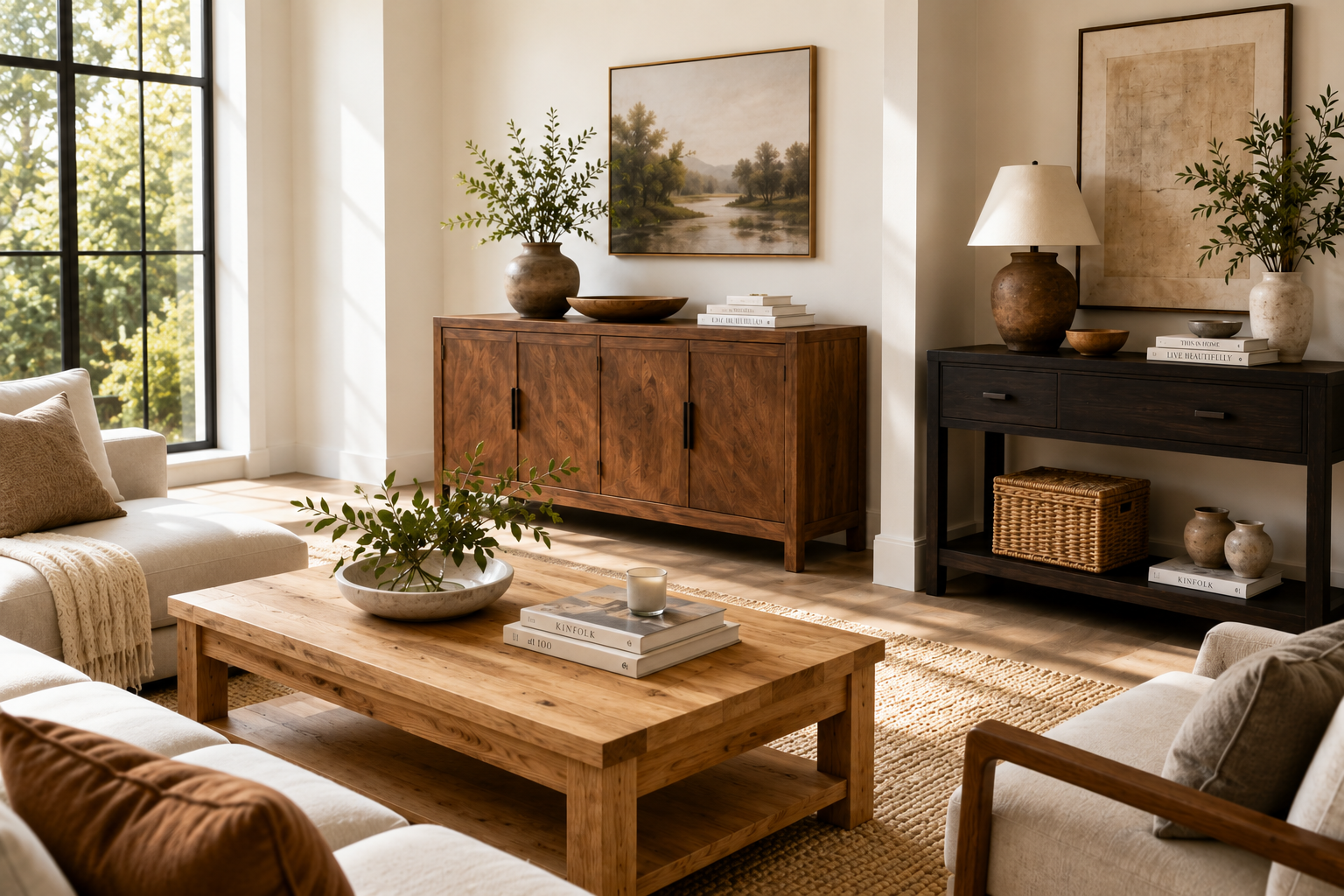
You've decided on solid wood. You know the piece - a bed, a sideboard, a chest of drawers. And then you land on the finish selector, and the decision that felt simple ten minutes ago suddenly has eight options: natural, distressed white, dark brown, two-tone, black, warm honey, espresso, grey-washed. Every one of them looks good in its own product photo. None of them tell you which one will actually look good in your room.
The best wood finish for your room depends on three key factors: the amount of natural light, your flooring's undertone, and the mood you want to create. Lighter finishes brighten darker spaces, darker stains add depth to well-lit rooms, and matching undertones helps furniture feel naturally connected to the rest of your space.
This is the guide that fills that gap. Choosing a wood finish isn't a matter of picking your favorite color swatch - it's a decision that should be driven by three concrete factors: how much natural light your room gets, what tone your existing flooring already carries, and the mood you're building toward. Get those three right, and the finish choice becomes obvious rather than overwhelming. Browse Oak & Loom's full solid wood furniture collection as you read.
"The wrong wood finish doesn't ruin a room - it just makes the room work a little harder than it should. The right one disappears into the space so completely that no one ever asks why it works.
Step 1 - Read Your Room's Natural Light Before Anything Else
Light is the single biggest factor in how a wood finish actually reads once it's sitting in your home - far more than how it looked on a screen. A finish that photographs beautifully under a showroom's even lighting can shift dramatically once it's placed under your room's specific conditions.
North-facing rooms and rooms with limited natural light tend to feel cooler and dimmer throughout the day. Dark finishes in these spaces can read as heavy or even a little flat, absorbing what little light is available. Lighter and warmer-toned finishes - such as natural, honey, or distressed white - reflect more available light and help the room feel brighter and more open.
South-facing rooms and spaces with abundant direct sun can handle - and often benefit from - darker finishes. Direct sunlight highlights the depth of colour and natural wood grain in darker stains that may appear less defined in low-light spaces. A darker piece can also provide visual balance, anchoring a bright, sun-filled room rather than disappearing into the light.
Before choosing a finish, spend a day noticing when and how light moves through the room. A finish chosen at midday under bright light can look completely different once evening lamp light takes over - checking both conditions is worth the extra ten minutes.
Step 2 - Match Your Finish to Your Existing Flooring, Not Fight It
Flooring is the largest fixed wood surface in most rooms, and it sets the undertone that every other wood piece has to work with. Fighting that undertone is one of the fastest ways to make a room feel visually unresolved.
Wood - whether in flooring or furniture - carries either a warm undertone (yellow, orange, or red base) or a cool undertone (grey, ash, or muted base). A warm honey oak floor paired with a cool grey-washed dresser will often feel slightly mismatched, even if both pieces are beautiful individually. A more cohesive approach is to stay within the same undertone family while varying the depth of colour. For example, a warm floor pairs well with finishes ranging from light natural oak to rich espresso, provided they all lean warm rather than cool.
If your flooring is a neutral mid-tone that doesn't strongly commit to warm or cool, you have the most flexibility - nearly any finish will work, which makes mood and light the deciding factors instead.

Step 3 - Choose Based on the Mood You're Building, Not Just the Trend
Every finish category carries a distinct emotional register, and the most successful rooms choose a finish that matches the feeling they're actually going for - not whichever tone is trending in home content that month.
Natural and light finishes read as calm, airy, and understated. They work well in Scandinavian, coastal, and minimalist interiors where the goal is a room that feels open and unfussy. They're also the most forgiving choice in a smaller room, since lighter wood visually recedes rather than dominating the space.
Dark and espresso finishes read as substantial, dramatic, and grounded. They suit traditional, transitional, and quiet-luxury interiors where furniture is intended to anchor the room rather than blend into it. In larger rooms with good natural light, darker finishes create the visual weight that makes a space feel balanced, intentional, and well-defined.
Distressed white finishes read as lived-in, romantic, and rustic. They're the natural choice for farmhouse, cottage, and vintage-inspired rooms, and they carry a practical advantage too - the distressing already celebrates imperfection, so day-to-day wear blends into the finish rather than standing out against it.
Two-tone and contrast finishes read as considered and contemporary. Pairing a natural wood body with a black or dark accent creates visual structure without the commitment of an all-dark piece - a middle path for rooms that want depth without heaviness.

Step 4 - Weigh the Practical Trade-Offs of Each Finish Family
Beyond aesthetics, each finish family behaves differently in daily use - and that should factor into the decision as much as color preference does.
Light and natural finishes can make deeper scratches, dents, or exposed wood easier to notice, but they're also among the easiest to spot-repair and refinish because there's less colour depth to match. They may also show dust and everyday dirt more readily on frequently used surfaces, particularly in high-traffic areas such as dining tables.
Dark finishes can make minor scuffs and colour variations less noticeable because the deeper stain helps disguise them. The trade-off is that dust, fingerprints, and fine surface scratches tend to be more visible, particularly on smoother or glossier finishes.
Distressed finishes - whether white, grey, or aged wood tones - are the most forgiving of daily wear by design. Because the finish already incorporates intentional imperfection, new marks tend to blend in rather than stand out, making this the lowest-maintenance option for busy households or pieces that will see heavy use.

Step 5 - Relate Your Finishes, Don't Match Them Exactly
One of the most common finish mistakes is assuming every wood piece in a room needs to be the exact same color. In practice, a room where every wood surface matches precisely tends to look flat and showroom-like rather than considered.
The more polished approach is to relate finishes within the same undertone family, rather than matching them stain-for-stain. A warm natural nightstand doesn't need to be the identical shade as a warm espresso bed frame - the shared warmth is what creates cohesion, while the variation in depth adds the kind of layered look that reads as intentional rather than default.
This same principle explains why two-tone furniture works so well in mixed spaces. By combining lighter and darker finishes in a single piece, it naturally bridges surrounding furniture and helps create a cohesive look without requiring every wood tone to match exactly.
The Quick Reference Guide: Wood Finish by Room Condition
|
Room Condition |
Best-Suited Finish |
Style Pairing |
Maintenance Note |
|
Low natural light / north-facing |
Natural, light honey, distressed white |
Scandinavian, minimalist, coastal |
May show deeper scratches more easily; simple to refinish |
|
Bright / south-facing, direct sun |
Dark brown, espresso, deep walnut |
Traditional, transitional, quiet luxury |
May disguise minor scuffs but shows dust and fine scratches |
|
Small room, any light |
Natural, light, two-tone |
Minimalist, modern, Japandi |
Visually recedes; keeps room open |
|
Large room, ample light |
Dark, espresso, black accents |
Traditional, dramatic, formal |
Anchors the space; handles scale well |
|
High-traffic / family use |
Distressed white, distressed grey |
Farmhouse, cottage, vintage |
Most forgiving of daily wear |
|
Mixed or undecided undertone |
Two-tone, natural + black contrast |
Contemporary, transitional |
Bridges lighter and darker pieces |
Common Wood Finish Mistakes - And How to Avoid It
Choosing a finish from a screen without checking your room's light. Product photography is shot under controlled, even lighting. The same finish can look noticeably warmer, cooler, darker, or lighter once it's under your room's actual conditions - always request a finish sample or check in-person if possible before committing to a large piece.
Fighting your flooring's undertone. A beautiful dark walnut piece against a cool grey-washed floor will always feel slightly at odds, no matter how good each looks individually. Identify your flooring's undertone first, and let it guide the furniture finish, not the other way around.
Matching every wood surface exactly. As covered above, identical matching across every piece tends to flatten a room rather than unify it. Aim for related tones with intentional variation instead.
Choosing a finish based on trend rather than practicality. A finish that looks beautiful in photos but highlights dust, fingerprints, or everyday wear in a busy household can quickly become a daily frustration, regardless of how on-trend it is. Consider how much maintenance you're comfortable with before making your final choice.
Ignoring how a finish will age. Solid wood finishes naturally deepen and develop character over time as they're exposed to light. Choose a finish you'll be happy to live with as it matures, and remember that one of solid wood's greatest advantages is that it can usually be sanded and refinished if your style changes in the future.
The Practical Checklist: Before You Choose a Finish
-
Observe your room's light at two different times of day - bright midday and evening lamp light.
-
Identify your flooring's undertone - warm or cool - and choose a furniture finish within that same family.
-
Decide on the mood - calm and airy, substantial and grounded, or lived-in and rustic - before comparing individual product photos.
-
Weigh practical maintenance - light finishes may make deeper scratches more noticeable, dark finishes tend to show dust and fine surface scratches, while distressed finishes are generally the most forgiving of everyday wear.
-
Plan for relation, not exact matching - vary depth within the same undertone rather than duplicating one finish across every piece.
-
Request a physical sample where possible, since screen colors can shift meaningfully once seen under real lighting.
-
Coordinate with existing pieces - browse Oak & Loom's solid wood furniture collection across finish families to find pieces that relate to what you already own
Conclusion
A wood finish is one of the few furniture decisions that touches every other choice in the room - the flooring it sits on, the light it catches, the mood the whole space settles into. It deserves more consideration than a quick scroll through finish thumbnails, but it doesn't need to be complicated either.
Read your room's light. Respect your flooring's undertone. Choose the mood you actually want to live in, not the one that's trending. When in doubt, let your room guide the decision rather than the product photo. And remember that solid wood's greatest advantage is flexibility - a finish will naturally mature over time, and because solid wood can be refinished, today's choice doesn't have to be permanent.
"The best finish isn't the one that stands out in a photo. It's the one that makes the whole room feel like it was always meant to look that way."
→ Browse All Solid Wood Furniture - Free shipping across the US.
→ Talk to the Oak & Loom team - finish samples, pairing advice, and custom inquiries welcome.
Frequently Asked Questions
Q1: How do I know if my wood flooring is warm or cool toned?
Look at the undertone beneath the surface color - warm floors carry yellow, orange, or red hints, while cool floors lean grey, ash, or muted. The simplest test is to compare your floor next to a pure white sheet of paper in natural daylight; any yellow or pink cast signals warm, while a greyish cast signals cool. Match furniture finishes within the same undertone family for the most cohesive look.
Q2: Should dark or light wood furniture go in a small room?
Light and natural wood finishes generally work better in small rooms, since they visually recede and keep the space feeling open. Dark finishes can still work in a small room if the room has good natural light and the piece is chosen for scale - but as a default, lighter finishes are the safer, more space-expanding choice.
Q3: Do all the wood pieces in a room need to match?
No - and in most well-designed rooms, they don't. Aim to relate finishes within the same warm or cool undertone family rather than matching them exactly. Varying the depth of color between pieces, while keeping the underlying tone consistent, creates a more layered and intentional look than uniform matching.
Q4: What's the most low-maintenance wood finish for a busy household?
Distressed finishes - whether white, grey, or aged wood tones - are generally the most forgiving for everyday wear because their intentionally varied appearance helps disguise minor marks and signs of use. Dark finishes can also help minimise the appearance of some scuffs and colour variations, although they tend to show dust, fingerprints, and fine surface scratches more readily than lighter or distressed finishes.
Q5: Can I change a wood finish after I've bought the furniture?
Yes - this is one of the core advantages of solid wood over engineered alternatives. A solid wood piece can be sanded down and refinished in a different stain or tone, essentially resetting the finish entirely. This isn't possible with veneer or engineered wood furniture, where only a thin surface layer exists to work with.
Q6: How do I choose a finish if my room has mixed lighting throughout the day?
Check the finish under both your room's brightest and dimmest natural conditions before deciding, and also view it under your usual evening lighting if possible. If the room changes significantly throughout the day, a mid-depth finish or a two-tone design often provides the most balanced look across different lighting conditions.
Share:
How to Choose the Right Size Chest of Drawers for Your Bedroom