
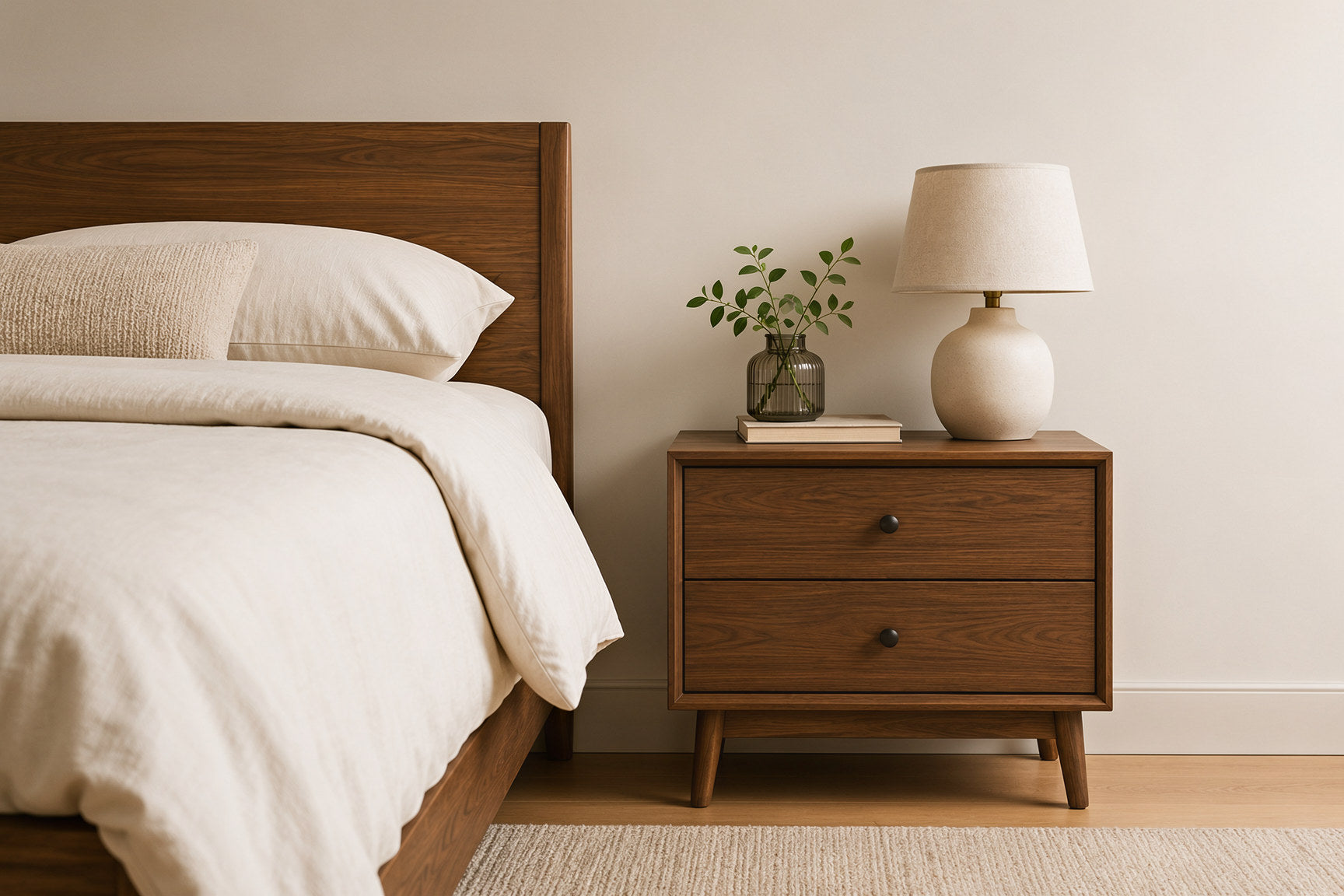
It happens in almost every bedroom at some point. The nightstand is beautiful - the right finish, the right style, the right amount of storage. But something feels subtly wrong every time you reach for your phone in the dark, or try to set down a glass of water without looking. The surface is just a few inches too low. Or too high. And that small miscalculation - made at the moment of purchase and never corrected - creates a low-grade friction that you feel every single morning and every single night.
Nightstand height is one of the most overlooked dimensions in bedroom furniture. Most people choose a nightstand based on style, storage, and finish - all of which matter enormously - without ever measuring whether the surface height will actually work alongside their specific bed. The result is a bedroom that looks right from the doorway and feels slightly off every time you use it.
This guide changes that. By the end, you'll know exactly how to calculate the ideal nightstand height for your bed, understand the factors that influence the measurement, and confidently choose a nightstand that looks balanced and feels comfortable to use every day. If you're exploring solid wood bedroom furniture, you'll also find practical examples using Oak & Loom's collection throughout this guide.
"A nightstand at the wrong height doesn't announce itself dramatically. It just makes every morning and every evening slightly harder than it needs to be - and slightly right would have cost nothing extra."
The Foundation: Why Nightstand Height Matters
Before the calculation, the principle. A nightstand surface should sit at a height that allows a person lying in bed to reach it comfortably - neither straining upward nor reaching downward at an awkward angle.
Reaching upward from a lying position is generally more comfortable than reaching downward. That's why the widely accepted guideline is to position a nightstand surface level with the top of your mattress or a few inches higher-never significantly below it. A nightstand that's more than 2–3 inches lower than your mattress forces you to reach downward, which can feel awkward and uncomfortable, especially when you're half-asleep or reaching for essentials during the night.
A nightstand surface that's level with or up to 6 inches higher than your mattress provides the most natural and comfortable reach. Your arm moves sideways with only a slight upward motion, making it easier to access everyday essentials like a phone, book, or glass of water without straining. The arm extends sideways and slightly upward, which is the most natural reaching motion from a lying position.
This relationship between mattress top and nightstand surface is the single most important measurement in nightstand selection. Everything else - style, storage, finish - is secondary to getting this height right.
Step 1 - Measure Your Total Bed Height
The starting point for every nightstand height calculation is your total bed height - measured from the floor to the top of your mattress surface. This is not the height of your bed frame alone. It is the combined height of the frame plus the mattress sitting on top of it.
Most people are surprised by how much total bed height varies between different bed styles. A low-profile solid wood platform bed with a standard foam mattress may measure 20–22 inches from the floor to the top of the mattress. The same mattress on a traditional bed frame with a box spring can reach 28–30 inches, while a storage bed with a taller base may measure 32 inches or more.
To measure your total bed height, place a tape measure on the floor beside your bed and measure vertically to the top surface of the mattress-the surface you actually sleep on, not the top of a mattress protector or bedding. Write this measurement down, as it forms the basis for calculating your ideal nightstand height.
If you are selecting a nightstand before choosing a bed frame, measure the frame's platform height from the manufacturer's specifications, then add your planned mattress depth. A standard memory foam or hybrid mattress runs 10 to 14 inches deep. A thicker luxury mattress can reach 16 inches or more. Add the two numbers - frame platform height plus mattress depth - to get your estimated total bed height.
Step 2 - Apply the Height Formula
Once you've measured your total bed height, calculating the ideal nightstand height is simple:
Ideal nightstand surface height = Total bed height (floor to mattress top) ± 2 to 6 inches
In practical terms, your nightstand surface should be no more than 2 inches below or up to 6 inches above the top of your mattress. This range provides a comfortable reach for most adults, making it easier to access everyday essentials while lying in bed.
The center of this range - nightstand surface level with or 2 to 3 inches above the mattress top - is where the most comfortable reach occurs for the majority of people. At this height, the arm extends naturally sideways with a slight upward angle, and items on the nightstand surface are accessible without any adjustment of body position.
Outside this range, comfort decreases quickly. A nightstand that's more than 6 inches above the mattress requires an awkward upward reach during the night, while one that's more than 2–3 inches below forces you to reach downward, placing unnecessary strain on your shoulder and upper arm-especially when lying on your side.
Once you've applied the formula, you'll have a clear target range for your ideal nightstand height. Most standard solid wood nightstands measure 24–30 inches, making them a suitable choice for many US bedrooms-but always compare the product's surface height with your own bed measurements before purchasing.

How Different Bed Types Affect the Calculation
Understanding how different bed types affect total bed height is what turns the formula into a practical buying tool. Here's how the most common bed configurations in US homes compare-and what they mean when choosing the right nightstand height.
Low-Profile Platform Beds
A solid wood low-profile platform bed - like several frames in Oak & Loom's wooden bed collection - typically has a platform height of 7 to 10 inches from floor to the top of the slat system. Add a standard 10 to 12-inch mattress and your total bed height sits at approximately 17 to 22 inches. This is the lowest common total bed height in US homes.
For example, if your platform bed measures 20 inches in total height, the ideal nightstand surface should be 18–26 inches high-lower than many standard nightstands. A nightstand measuring 28–30 inches would sit 8–10 inches above the mattress, making it less comfortable to use. For low-profile platform beds, choose a nightstand with a 20–26-inch surface height, and always compare the surface height, not just the overall product height.
Standard Platform Beds
A standard platform bed with a mid-height frame - 12 to 16 inches from floor to slat - and a 10 to 14-inch mattress produces a total bed height of 22 to 30 inches. This is the most common total bed height range in US master bedrooms and the range that standard nightstands - 24 to 28 inches tall - are designed to serve.
If your total bed height falls within this range, most standard-quality nightstands will provide a comfortable fit. Even so, it's still worth checking the surface height before purchasing, as dimensions can vary slightly between manufacturers.
Storage Beds and Taller Frames
A storage bed - with drawers built into the base - typically raises the platform height to 18 to 24 inches from floor to mattress platform. Add a 12-inch mattress and total bed height reaches 30 to 36 inches. At this height, a standard 26-inch nightstand sits 4 to 10 inches below the mattress top - at or beyond the comfortable lower limit.
For storage beds and taller bed frames, a nightstand with a 28–32-inch surface height usually provides the most comfortable reach. Before buying, always verify the surface height specification rather than relying on the product's overall height, as the two measurements aren't always the same.

The Bed Size Variable: How King, Queen, and California King Affect Nightstand Choice
Bed size affects nightstand selection in two ways -height and visual proportion - and both deserve consideration.
On the height side, King and California King beds are often paired with slightly thicker mattresses than Queen beds, On the height side, King and California King beds are often paired with thicker mattresses, which can increase the overall bed height compared to many Queen bed setups. A mattress that's 14–16 inches thick, instead of the more common 10–12 inches, adds 2–4 inches to your total bed height-raising the ideal nightstand height by the same amount.
On the proportion side, a King or California King bed has a wider visual presence than a Queen - and the nightstands flanking it need sufficient visual weight to balance that presence. A very small, delicate nightstand beside a large King frame looks undersized and out of proportion, regardless of whether the height calculation is correct. Aim for nightstands with a visual footprint - drawer width, body depth - proportional to the bed frame beside them.
For a Queen bed, a nightstand 18–22 inches wide usually provides balanced proportions. For King or California King beds, 20–26 inches wide creates a more substantial look. These measurements are guidelines rather than strict rules, but they're a useful starting point when balancing both functionality and visual scale.
"Getting the height right is the functional requirement. Getting the proportion right is what makes the bedroom look like it was designed rather than assembled."
The Quick Reference Guide: Nightstand Height by Bed Type
Use the table below as a quick reference to match your bed height with the recommended nightstand surface height. These measurements are general guidelines-always measure your own bed before making a purchase.
|
Bed Configuration |
Approx. Total Bed Height |
Ideal Nightstand Surface Height |
|
Low-profile platform + 10" mattress |
17–20 inches |
18–24 inches |
|
Low-profile platform + 12" mattress |
19–22 inches |
20–26 inches |
|
Standard platform + 10" mattress |
22–26 inches |
22–28 inches |
|
Standard platform + 12" mattress |
24–28 inches |
24–30 inches |
|
Standard platform + 14" mattress |
26–30 inches |
26–32 inches |
|
Storage bed + 12" mattress |
30–34 inches |
28–34 inches |
|
Storage bed + 14" mattress |
32–36 inches |
30–36 inches |
|
Traditional frame + box spring + 12" mattress |
28–32 inches |
26–32 inches |
Quick Rule: Your nightstand surface should sit up to 2 inches below or up to 6 inches above the top of your mattress for the most comfortable everyday reach.
What to Do When Two Nightstands Don't Match in Height
In many households, two people sharing a bed have different bedside preferences. One partner may be taller, use a thicker mattress or pillow, or simply prefer essentials within easier reach. In these situations, choosing two identical nightstands isn't always the most practical solution.
Mismatched nightstands-two coordinating pieces with different heights, styles, or storage layouts-can solve this practical challenge while creating a more thoughtfully designed bedroom. The visual connection comes from shared materials, finishes, or design details rather than identical dimensions, allowing each person to enjoy a nightstand that's comfortable to use.
This approach works particularly well with solid wood furniture collections that offer multiple nightstand styles and heights within a consistent design language. Choosing pieces with matching wood tones, similar hardware, or complementary silhouettes helps create a cohesive look-even when the dimensions differ. Oak & Loom's collection follows this approach, making it easy to pair different nightstand designs while maintaining a balanced bedroom aesthetic.

Common Nightstand Height Mistakes - And How to Avoid Them
Measuring the overall nightstand height instead of the surface height. A nightstand listed as 28 inches tall may have a usable surface height closer to 26 inches, depending on the thickness of the top panel. Always check the surface height-the distance from the floor to the top of the tabletop-rather than relying on the overall product height.
Ignoring the mattress topper. If you use a mattress topper - particularly a thick memory foam topper of 3 inches or more - add that depth to your total bed height calculation. A 2-inch miscalculation from an unmeasured topper can push your nightstand out of the comfortable reach zone.
Choosing a nightstand before replacing your bed. If you plan to upgrade your bed frame within the next year or two, choose your bed first and your nightstand second. Since your bed determines the ideal nightstand height, buying furniture in the wrong order may leave you with a nightstand that no longer fits comfortably.
Assuming all platform beds are the same height. Platform bed heights vary significantly between manufacturers and even between models from the same manufacturer. Always check the specific frame's platform height specification - not a general estimate for "platform beds."
Prioritising style over height. Even the most beautiful nightstand can become frustrating if it's uncomfortable to use every day. Measure first, confirm the correct height range, and then choose the style, finish, and storage features that best suit your bedroom.
The Practical Checklist: Before You Buy a Nightstand
Use this quick checklist before buying a nightstand to make sure it fits both your bed and your daily routine.
-
Measure your total bed height. Floor to mattress top surface - including any mattress topper if applicable. Write the number down.
-
Calculate your target range. Your nightstand surface should sit up to 2 inches below or up to 6 inches above the top of your mattress.
-
Check the nightstand's surface height. Not the total height - the surface height. If it is not listed in the product specifications, contact the retailer to confirm.
-
Assess visual proportion. Is the nightstand's width and body depth proportional to your bed frame? For King and California King beds, err toward wider and more substantial nightstands.
-
Consider drawer and storage access. If you regularly use your nightstand drawers, make sure the handles and storage are easy to reach while lying in bed. If you have to sit up every time you need something, the layout may not be as practical as it looks.
-
Plan both sides together. If you're buying two nightstands, check the bed height on both sides. Some bed frames aren't perfectly level at the edges, and each sleeper may have different comfort preferences.
-
Connect the nightstand to the bed frame visually. Browse Oak & Loom's solid wood nightstands alongside the solid wood bed frames to find combinations that share material quality and visual language - the pairing should feel like a considered decision, not a coincidence.
-
Create a cohesive look. Choose nightstands that complement your bed frame in material, finish, and overall style. If you're exploring Oak & Loom's solid wood bedroom collection, look for combinations that share the same craftsmanship and design language so the space feels intentionally coordinated.

Conclusion
Nightstand height is one of those furniture details that most people only appreciate after choosing the wrong one. Fortunately, getting it right is simple. By measuring your bed correctly and applying a straightforward formula, you can choose a nightstand that feels comfortable to use every day while creating a bedroom that looks balanced and thoughtfully designed. The right height doesn't just improve convenience-it enhances the way your space functions and feels.
Before making your purchase, measure your total bed height from the floor to the top of your mattress, calculate your ideal nightstand height range, and always confirm the product's surface height rather than relying on its overall dimensions. Taking these few extra minutes helps you avoid a common buying mistake and ensures your nightstand is both practical and visually proportional to your bed.
A well-made solid wood nightstand at the correct height is more than a place to set down a book or a glass of water. It's a piece of furniture you'll use every day-one that adds lasting comfort, durability, and timeless character to your bedroom for years to come.
"The details that no one notices consciously are the ones that make a room feel right without anyone being able to say exactly why."
Ready to Find the Right Nightstand?
Browse Oak & Loom's collection of solid wood nightstands with detailed dimensions and thoughtfully crafted designs to find the perfect match for your bed and bedroom style.
Need help deciding? The Oak & Loom team is happy to provide guidance on nightstand height, product pairing, and custom furniture recommendations to help you choose with confidence.
Frequently Asked Questions
Q1: What height should a nightstand be next to a bed?
The ideal nightstand surface should sit level with your mattress or between 2 inches below and 6 inches above the top of the mattress. For most people, the most comfortable position is level with or 2–3 inches above the mattress, making it easy to reach everyday essentials without straining.
Q2: How do I measure the right nightstand height for my bed?
Measure from the floor to the top of your mattress, including any mattress topper you use. Your ideal nightstand surface should fall between 2 inches below and 6 inches above that measurement. When comparing products, always check the surface height rather than the overall product height, as the two measurements can differ depending on the construction.
Q3: Are standard nightstands the right height for platform beds?
It depends on your platform bed's total height. Low-profile platform beds (17–22 inches) often require shorter-than-standard nightstands, while standard platform beds (22–30 inches) usually pair well with nightstands measuring 24–30 inches in height. Measuring your own bed is the best way to ensure a comfortable fit.
Q4: Can nightstands on either side of the bed be different heights?
Yes. If two people share a bed, different nightstand heights can actually improve comfort by matching each person's sleeping position, mattress setup, or personal preference. To keep the room visually balanced, choose nightstands with complementary materials, finishes, or design styles rather than focusing on identical dimensions.
Q5: Does nightstand height matter for a King size bed?
Yes. King and California King beds are often paired with thicker mattresses, which can increase the total bed height and require a taller nightstand. In addition to height, consider proportion-larger beds typically look best with wider, more substantial nightstands that create a balanced bedroom layout.
Q6: What is the standard nightstand height in the US?
Most standard nightstands in the US measure 24–30 inches tall, which suits many beds with a total height of 22–30 inches. However, standard dimensions are only a starting point. The best nightstand height depends on your specific bed and mattress, so always measure before making a purchase.


Share:
Layering Wood Tones in the Living Room: Avoiding a Matchy-Matchy Look
How to Choose Dining Chairs That Work With a Solid Wood Table