
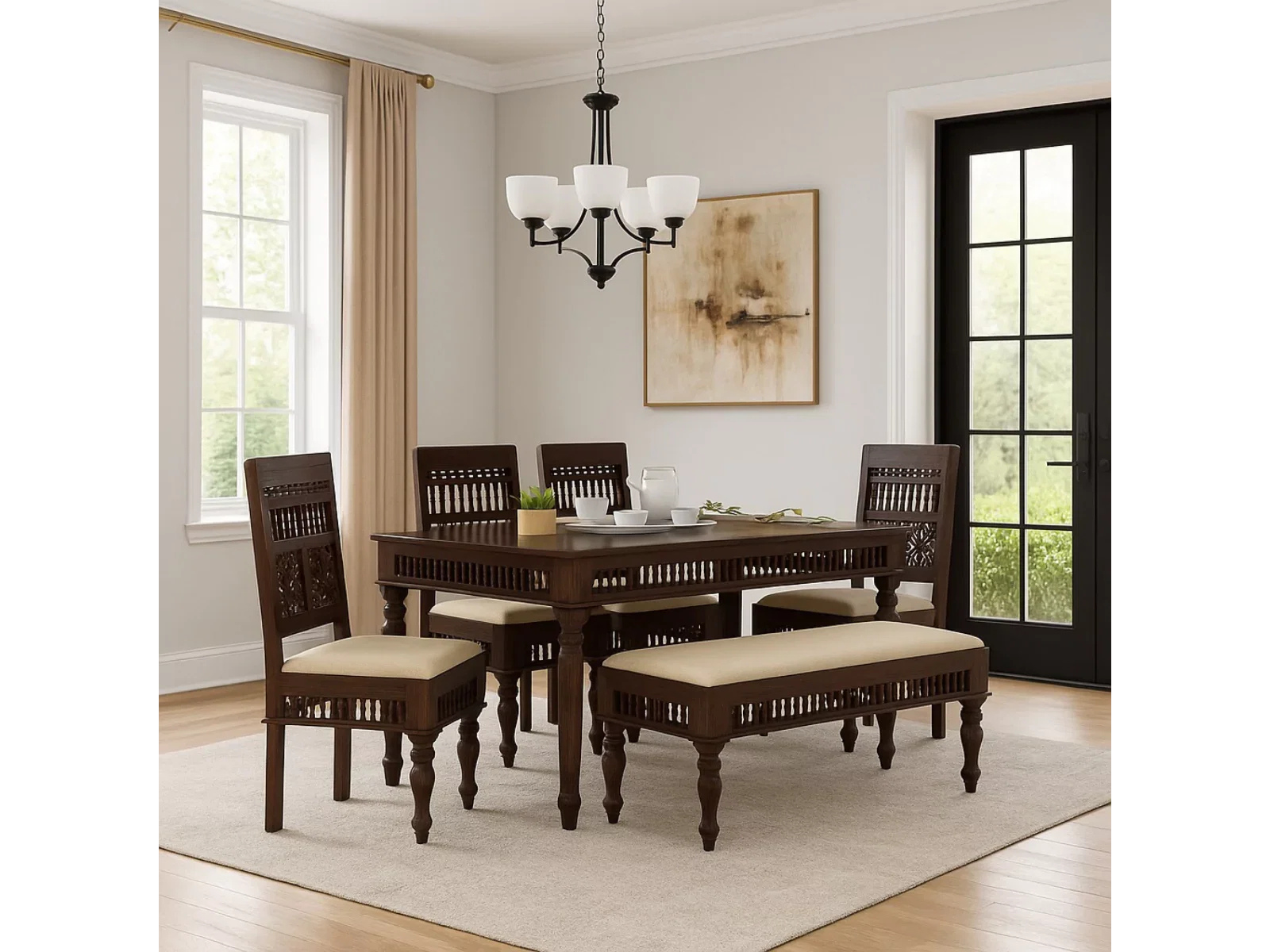
Two households can order the exact same dining table and end up having completely different everyday experiences, depending on one decision: bench or chairs. A bench offers flexible seating and can make it easier for kids to get in and out, while a set of chairs gives every diner a defined spot, with armrests if needed and no shuffling required to leave the table mid-meal.
Neither is objectively better - but for daily use, rather than how the room photographs, the right choice depends on specifics most buyers don't think through until after the table's already ordered. Here's how the two actually compare, starting with what they look like side by side:
Quick answer: For everyday use, a dining bench works especially well for households with kids, frequent guests, or limited space because it offers flexible seating and can make better use of the table's available length. Chairs work best where individual comfort, back support, and easy in-and-out access matter at every meal. Many households use both - chairs on the ends, a bench along one side.
Why This Matters
The choice affects daily life more than it affects the room's appearance. A bench that looks perfect in photos can mean someone climbing over a sibling to leave the table on a Tuesday night. Chairs that look formal and correct can mean a cramped squeeze when six people show up instead of four.
Getting this right means the table works for the meals you actually eat, not just the ones you host twice a year. It's a decision worth making deliberately, not by default.
Dining Bench vs. Dining Chairs: How They Actually Compare
Seating Capacity and Flexibility
As a practical planning guideline, allow around 24 inches of table width per diner for standard dining chairs. For more guidance on seating capacity and table size, see our How Many People Can Your Dining Table Actually Seat? A Sizing Guide. A bench can sometimes accommodate diners in a slightly tighter footprint - roughly 20–22 inches per person - because people can shift along the seat rather than occupying a fixed individual space. The actual capacity depends on the bench's length, table design, and how much personal space diners need, but a bench can make better use of available table length when guest counts vary from week to week.
Comfort for Everyday Meals
Chairs offer a defined, stable seat - with back support, armrests if you choose them, and a consistent amount of personal space for each diner. If you're choosing chairs for a solid wood table, our How to Choose Dining Chairs That Work With a Solid Wood Table can help you compare the factors that matter for comfort and fit. A bench trades some of that individual structure for flexibility: there is no assigned seat, and small children can often get in and out without having to maneuver a separate chair. The trade-off is less back support on a backless bench and less personal space when the bench is full.
Here's what that space difference actually looks like laid out along the table's edge:

Cleaning and Maintenance
A bench can simplify everyday floor cleaning because there are fewer separate pieces to move around than with four to six individual chairs. A solid-wood bench is especially straightforward to wipe down, while upholstered benches require the same attention to spills and crumbs as upholstered chairs. Chairs, particularly upholstered ones, may take longer to clean individually but can be pulled out completely for easier access underneath.
A bench doesn't just make efficient use of floor space - it can also reduce the daily friction of moving individual seats around, which matters when the table is used by kids every day.
The Mixed Approach - Bench and Chairs Together
Many households split the difference: chairs on the table's ends or one side, with a bench along the other. This keeps individual back support and armrests available where they're most useful while giving kids or overflow guests the flexibility of a bench. For growing households, our [guide to choosing a dining table that grows with your family] also covers how to plan for changing seating needs. For many families, the combination offers a practical balance between individual comfort and flexible seating, rather than forcing a choice between the two.
Here's how to work through the decision for your own household:

Comparison Tables
Here's the same comparison laid out by the factors that actually decide daily use.
|
Factor |
Dining Bench |
Dining Chairs |
|
Space per person |
Roughly 20–22 in as a planning guideline |
Around 24 in for a standard dining chair; wider chairs may need more |
|
Seating flexibility |
Diners can shift along the seat |
Each diner has a defined seat |
|
Back support |
None on a backless bench; available with a backed design |
Typically provides individual back support |
|
Ease with kids |
Easy for children to get in and out without moving a chair |
Requires pulling the chair out and pushing it back in |
|
Getting in and out |
Less convenient for someone seated in the middle |
Easy individual access |
|
Cleaning underneath |
Fewer separate pieces to move than individual chairs |
Multiple chairs and legs may require more repositioning |
|
Personal space |
Flexible, but shared with others on the bench |
Defined space for each diner |
|
Formality |
Can range from casual to refined depending on design |
Can range from casual to formal depending on design |
The same comparison, in a faster reference format:

Expert Advice: Who Actually Benefits Most From Each
Bench seating can be especially practical for households with young children, frequent last-minute guests, or a table that doubles as a space for homework, crafts, or laptops. Chairs can be a better fit when the table is used for longer, seated meals or when individual comfort, back support, and easy access matter more than flexible seating. Chairs with armrests can also be useful for anyone who prefers additional support when sitting down or standing up.

Designer Tips
Designer Tip: If choosing a bench, match its height carefully to the table. Even a small mismatch can affect legroom and make everyday meals less comfortable.
Worth Considering: A backless bench works well for shorter, casual meals but may feel less comfortable during longer meals because it doesn't provide back support. If your table is regularly used for extended meals, consider a backed bench or individual chairs.
Worth Knowing: A bench can sometimes offer a lower cost per seat than buying several individual chairs, but pricing varies widely by material, construction, upholstery, and craftsmanship. Compare the total cost based on the seating capacity you actually need.
Common Mistakes
|
Mistake |
Reality |
|
Choosing a bench purely for the farmhouse look |
Comfort for actual meal length matters more than aesthetics |
|
Assuming a bench always seats more people |
A bench only adds flexibility when diners have enough room to sit comfortably; a crowded bench can feel tighter than chairs |
|
Skipping back support for daily bench use |
A backless bench can suit shorter, casual meals but may be less comfortable for longer ones |
|
Buying chairs without measuring their width |
Wider dining chairs and armchairs need more table-edge space, so measure the actual chair dimensions before planning seating |
|
Not considering how kids will use the seating |
Benches can make it easier for young children to get in and out without moving an individual chair |
The right seating isn't the one that looks best in the listing photo - it's the one nobody has to think about by the third week of ownership.
Buying Checklist
The same seven checks, condensed into one saveable graphic:

Frequently Asked Questions
Q1: Is a dining bench more comfortable than chairs for everyday use?
It depends on meal length and who's using it. Chairs offer individual back support and personal space, making them a better fit for longer meals. Benches can work well for quick, casual meals and make it easier for children to get in and out, but a backless bench provides less back support.
Q2: How much space does a dining bench need compared to chairs?
As a practical planning guideline, allow roughly 20–22 inches per person on a bench and around 24 inches for a standard dining chair. These are starting points rather than fixed rules - the actual space needed depends on the bench length, chair width, table design, and how much personal space diners prefer.
Q3: Can I mix a dining bench with chairs at the same table?
Yes. A mixed setup is one of the most flexible options for everyday dining. Chairs at the table's ends provide individual back support and easy access, while a bench along one side offers flexible seating for children or additional guests.
Q4: Are dining benches good for small children?
Yes. Benches can make it easier for young children to get in and out without pulling out and pushing back an individual chair. They can be especially practical for families who use the dining table every day, although supervision and the bench's stability should still be considered.
Q5: Can it be difficult to get out of a dining bench?
It can be, especially for someone seated in the middle of a full bench. Unlike individual chairs, a bench doesn't give each diner a separate exit path. If people frequently get up during meals, consider a shorter bench, leave one side open, or use a bench-and-chair combination.
Q6: Do dining benches need a backrest?
Not necessarily. A backless bench works well for shorter, casual meals, but it may be less comfortable during longer meals because it provides no back support. If your table is regularly used for extended meals, a backed bench or individual chairs may be a better fit.
Final Summary
There's no universal right answer between a bench and chairs - only a right answer for how your table actually gets used. A backless bench that seats five kids comfortably at breakfast is the correct choice for one household and the wrong one for a family that hosts long, seated dinners weekly. Match the seating to the meals, not the other way around.
A dining table is judged by every meal eaten at it, not the one photographed for the listing - choose the seating that holds up to the first kind.
Deciding Between a Bench, Chairs, or Both?
If you're weighing a bench, chairs, or a mix of both for your table, our design team can help you work through sizing and seating capacity for your space. Browse our dining chairs collection or complete dining sets, or reach out for free guidance on choosing the right combination for your household.

Share:
The Complete First Apartment Checklist: What to Buy for Every Room
What Is Rustic Interior Design? A Complete Style Guide