
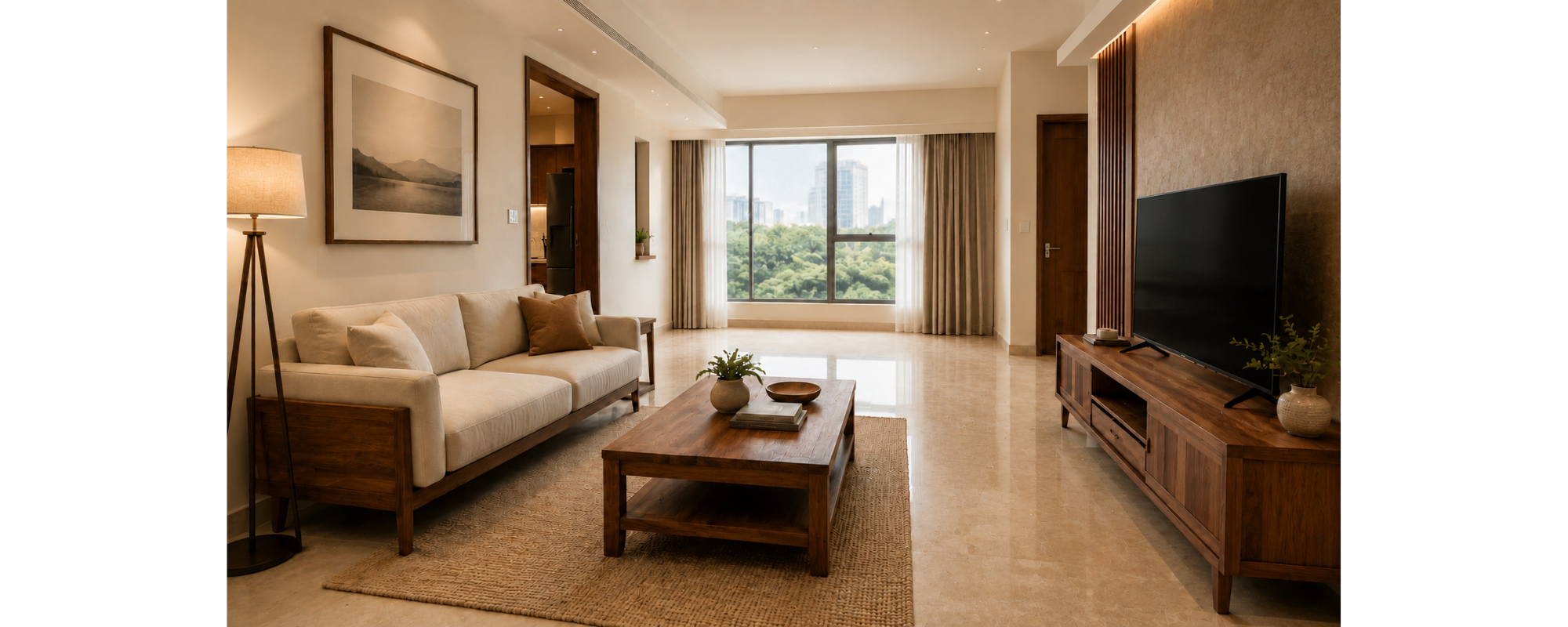
Moving into your first apartment comes with a strange kind of math problem: you need almost everything at once, but you can't actually buy everything at once, and most lists that promise to solve this just hand you an enormous pile of items with no order to them. This one is organized differently. It's built around two questions that actually matter - what do you need the day you move in, and what can reasonably wait a few weeks - plus something most first-apartment guides skip entirely: how to make sure the furniture you buy actually fits.
Before You Start Shopping
A few minutes of prep before you open a single shopping tab will save you far more time (and money) than it costs.
Measure Your Space (and Your Doorways) First
This is the step almost every first-apartment checklist skips, and it's the one most likely to cost you real money if you skip it too.
Before buying anything larger than a lamp, measure three things: the room the furniture will live in, the path it has to travel to get there, and the doorways along that path. A sofa that fits your living room perfectly can still be unreturnable if it can't get through your front door, around a hallway corner, or into a small elevator.
Start with the room. Measure the wall you're planning to place furniture against, and measure the width of the walkway you'll want to keep clear - interior designers generally recommend leaving at least 30 to 36 inches of open path around major furniture so the room doesn't feel like an obstacle course. Then measure every doorway, stairwell turn, and elevator interior between the building entrance and your apartment door. Most interior doors in US homes are 30 to 36 inches wide, but older buildings, walk-ups, and narrow hallway turns can be considerably tighter - and a sofa or dresser that's a few inches too wide or deep simply won't turn the corner, no matter how it measures against the wall.
If you're ordering furniture online, check the exact box dimensions the retailer lists, not just the assembled size - a boxed piece is sometimes larger than the finished product before it's put together.

Take Inventory of What You Already Own
Before adding anything to a cart, walk through what you're bringing with you. Even a first apartment rarely starts completely empty - hand-me-down furniture, a mattress from a childhood bedroom, kitchen basics from a parent's extra set. Knowing what you already have prevents the most common first-apartment mistake: buying two of something because you forgot you owned one.
Set a Realistic Furniture Budget
You don't need to furnish an entire apartment in one weekend, and trying to usually means overspending on things that don't matter and underspending on the pieces that do. A more sustainable approach is to spread purchases across your first few months, prioritizing the rooms and pieces you use every day (bed, seating, a table to eat at) over the ones you'll use occasionally. The Buy Now vs. Buy Later section below breaks this down room by room.
What to Buy Before Moving-In Day
You don't need your whole apartment furnished for night one, but a few things make the difference between a smooth first night and a genuinely rough one.
Your Move-In Day Essentials Box
Pack one box or bag with everything you'll want within the first few hours, separate from the rest of your boxes so you're not digging through everything you own to find a toothbrush:
-
Bedding - sheets, one pillow, a blanket
-
Toiletries - toothbrush, toothpaste, soap, a towel
-
A shower curtain and basic bathroom supplies
-
One plate, one cup, and basic utensils
-
Toilet paper and paper towels
-
A phone charger
-
Basic cleaning supplies (all-purpose cleaner, a rag)
-
A flashlight or spare lightbulbs, in case anything's out
 Small Space Living
Living Room Essentials
The living room is usually where you'll want to invest the most thought, since it's the room guests actually see and the one you'll spend the most waking hours in.
-
Sofa or a pair of comfortable chairs, sized to the room rather than the biggest one you can afford
-
A coffee table that fits your space
-
A media console or TV stand, ideally with some enclosed storage
-
A floor or table lamp - overhead lighting alone tends to feel harsh
-
Curtains or blinds
-
A rug, if your floors are hard surface
-
Somewhere to put your keys and mail near the door

Bedroom Essentials
Your bedroom doesn't need to be elaborate, but a few things are worth getting right from day one, since poor sleep makes everything else about a new apartment harder.
-
Sheets (two sets is a reasonable minimum, so one can be in the wash)
-
Pillows and a comforter or duvet
-
A nightstand - even a small side table works if a proper nightstand isn't in budget yet
-
A lamp you can reach from bed
-
Somewhere to store clothes: a dresser, or a small wardrobe/armoire if your closet space is limited
-
Curtains or blinds, ideally room-darkening if your building gets a lot of streetlight
Kitchen Essentials
You don't need a fully outfitted kitchen from a cooking show - you need enough to make a real meal without improvising with paper plates indefinitely.
-
One good chef's knife, plus a paring knife
-
A cutting board
-
One pot large enough for pasta, one pan for everyday cooking
-
A set of mixing bowls
-
Basic dishware: plates, bowls, glasses, mugs - two to four of each is usually enough to start
-
Silverware
-
Measuring cups and spoons
-
A can opener
-
Dish soap, a sponge, and dish towels
-
A trash can and bags
-
A coffee maker or kettle, if that's part of your morning routine

Dining Essentials
Even in a small apartment, having somewhere to actually sit down and eat - rather than eating standing at the counter indefinitely - makes a bigger difference to how a space feels lived-in than most people expect.
-
A table sized to your space - a small bistro table or two-top works fine in a studio; a proper four-seat table makes sense if you'll host occasionally
-
Chairs to match
-
A place mat set or simple table linens, if you want the table to double as a workspace without looking like one
-
A sideboard or console, if you have the room, for extra storage and serving space when you do have people over

Bathroom Essentials
The bathroom is one of the cheapest rooms to fully outfit, and one of the least fun to be caught without.
-
Shower curtain and liner (unless your shower has a glass door)
-
Bath mat
-
Towels - bath, hand, and washcloth, ideally two of each
-
Toilet paper, and enough of it to not need an emergency run
-
Hand soap
-
A trash can
-
A plunger - genuinely, buy this before you need it, not after
Cleaning & Household Basics
Unglamorous, but this is the category that keeps a new apartment from feeling neglected within the first month.
-
Broom and dustpan, or a vacuum
-
All-purpose cleaner
-
Sponges and cleaning cloths
-
Laundry detergent (check whether your machine requires an HE - high-efficiency - formula)
-
A basic tool kit: screwdriver, hammer, tape measure
-
Nails or wall hooks for hanging anything
-
A few extra lightbulbs in the right size for your fixtures
-
Batteries, for remotes and smoke detectors
What Furniture to Buy First (and What Can Wait)
This is where most checklists stop being useful - they tell you what to buy, but not in what order, which leaves you either overspending in week one or living without basics for months. Here's a more realistic sequence, organized by what you'll actually miss if you don't have it.
|
Buy Now |
Buy Later |
|---|---|
|
A proper dresser (a few boxes or a rolling rack can hold you over) |
|
|
At least one comfortable seat (sofa, loveseat, or a good chair) |
A second seating piece or accent chair |
|
A table to eat at, even a small one |
A larger dining set built for hosting |
|
A coffee table or side table for the living room |
Decorative accent furniture - bar carts, ottomans, bench seating |
|
Basic kitchen tools and dishware |
Specialty appliances (stand mixer, air fryer, etc.) |
|
Curtains or blinds for privacy |
Layered window treatments or upgraded hardware |
|
One lamp per room you'll use at night |
A full lighting scheme with accent lighting |
The logic here is simple: prioritize what affects your sleep, your ability to eat a real meal, and your privacy. Everything else genuinely can wait until you've lived in the space long enough to know what it actually needs.
How to Avoid Buying Furniture That's Too Big for Your Apartment
This is the mistake almost every first-apartment guide warns about in one sentence and then never actually explains. A few concrete habits prevent it:
Measure before you fall in love with something. It's much easier to walk away from a sofa online than one you've already seen fit - measure your space first, then shop, not the other way around.
Account for walking space, not just wall space. A sectional might fit against the wall perfectly and still leave you squeezing past the coffee table to reach the kitchen. Leave real clearance for the paths you'll actually walk every day.
Check the depth, not just the width. Width gets measured; depth gets forgotten. A deep sofa or an oversized dining table can make a small room feel considerably smaller than its square footage suggests, even when the width fits fine.
Bring or tape out the dimensions. Painter's tape on the floor, outlining exactly where a piece would sit, is a five-minute check that prevents a genuinely common and expensive mistake.
When in doubt, size down. A slightly smaller sofa or table in a small apartment usually looks intentional and well-proportioned. A slightly too-large one usually looks like a mistake, even if it technically fits.
Also worth flagging before you buy anything large: measure the delivery path, not just your apartment. A piece that fits your living room perfectly can still get stuck at the building entrance, a stairwell landing, or an elevator door that's narrower than the hallway it opens into. If you live in a walk-up or an older building, it's worth calling ahead to check elevator interior dimensions and stairwell turn widths before ordering anything you can't easily return.
First Apartment Checklist : Frequently Asked Questions
What furniture do I need for my first apartment?
At minimum: a bed, a place to sit, a table to eat at, and some form of storage for clothes. Everything past that - a second seating piece, a full dining set, decorative furniture - can reasonably wait until you've lived in the space and know what it actually needs.
What should I buy first when furnishing a new apartment?
Start with what affects your sleep, meals, and privacy: bed frame and mattress, one comfortable seat, a table to eat at, and window coverings. These are the items you'll notice missing within the first 24 hours; everything else can wait a few weeks without real disruption to daily life.
How much does it cost to furnish a first apartment?
Costs vary widely depending on whether you buy new, secondhand, or a mix of both, and how much of the apartment you furnish at once. A phased approach - covering the essentials first and adding pieces over several months - tends to be both more affordable and easier to plan around than furnishing everything in a single trip.
What can wait until after you move in?
Decorative furniture, a second dining set, accent chairs, and anything purely aesthetic can generally wait. It's often easier to make these decisions after living in the space for a few weeks and seeing how you actually use each room, rather than guessing before you've moved in.

Share:
Will a Solid Wood Bed Frame Work With an Adjustable Base?
Dining Bench vs. Dining Chairs: Which Is Better for Everyday Use?