
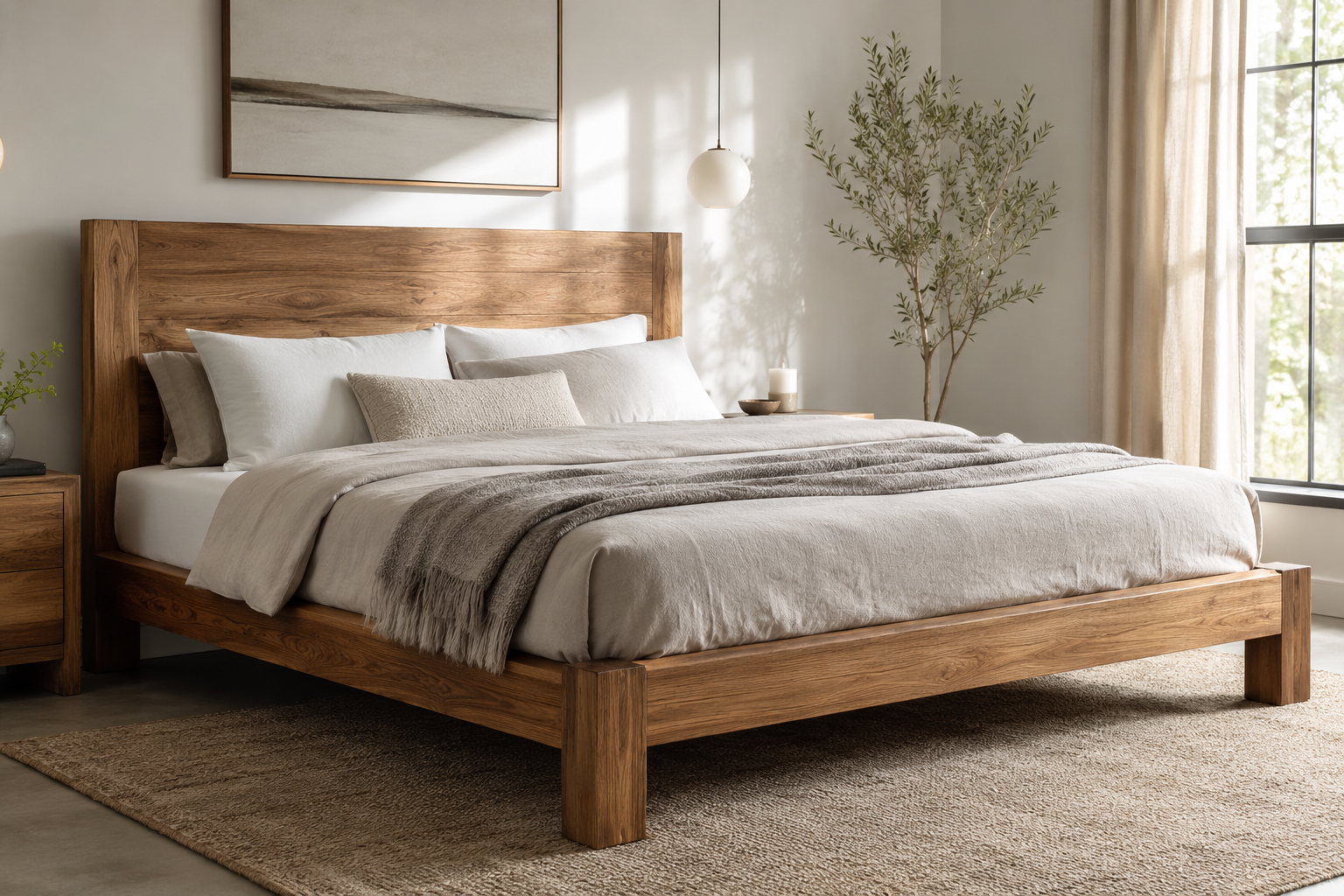
Solid Wood Bed Frame for Heavy Person: What to Look For Before You Buy
Most bed frame listings in the United States include a weight capacity somewhere in the fine print. Most US buyers never look at it-until the frame starts creaking, flexing, or showing signs of wear under daily use.
If you are a heavier person shopping for a solid wood bed frame, or if you and your partner have a combined weight that exceeds what many standard frames are designed to support, this guide is for you. Rather than simply listing "sturdy-looking" options, it explains what actually makes a bed frame structurally strong, what the specifications mean, and what you should verify before making a purchase.
The good news is that, when built correctly, solid wood bed frames are among the most durable and structurally reliable choices for heavier sleepers. The challenge is that not all solid wood frames are built to the same standard. The difference between a frame that remains stable for decades and one that begins to loosen or develop issues within a few years often comes down to a handful of construction details that many product listings never mention.
If you're comparing different options, keep these structural features in mind as you browse Oak & Loom's collection of solid wood bed frames, available with free shipping across the contiguous United States.
"The right bed frame for a heavy person isn't the one that looks the heaviest-it's the one built with the right joinery, the right wood species, and the right center support system, regardless of how substantial it appears in a photograph."
Quick Answer: What Makes a Solid Wood Bed Frame Good for a Heavy Person?
The key factors to look for in a solid wood bed frame for a heavy person are a weight capacity of 1,000 lbs or higher for the complete frame system, mortise-and-tenon structural joinery at all rail-to-post connections, reinforced center support rails for queen and king sizes, furniture-grade hardwood (such as acacia or mango rather than pine or other softwoods), and slat spacing no wider than 3 inches with a minimum 1.5-inch slat thickness. Together, these features play a major role in how well a bed frame supports heavier loads, maintains its structural integrity, and performs over years of regular use.
Why Most Bed Frames Fail Under Heavy Loads - And Why Solid Wood Is Different
Before looking at what to buy, it helps to understand why many standard bed frames struggle under heavier loads. Once you understand how bed frames typically fail, the construction features that matter become much easier to evaluate.
The weakest points in most bed frames are the joints-specifically where the side rails connect to the headboard and footboard. Every time someone gets in or out of bed, sits on the edge, or shifts during sleep, these connections experience repeated lateral stress. Over time, joints that are not designed for sustained heavy loads can gradually develop movement or looseness, which often leads to creaking, shifting, and reduced stability.
In MDF and particleboard frames, this process is often accelerated because the material can compress around fasteners under sustained loads. Bolt holes may gradually widen, reducing the strength of the connection over time. As wear progresses, the frame may become increasingly unstable and eventually require repair or replacement.
Solid hardwood frames generally resist this type of compression more effectively. However, frames that rely primarily on bolt-and-bracket connections can still develop slight movement over years of repeated use, especially under heavier loads.
Solid hardwood frames built with well-crafted mortise-and-tenon joinery offer a different approach. As used throughout Oak & Loom's bed frame collection, this traditional wood-to-wood joint distributes stress across a larger contact area rather than relying primarily on mechanical fasteners. When properly manufactured and maintained, mortise-and-tenon joinery is widely regarded as one of the strongest and most durable construction methods for furniture that experiences repeated daily use.
For a complete explanation of why joinery plays such an important role in furniture longevity, read: How to Identify Quality Joinery - The Hidden Sign of Great Furniture.
The 6 Things to Check Before Buying a Solid Wood Bed Frame for a Heavy Person
Check 1 - The Weight Capacity Rating
This is the first number to find - and the one most US buyers skip. Every bed frame should have a stated weight capacity: the maximum combined load of sleepers the frame is tested to support.
For a single heavy person: look for a minimum weight capacity of 800 lbs for the complete frame system.
For a heavy couple: look for a minimum weight capacity of 1,000 to 1,200 lbs for the complete frame system.
Standard bed frames sold in the US market are typically rated at 500 to 700 lbs - adequate for average-weight sleepers, inadequate for heavy users.
Important caveat: weight capacity ratings are not standardized across the US furniture industry. A frame rated at "800 lbs" by one manufacturer may have been tested to different protocols than one rated at "800 lbs" by another. Always ask specifically: what testing standard was used, and what does the rating include (frame only, or frame plus mattress)?
At Oak & Loom, our team can provide specific load capacity information for any frame in the collection before purchase. Contact us before ordering.
Check 2 - Mortise-and-Tenon Joinery at All Structural Connections
For a heavy person, joinery method is the single most important construction factor - more important than the wood species, the finish, or the visual weight of the frame.
Ask specifically what type of joinery is used where the side rails connect to the headboard and footboard. Well-made mortise-and-tenon joinery is widely regarded as one of the strongest and most durable options for solid wood furniture because it distributes stress across the joint rather than relying primarily on mechanical fasteners. Other connection systems-such as bolts, cam locks, or brackets-can also perform well when engineered properly, but their long-term performance depends heavily on design quality and construction.
At Oak & Loom, mortise-and-tenon joinery is used at all primary structural connections across every frame in the collection. This is not a premium upgrade on certain frames - it is the construction standard applied uniformly.

Check 3 - Reinforced Center Support Rails
The center of a bed frame - the span between the two side rails - is the most structurally vulnerable point under heavy loads. Without adequate center support, this span flexes under the weight of a heavy mattress and heavy sleepers, creating progressive stress on the side rail connections and eventual frame noise and instability.
For a queen-size solid wood bed frame for a heavy person: the frame must have at minimum one reinforced center support rail running the full length of the frame, with a floor-contact leg in the center.
For a king-size solid wood bed frame, look for dual reinforced center support rails, each running the full length of the frame with floor-contact legs.
A center support rail that does not contact the floor - a floating rail suspended between the side rails without floor support - is not adequate for heavy loads. The rail must contact the floor to transfer the load downward rather than distributing it across the side rail spans.
At Oak & Loom, every queen and king frame in the collection includes reinforced solid hardwood center support with floor-contact legs - built into the standard construction, not an optional upgrade.
Check 4 - Wood Species and Grade
Not all solid wood is equal under heavy loads. The relevant measure is Janka hardness - the resistance of the wood species to compression and denting under sustained load.
|
Wood Species |
Janka Hardness |
Heavy Load Suitability |
|
Solid Acacia |
1,700–2,300 lbf |
✅ Excellent |
|
Solid Mango |
~1,070 lbf |
✅ Good |
|
Solid Pine |
~870 lbf |
⚠️ Marginal |
|
Softwood (fir, spruce) |
500–700 lbf |
❌ Not suitable |
|
MDF (comparison) |
~350 lbf equiv |
❌ Generally not recommended for sustained heavy loads |
For a solid wood bed frame for a heavy person, solid acacia is the stronger species choice - its Janka hardness of 1,700+ lbf provides significantly more resistance to compression at joint points and surface wear than softer alternatives. Solid mango at 1,070 lbf is adequate for most heavy users in standard residential conditions.
Wood grade also matters: furniture-grade hardwood - free of structural knots and with stable, straight grain in the structural components - is more dimensionally stable than lower grades under sustained load.
Check 5 - Slat System Specifications
The slat system in a solid wood bed frame for a heavy person must meet specific requirements:
Slat spacing: No wider than 2.5 to 3 inches for heavy loads. Wider spacing allows the mattress to sag between slats under heavy weight, creating uneven support and progressive mattress compression.
Slat thickness: Minimum 1.5 inches for heavy loads. Thinner slats flex under sustained heavy weight, creating progressive movement at the slat contact points that generates noise and eventual slat cracking.
Slat material: MDF or composite slats are generally more susceptible to compression and damage under sustained heavy loads than solid hardwood slats.
Center slat support: For queen and king frames, slats that span the full width of the frame without a center support point may not provide sufficient support for heavy loads. Look for slats that either rest on a center rail or are short enough that the span does not exceed 30 inches without support.
Check 6 - The Frame's Construction at the Leg-to-Rail Connection
The legs of a solid wood bed frame - and specifically how they connect to the side rails - determine how well the frame handles the lateral stress of heavy users sitting on the edge, getting in and out of bed, and the repeated shifting of sleep movement.
For heavier sleepers, look for a leg-to-rail connection that uses either traditional mortise-and-tenon joinery or a well-engineered reinforced bolt-and-bracket system. The goal is a rigid connection that minimizes movement under repeated daily use.
Check this by gripping one leg and applying lateral pressure while the frame is assembled. A properly constructed connection does not flex or produce noise under hand pressure. Noticeable movement at this joint during a simple stability check may become more apparent under the repeated stresses of everyday use.

Why MDF and Engineered Wood Frames May Wear Faster Under Heavy Loads
This section is for US buyers comparing a lower-cost engineered wood bed frame with a solid wood alternative.
Engineered wood materials such as MDF and particleboard can perform well in many everyday applications. However, under sustained heavy loads and repeated daily use, they are generally more susceptible to wear than well-constructed solid hardwood frames.
A common pattern of wear may look like this:
Early use: The frame performs as expected, although minor creaking may develop over time with regular movement.
After extended use: Repeated stress can gradually loosen fasteners as the engineered wood around connection points compresses. This may lead to increased noise, slight movement, or reduced stability.
Long-term use: Depending on the quality of construction, weight carried, and frequency of use, the frame may eventually require repair or replacement as joints, fasteners, or slats wear over time.
For heavier sleepers, this wear process may occur sooner because the frame is subjected to greater and more frequent loading than it would experience under average household use.
By comparison, a well-built solid hardwood bed frame with quality joinery and reinforced center support is generally better suited to handling sustained heavy loads over many years. Hardwood is more resistant to compression around structural joints, helping maintain stability and reduce movement throughout the life of the frame.
Considering Long-Term Value
While solid wood bed frames typically cost more upfront, many homeowners view them as a long-term investment because they can often be repaired, refinished, and used for many years when properly maintained. Lower-cost engineered wood frames may have a lower initial purchase price, but replacement costs over time can reduce the apparent savings for some buyers.
Ultimately, the better value depends on your budget, expected lifespan, and how heavily the bed will be used.

Practical Considerations for Heavy People Choosing a Solid Wood Bed Frame
Bed Height Matters More for Heavy People
Getting in and out of bed places more strain on the knees, hips, and back for many heavier adults, making bed height an important comfort consideration. For many people, a combined bed height (frame plus mattress) of 26 to 30 inches provides a comfortable balance—high enough to make sitting and standing easier while still allowing proper sleeping posture.
Ultra-low platform beds, particularly those with a total height below 22 inches, may require more effort to get in and out of. If comfort and ease of movement are priorities, a mid-height bed frame is often the better choice.
Edge Support Is Worth Considering
Many people naturally sit on the edge of the bed while getting dressed, putting on shoes, or before lying down. For heavier sleepers, strong edge support can improve stability and comfort during these everyday activities. A well-built solid wood bed frame with sturdy side rails provides a stable foundation that complements a supportive mattress.
California King vs. King for Taller Sleepers
If you're both tall (around 6'2" or taller) and need a bed designed for heavier loads, a California King offers an additional 4 inches of length compared with a standard King (84 inches versus 80 inches). That extra length can provide better legroom and a more comfortable sleeping position for taller individuals.
Choosing the Right Mattress
Your mattress is just as important as your bed frame. For heavier sleepers, consider:
-
A mattress specifically designed for higher weight capacities, often marketed as heavy-duty or bariatric.
-
A mattress thickness of approximately 12 to 14 inches, depending on the construction and support system.
-
A hybrid, latex, or high-density foam mattress designed to maintain support under sustained use.
For more guidance on mattress compatibility, read: What Mattress Works Best With a Solid Wood Slat Bed Frame?

What to Ask Before Purchasing Any Solid Wood Bed Frame for a Heavy Person
Use this checklist when evaluating any solid wood bed frame for heavier use:
What is the stated weight capacity?
(Look for at least 800 lbs for an individual heavier sleeper and 1,000 lbs or more for couples, depending on the manufacturer's specifications.)
What type of joinery is used at the rail-to-headboard and rail-to-footboard connections?
(Well-crafted mortise-and-tenon joinery is generally considered one of the strongest options for solid wood frames, although other reinforced connection systems may also perform well when properly engineered.)
How many center support rails does the frame have, and do they contact the floor?
(For queen-size frames, look for at least one center support rail with a floor-contact leg. King-size frames typically benefit from dual center support rails.)
What wood species is used for the structural components?
(Hardwoods such as acacia and mango are generally better suited to heavier loads than softer wood species.)
What are the slat thickness and slat spacing?
(Look for solid wood slats with approximately 1.5-inch thickness and spacing of 3 inches or less, or follow the mattress manufacturer's support recommendations.)
Can the frame be repaired or refinished if needed?
(Solid wood frames can often be repaired or refinished, while MDF, particleboard, and veneered surfaces generally offer fewer repair options.)
At Oak & Loom, we're happy to answer these questions before you purchase and provide detailed information about the construction, materials, and weight capacity of every bed frame in our collection.
Conclusion
A solid wood bed frame for a heavy person is not a niche purchase-it is simply a situation where construction quality becomes especially important. Under heavier daily use, the differences between quality joinery, durable hardwood, reinforced center support, and well-designed structural components become more noticeable over time.
The six factors covered in this guide-adequate weight capacity, strong joinery, reinforced center support, furniture-grade hardwood, properly designed slats, and stable leg-to-rail connections-work together to determine how well a bed frame performs over years of regular use. Choosing a frame built with these features can help improve stability, durability, and long-term comfort for heavier sleepers.
At Oak & Loom, every solid wood bed frame is built with these construction principles in mind. If you'd like more information about a specific model, our team can provide details on its materials, joinery, center support system, and recommended weight capacity before you purchase.
"The strongest bed frame for a heavy person isn't necessarily the one that looks the most substantial-it's the one built with thoughtful engineering, quality materials, and durable joinery."
→ Browse our collection of solid wood bed frames with free shipping across the contiguous United States.
Have questions about weight capacity or construction? Our team is happy to help.
Frequently Asked Questions
What is the best solid wood bed frame for a heavy person?
The best solid wood bed frame for a heavy person should prioritize construction quality over appearance. Look for a stated weight capacity of 1,000 lbs or higher for couples, mortise-and-tenon or other high-quality structural joinery, reinforced center support with floor-contact legs, furniture-grade hardwood such as acacia or mango, and solid wood slats with spacing of 3 inches or less. At Oak & Loom, these construction principles are incorporated across our bed frame collection, and our team can provide detailed weight capacity information before you purchase.
How much weight can a solid wood bed frame hold?
Weight capacity varies depending on the design, materials, and construction of the frame. Many well-built solid wood bed frames with reinforced center support are designed to support 800 to 1,000 lbs or more of combined weight, although specifications differ by manufacturer. Always verify the stated weight capacity and ask whether the rating applies to the frame alone or the combined frame-and-mattress system.
Do solid wood bed frames break under heavy people?
A well-constructed solid wood bed frame made from quality hardwood, reinforced center support, and durable joinery is designed to withstand years of regular residential use, including heavier loads within its rated capacity. Compared with many engineered wood alternatives, solid hardwood is generally more resistant to compression and joint wear over time. As with any furniture, durability ultimately depends on the quality of construction, proper assembly, and staying within the manufacturer's recommended weight limits.
Is a king or queen solid wood bed frame better for a heavy person?
For a single heavier sleeper, a queen-size bed frame with reinforced center support is often sufficient while taking up less floor space. For heavier couples, a king-size frame provides additional sleeping width and typically includes more substantial center support. If you're also 6'2" or taller, a California King offers an extra 4 inches of length for improved legroom and sleeping comfort.
What wood is strongest for a bed frame for a heavy person?
Among commonly used furniture hardwoods, acacia is one of the strongest practical choices, with a Janka hardness rating of approximately 1,700–2,300 lbf. Its high hardness helps resist dents and surface wear, making it well suited to durable furniture. Mango wood is also a strong and reliable hardwood when combined with quality construction and reinforced support.
Does Oak & Loom offer solid wood bed frames for heavy people with free US shipping?
Yes. Oak & Loom offers free shipping across the contiguous United States on every solid wood bed frame in our collection. If you have questions about construction, joinery, center support, or weight capacity, our team is happy to provide detailed information so you can choose the frame that's right for your needs.

Share:
Low Profile Bed vs High Profile Bed: Pros, Cons & Which One Suits Your Bedroom
Blanket Box vs Chest of Drawers: Which Storage Piece Belongs in Your Bedroom?