
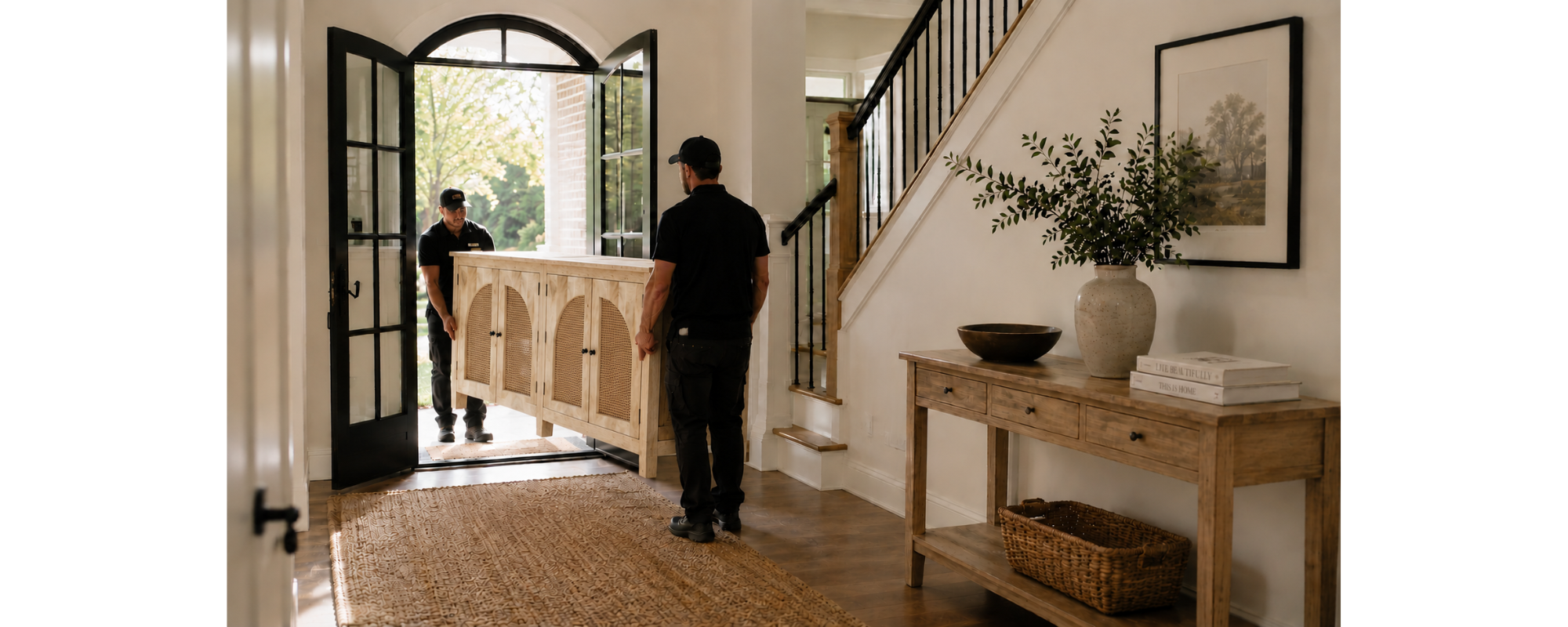
Before ordering large furniture, measure both the piece and the entire route it will take into your home. A 71-inch sideboard, for example, may be wider than a typical doorway but could potentially be maneuvered through at an angle. Whether it actually fits depends on the doorway, hallway, turns, staircase, landing, and the furniture's dimensions.
The doorway is only one part of the fit check. This guide shows you what to measure before delivery day, including the furniture itself, doorway, hallway, turns, staircase, landing space, and the appropriate diagonal measurement for the piece.

Quick answer: Measure the doorway's clear width and height, the width of any hallway or turn leading to the room, and the staircase width, height, and landing space if applicable. Then check the furniture's relevant dimensions and diagonal measurement against the available clearance, Some larger pieces may need to be tilted or rotated through a doorway rather than carried straight through. . If the relevant furniture measurement clears the doorway, the piece may be able to pass through at an angle, but you still need to confirm the hallway, turns, staircase, landing, and other clearance points along the delivery path.
Why This Matters
A furniture piece can look perfect online and still become a delivery problem if it cannot clear the route into your home. If a piece cannot clear the delivery path, resolving the problem can mean rescheduling delivery, arranging additional handling, or reconsidering the piece altogether. Once a solid wood piece is delivered, a measuring mistake can quickly become a moving problem rather than a simple ordering issue. A few minutes with a tape measure before you order can help prevent that outcome.
It also matters on delivery day itself. White-glove teams can maneuver furniture carefully and navigate challenging spaces, but they cannot create clearance where none exists. Knowing your measurements in advance means the delivery team can work from a confirmed path instead of discovering a clearance problem on your staircase landing.
How to Measure Doorways and Stairs, Step by Step
Measuring the Doorway
Measure the doorway's clear width - the actual usable opening with the door fully open, not the outer frame - at its narrowest point. Also measure the clear height from the floor to the lowest point of the doorway opening. Check for anything that reduces the usable space, including door stops, trim, molding, or a threshold. As an accessibility reference, the ADA National Network identifies 32 inches of clear width as a minimum for accessible doors, but residential doorways vary, so always measure your actual opening before ordering.
Measuring the Hallway and Turns
A wide doorway doesn't help if the hallway leading to it is narrow or turns sharply. Measure the hallway's width at its narrowest point and note any 90° turns or other tight corners. A piece that clears a straight hallway can still get stuck when it needs to rotate around a corner. For each turn, check the available space between the walls and account for any protruding trim, railings, or fixtures that could reduce the usable clearance.
Measuring the Staircase
For stairs, measure the clear width between handrails or walls, the vertical clearance from each tread to the ceiling or any overhead obstruction, and the available landing space at every turn. Spiral staircases, switchback stairs, and mid-flight landings can be particularly challenging because the furniture may need to be tilted and rotated while moving upward. A piece that clears a straight staircase can still fail at a tight landing or low-ceiling point.
Here's how the key measurements fit together along the delivery path:

The Diagonal Measurement Method
Furniture is often moved through a doorway by tilting or rotating it rather than carrying it straight through. The relevant measurement depends on the type and shape of the furniture and how it can be maneuvered. For some rectangular pieces, a diagonal measurement can be calculated using the Pythagorean theorem: √(width² + height²). However, this calculation is only a planning reference, not a guarantee that the piece will fit. You also need to compare the furniture's relevant dimensions with the doorway's clear width and height and confirm that there is enough space to tilt, rotate, and maneuver it through the hallway, turns, staircase, and landing.
A piece that is wider than the doorway may still fit when tilted, but a doorway diagonal alone does not guarantee that it will make it through the entire delivery path.
Example: Suppose a sideboard is 71 inches wide, 18 inches deep, and 39 inches high, while your doorway has a 30-inch clear width. You cannot simply compare the 71-inch width with the 30-inch doorway and conclude that it will not fit. The piece may be able to pass through at an angle. However, you must also check its depth and height, the doorway's clear height, and whether the hallway or nearby walls provide enough room to rotate it safely.
The doorway is only the first clearance point. Hallway turns, staircase landings, low ceilings, trim, and other tight spaces can determine whether a piece actually reaches the room.
Here's how to work through these measurements in order before you place an order:

Comparison Tables
Different furniture types require different measurements and maneuvering space, so there is no single doorway width that guarantees a piece will fit. Use the table below as a quick guide to the dimensions you should check, then compare the exact furniture specifications with the narrowest point along your delivery path.
|
Furniture Type |
Key Furniture Measurements |
Delivery Path Measurements to Check |
|
Width, depth, height |
Doorway and hallway width |
|
|
Dresser or chest of drawers |
Width, depth, height, diagonal height |
Doorway, hallway turns, and staircase |
|
Sideboard or buffet |
Width, depth, height |
Doorway, turns, staircase, and landing |
|
Bed headboard |
Width, height, diagonal |
Doorway, hallway, staircase, and landing |
|
Dining table |
Length, width, height/thickness |
Widest entry point, turns, hallway, and stairs |
For larger pieces such as solid wood dining tables, also check the longest dimension and the space available to rotate the piece around corners.
These are general planning guidelines rather than guaranteed clearance requirements. Always check the exact dimensions of the furniture and the available clearance at every point along the delivery route before ordering.
Here's the same information in a faster, saveable format:

Expert Advice: What Movers Check That Buyers Miss
Experienced delivery teams pay close attention to three areas buyers often overlook: ceiling height at stairway turns, because a low ceiling can limit how far a piece can be tilted; the actual door swing, because a nearby wall or obstruction may prevent the door from opening fully; and trim or molding around the doorway, which can reduce the usable clear width compared with the outer frame. Any one of these details can turn a piece that appears to fit on paper into one that is difficult or impossible to maneuver through the space.

Designer Tips
Designer Tip: For a room at the top of a switchback staircase, consider pieces with removable legs, a removable base, or other separable components rather than one-piece case goods. Ask the retailer whether the piece can be partially disassembled before ordering.
Worth Considering: If you're deciding between two similar pieces and one is a few inches narrower, that difference can be significant in a tricky stairwell. When delivery access is tight, the piece's dimensions and maneuverability may matter more than small differences in finish or price.
Did You Know? Depending on the furniture maker and the piece, custom sizing may be available to accommodate a tight doorway or staircase. If a piece is close to your available clearance, ask about narrower dimensions or other customization options before assuming it won't work for your space.
Common Mistakes
|
Mistake |
Reality |
|
Measuring only the doorway |
The hallway, turns, staircase, and landing can create additional clearance problems even when the doorway itself is wide enough. |
|
Measuring the door frame instead of the clear opening |
Door stops, trim, molding, and thresholds can reduce the actual usable clearance. |
|
Assuming it'll fit because it looked fine in the room online |
The delivery path matters just as much as the space where the furniture will ultimately sit. |
|
Ordering without checking the appropriate diagonal measurement |
Some pieces can be maneuvered at an angle, so width alone does not always determine whether they will fit. |
|
Skipping measurements because delivery is white-glove |
Delivery teams can maneuver furniture carefully, but they cannot overcome physical clearance limits. |
A tape measure costs far less than a delivery problem -and a few minutes of measuring can help prevent a piece from getting stuck before it reaches its intended room.
Buying Checklist

Frequently Asked Questions
Q1: How do I know if my furniture will fit through my door?
Measure the doorway's clear width and height, then compare those measurements with the furniture's overall dimensions and its appropriate diagonal measurement, such as diagonal depth or diagonal height depending on the piece. A piece that is wider than the doorway may still fit when tilted or rotated, but you also need to check the hallway, turns, staircase, landing, and any other tight points along the delivery path.
Q2: What is the diagonal measurement method?
The diagonal measurement method helps determine whether a piece can be tilted or rotated through an opening rather than carried straight through. The relevant furniture measurement depends on the type of piece-for example, diagonal depth may be important for some sofas, while diagonal height can be relevant for dressers or bookcases. Compare the appropriate furniture measurement with the doorway's clear dimensions, then confirm that the rest of the delivery path provides enough room to maneuver.
Q3: How wide should a doorway be for a sideboard or dresser?
There is no single doorway width that guarantees a sideboard or dresser will fit. The required clearance depends on the piece's width, depth, height, shape, and how it can be tilted or rotated. Measure the exact furniture dimensions and compare them with the narrowest doorway, hallway, turn, staircase, or landing along the delivery path before ordering.
Q4: What should I measure on a staircase before ordering furniture?
Measure the staircase's clear width between handrails or walls, the vertical clearance from the treads to the ceiling or other overhead obstructions, and the available landing space at every turn. Also check for banisters, low ceilings, railings, or other features that could restrict how the furniture can be tilted or rotated.
Q5: Can furniture be custom-built to fit a tight doorway or staircase?
Depending on the furniture maker and the piece, custom sizing or other modifications may be available for challenging delivery spaces. If a piece is close to your tightest measurement, ask before ordering whether a narrower version, removable components, or another modification is possible.
Q6: Does white-glove delivery guarantee my furniture will fit?
No. White-glove delivery provides professional handling and careful maneuvering, but it cannot overcome physical clearance limits. The buyer should still confirm the dimensions of the furniture and the entire delivery path-including doorways, hallways, turns, stairs, landings, and elevators where applicable-before delivery.
Final Summary
Before ordering furniture, measure both the piece and the entire route it needs to travel. Check the doorway, hallway, turns, staircase, landing, and elevator where applicable, then compare those measurements with the furniture's exact dimensions and the way the piece can be maneuvered. A doorway that looks wide enough on its own may still leave too little room to turn, tilt, or rotate the piece farther inside.
The best delivery path is the one you've measured before the furniture arrives.
Ready to Order With Confidence?
If you're ordering a larger piece-such as a sideboard, bed frame, or dining table-and you're unsure whether it will clear a tight spot in your home, contact our team before ordering. Sharing your measurements can help identify any dimensions or clearance points worth double-checking before delivery. If a piece is close to your available space, you can also ask about custom sizing options.
Reach out through our contact page, or explore custom sizing if you need a piece adapted to your space.



Share:
Hand-Carved vs. CNC-Carved Furniture: The Honest Difference
Will a Solid Wood Bed Frame Work With an Adjustable Base?