
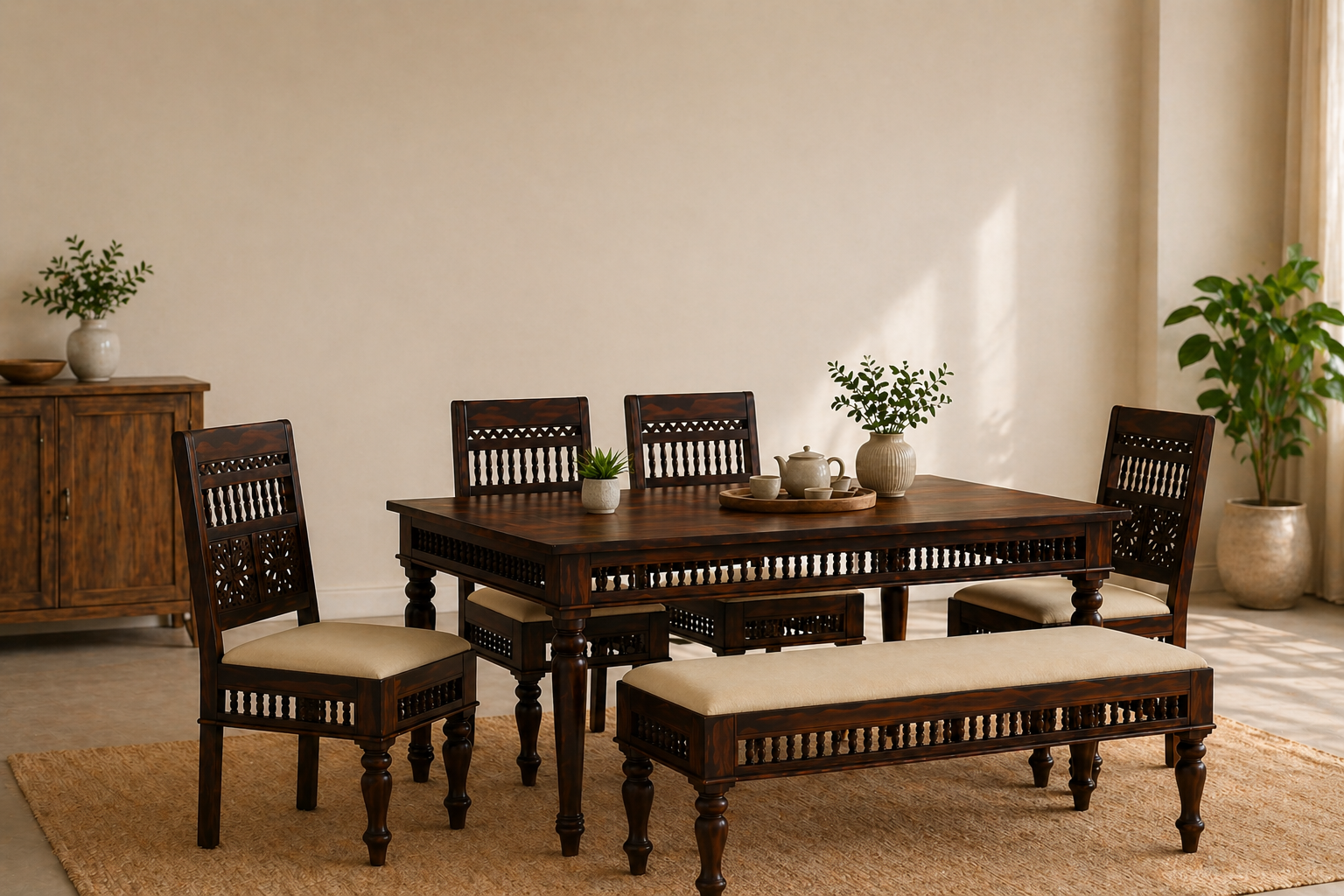
You’re standing in a furniture showroom. Two dining tables sit side by side, looking almost identical . Same wood tone, same dimensions, same price. You tap the surface of both - both feel solid. You run your hand along the edge - both feel smooth.
So how do you know which one will still look the same in fifteen years - and which one will start loosening, wobbling, and showing signs of weakness within three?
The answer is hidden in plain sight. sight. It exists at every point where two pieces of wood meet. It is in the corner of the drawer. In the base of the leg. In the underside of the tabletop - where nobody ever looks in a showroom.
It is called joinery - the single most reliable indicator of how long a piece of furniture will actually last
This guide will teach you exactly what joinery is and why it matters more than the finish, the price tag, or even the wood species. It will also show you how to identify quality joinery - whether you are in a showroom, shopping online, or examining a piece already in your home.
Once you understand joinery, you will never look at furniture the same way again.
Whether you are shopping for a dining table, a sideboard, a bed frame, or a coffee table - joinery is the first thing you should understand - and the last thing most buyers think to check.
"Beautiful furniture is built twice - once in the wood, and once in the joints. Get the joints wrong, and nothing else matters."
What Is Joinery?
Joinery refers to the methods used to connect individual pieces of wood to form a complete piece of furniture. Every piece of furniture is made up of multiple components - legs, rails, tabletops, drawer sides, cabinet frames, and headboard panels. These components need to be securely held together. The way these components are connected - the joinery - determines the structural integrity of the entire piece .
Think of joinery as the skeleton of the furniture. You cannot see it. when the piece is finished and sitting in your living room. But it is entirely responsible for whether the piece withstands daily use for five years - or fifty
Poor joinery relies on staples, nails, and hot glue - fast, cheap, and structurally weak . Quality joinery uses interlocking wood-to-wood connections that have been trusted by furniture makers for thousands of years - because nothing has ever matched them for sheer mechanical strength and longevity
The 5 Types of Joinery - From Worst to Best
1. Staples and Nails - Avoid
Staples and nails are the weakest form of furniture joinery . They are used because they are fast and require minimal skill to apply . A pneumatic nail gun can join two pieces of wood in under a second.
staples and nails hold wood together mechanically - by penetrating the surface - rather than interlocking with it . Over time, as wood expands and contracts with humidity and temperature changes, these fasteners work loose. The joint eventually fails - drawers begin to wobble, legs shift, and the frame starts to separate.
Any furniture that relies primarily on staples or nails for its structural joints is built to be replaced, not kept.
How to identify it: Check the corners of drawers and the undersides of shelves. If you see staple heads or exposed nail heads at any structural joint - that piece was built for speed, not quality.
2. Cam Lock and Dowel - Mass Production Standard
Cam locks and dowels are the standard joinery used in flat-pack, mass-produced furniture . Dowels are small cylindrical wooden pegs that fit into pre-drilled holes in both pieces, held in place with adhesive. Cam locks are metal fittings that bolt pieces together.
This joinery is far better than nails and staples - it is precise, consistent, and when done well, reasonably strong. It works adequately for furniture that sees moderate use in low-stress applications.
The main weakness is that it depends heavily on adhesive strength and the precision of the drilled holes. If either fails - and over time, under regular use, they often do - the joint typically cannot be repaired. The piece must be replaced.
How to identify it: Flat-pack furniture almost always uses this system. Look for small round plastic plugs covering bolt holes on the sides and backs of pieces. These cover the cam lock fittings. Perfectly uniform joinery with no visible grain connection between the pieces is another indicator.
3. Biscuit Joinery - Better, But Still Limited
Biscuit joinery uses small, compressed wooden ovals (biscuits) inserted into matching slots cut into both pieces of wood, then glued in place. The biscuits swell when the glue is applied, creating a tight, aligned joint.
This is a legitimate joinery method used in quality furniture production. It creates good alignment and reasonable strength for panels and tabletops. However, it is not strong enough for primary structural joints - such as legs, rails, and frames - that bear the real load of a piece under daily use
How to identify it: You generally cannot see biscuit joinery in a finished piece - it is entirely internal. It is typically used in tabletops and panel furniture rather than leg-to-rail connections.
4. Mortise-and-Tenon - The Gold Standard
The mortise-and-tenon joint is thousands of years old. It has been used in ancient Egyptian furniture, Chinese timber framing, and medieval European cathedrals. It is still used by skilled furniture makers today - because nothing has ever been invented that matches it for structural integrity in solid wood furniture.
The joint works like this: a tenon - a shaped projection cut into the end of one piece - fits precisely into a mortise, a corresponding cavity in the receiving piece. The two pieces interlock. When secured with adhesive and, in the best examples, a wooden peg, the joint becomes a single structural unit. A well-cut mortise-and-tenon joint doesn’t just hold over time - it actually becomes stronger . As the wood settles and the adhesive fully cures, the connection becomes tighter. A dining table built with mortise-and-tenon leg-to-rail joints, maintained correctly, will be structurally sound in 50 years.
This is the joinery Oak & Loom uses across all primary structural connections in our furniture.
How to identify it: In a showroom, you can sometimes see the end of the tenon on the outside face of a leg - a small rectangular mark where the joint was cut. A craftsman who uses mortise-and-tenon joinery is proud of it - ask directly. Any quality brand will tell you immediately.
5. Dovetail Joinery - The Mark of Master Craftsmanship
Dovetail joinery is the most recognized and admired joint in furniture making. Its distinctive interlocking fan-shaped tails and pins are a visual signature of handcraft - and for good reason. A properly cut dovetail joint is mechanically self-locking by design. . It cannot be pulled apart in the direction of the greatest stress.
Dovetail joints are primarily used in drawers - the corner connections where the drawer sides meet the drawer front and back. In a quality drawer, the dovetails are cut by hand or with precision machinery, fitted tightly, and glued. The result is a drawer that withstands years of daily opening, closing, and loading without the joint failing.
When you see exposed dovetail joints on a drawer front - whether hand-cut with slight irregularities or machine-cut with perfect uniformity -you’re looking at a piece that was built to last.
How to identify it: Pull a drawer out fully and look at the corners where the sides meet the front and back. If you see the characteristic fan-shaped interlocking pattern - you are holding quality furniture. If you see a flat flush joint, a stapled corner, or just glue - you are not. 
How to Check Joinery When Shopping - A Practical Guide
Here is your step-by-step joinery inspection checklist for any piece of furniture you are considering:
Step 1 - Lift a Corner
Slightly lift one corner of the piece and let it settle back. A piece with quality joinery will feel completely rigid - no flex, no sound, no movement. A piece with weak joinery will flex slightly or make a subtle creaking sound This is one of the quickest ways to identify structural weakness before making a purchase
Step 2 - Pull the Drawers Out Fully
Remove any drawers completely, if possible . Look at all four corners of the drawer box - both the front-to-side joints and the back-to-side joints. Quality joinery means dovetail joints, or at minimum, box joints . Flat glued joints or visible staples mean the drawer will fail with regular use.
Step 3 - Examine the Leg-to-Rail Connection
On tables and chairs, the most structurally stressed joint is where the legs meet the horizontal rails - the frame that connects the legs . Run your finger along this joint. A quality mortise-and-tenon joint will be tight - no visible gap, no flex when you push the rail sideways. A poor joint will show a slight gap or flex under hand pressure.
Step 4 - Check the Back Panel
Turn the piece around. On quality furniture, the back panel is solid wood or thick plywood, attached securely. On cheaper furniture, the back panel is often thin hardboard stapled into a groove . Push lightly on the back panel - if it flexes noticeably, the structural integrity of the entire piece is compromised.
Step 5 - Ask the Brand Directly
This is the most reliable check of all. Ask: “What joinery methods do you use for the structural connections in this piece? " A brand that builds with quality joinery will answer immediately and with specificity - naming the exact methods used, such as mortise-and-tenon and dovetail, and where they are applied.
A brand that deflects, changes the subject to aesthetics, or gives a vague answer like "strong construction "is telling you everything you need to know about the quality of the piece.
Why Joinery Matters More Than the Finish or the Price Tag
Most buyers evaluate furniture by what they can immediately see and feel - the surface finish, the color, the overall aesthetic. These things matter - but they do not determine how long a piece of furniture will last.
A beautifully finished piece with poor joinery will begin to reveal its structural weaknesses within just a few years. Drawers begin to wobble. Table legs develop a slight lean. The frame starts to creak under weight. No surface finish, however beautiful, can compensate for a failing joint beneath it
Conversely, a piece with exceptional joinery - properly cut mortise-and-tenon connections and hand-fitted dovetail drawers - will outlast the finish, outlast the trends, and often outlast the home it was bought for. The finish can be refreshed, and the wood can be sanded . But the joints, if done right, never need attention. They simply hold - year after year.
This is why the best furniture makers have always taken pride in their joinery. It is the most honest part of what they make - the part that cannot be hidden by paint or photography, and cannot be faked by even the most convincing showroom display. 
What Oak & Loom Uses - And Why
At Oak & Loom, joinery is not a detail we add at the end - it is the foundation on which every piece is designed.
Every structural connection in our furniture uses mortise-and-tenon joinery - from the legs-to-rails on every table and bed frame to the internal frames inside every cabinet and sideboard. Where adhesive is used, it is food-grade and applied with precision - never sprayed on assembly lines.
Every drawer in our collection is built with dovetail corner joinery - hand-fitted, tightly joined, and designed to withstand years of daily use without loosening
We do not use these methods because they are faster - they are not. We use them because that justify the claim that a piece of furniture is truly built to last a lifetime.
You can verify this yourself. Pull out any Oak & Loom drawer and look at the corners. Ask our team about the joinery on any specific piece. We will answer without hesitation - because the quality speaks for itself.
Explore Oak & Loom’s full collection of dining room furniture, living room furniture, and bedroom furniture - every piece built to the same joinery standards, without exception.
Joinery and Sustainability - The Connection Nobody Talks About
There is an environmental dimension to joinery that is rarely discussed.
Furniture built with quality joinery can last 20, 30, even 50 years Furniture built with staples and nails typically lasts just 3 to 7 years . Over a lifetime of homeownership, a family that invests in quality joinery replaces furniture once or twice . A family that buys cheaply made furniture cycles through five to ten pieces of the same item — generating five to ten times the manufacturing waste, transport emissions, and landfill impact
Quality joinery is not just a standard of craftsmanship - it is a commitment to sustainability
At Oak & Loom, our furniture is built from responsibly sourced solid wood and joined with methods that ensure every piece lasts long enough to genuinely justify the tree it came from. For more on our sustainability approach, browse our sideboards collection and dining sets - built for the long term, in every sense.
Conclusion
Joinery is the part of furniture that most buyers never think to look at - or even consider. . It It is hidden inside drawers, buried in leg connections, and invisible beneath the surface . Furniture brands that build poorly count on this - because if buyers looked at the joinery, the game would be over for cheaply made furniture almost immediately .
Now you know exactly what to look for .
The next time you stand in front of a piece of furniture - whether in a showroom or on a website - ask the right questions. Pull the drawer out. Look at the corners. Ask about the leg-to-rail connections. Ask specifically: is it mortise-and-tenon, dovetail, or simply nails and staples?
The answer will tell you everything you need to know about whether that piece deserves a place in your home. Beautiful furniture begins with beautiful joinery. At Oak & Loom, we build every structural connection - every leg, every rail, every drawer - with the same joinery methods that have kept furniture standing for centuries . Not because it is fashionable - but because it is right
"Great furniture is not built from great wood alone. It is built from great decisions - about how that wood is cut, shaped, and joined. The joinery is where the commitment shows."
→ Explore Oak & Loom's full solid wood collection: oakandloom.com/collections/all
→ Have a question about any piece? Talk to our team.
Frequently Asked Questions
What is the strongest type of joinery in furniture?
The mortise-and-tenon joint is widely considered the strongest structural joinery for solid wood furniture. It has been used for thousands of years - in ancient Egyptian furniture, traditional Chinese construction, and European cabinetmaking - because it creates a mechanically interlocking connection that becomes stronger over time as the wood settles. For drawers specifically, the dovetail joint is the gold standard - self-locking in the direction of greatest stress and capable of lasting decades of daily use. At Oak & Loom, both methods are used throughout our dining tables, sideboards, and bed frames.
How can I check joinery quality when buying furniture online?
Ask the brand directly - this is the most reliable method. Contact the brand and ask: What joinery methods are used for the structural connections in this piece? A quality brand will answer specifically and confidently. A brand that gives vague answers like "solid construction" or "sturdy build" is avoiding the question for a reason. You can also read product descriptions carefully - quality brands mention joinery methods explicitly. At Oak & Loom, you can contact our team with any specific joinery question about any piece we make.
Can poor joinery be repaired?
It depends on the method. Loose dowel joints and failed adhesive connections can sometimes be re-glued if caught early. However, staple and nail joinery that has failed structurally is often very difficult to repair properly - the holes weaken the wood around them and the fasteners cannot be re-tensioned. Quality joinery - mortise-and-tenon and dovetail - rarely needs repair at all when properly made. If it does loosen over decades of use, a skilled craftsman can re-glue the joint and restore it completely. This repairability is another reason why quality joinery is a long-term investment. For guidance on caring for solid wood furniture, read our blog on how to protect a wooden dining table.
Does joinery quality matter for all types of furniture equally?
Joinery matters most for furniture that bears regular structural loads - dining tables, bed frames, chairs, and sideboards. These pieces experience daily stress - weight, movement, vibration - and weak joinery fails faster under these conditions. It matters slightly less for purely decorative pieces or items with minimal load-bearing requirements. However, as a general principle - if the piece is meant to last and be used regularly, quality joinery is non-negotiable regardless of the furniture category.
Is handmade joinery always better than machine-cut joinery?
Not necessarily. The quality of joinery depends on the precision and care applied - not solely on whether it was cut by hand or machine. A machine-cut mortise-and-tenon joint made to precise tolerances in a quality workshop is excellent joinery. A hand-cut dovetail made by a skilled craftsman is also excellent joinery. What matters is the method chosen, the precision of the fit, and the quality of the adhesive used. What is always inferior is joinery that prioritizes speed over strength - staples, random nails, and hot glue applied carelessly - regardless of whether a human or machine applied them.
How does joinery relate to the overall value of furniture?
Joinery is the single most honest indicator of furniture value. A piece can be visually beautiful, expensively finished, and sold at a high price - but if the joinery is poor, the value is not there. Conversely, a piece with exceptional joinery - even in a simpler design - will deliver genuine long-term value because it will still be standing - and still be beautiful - in twenty years When evaluating any furniture purchase, the joinery is where you find out whether the price reflects real craft or just marketing. At Oak & Loom, every piece in our full collection is built with the same joinery standard - because we believe value should exist in the furniture itself - not just in the price tag.

Share:
How to Mix Furniture Styles Without Clutter: 5 Rules Designers Never Reveal
California King vs. King Size Bed: Which Should You Buy?