
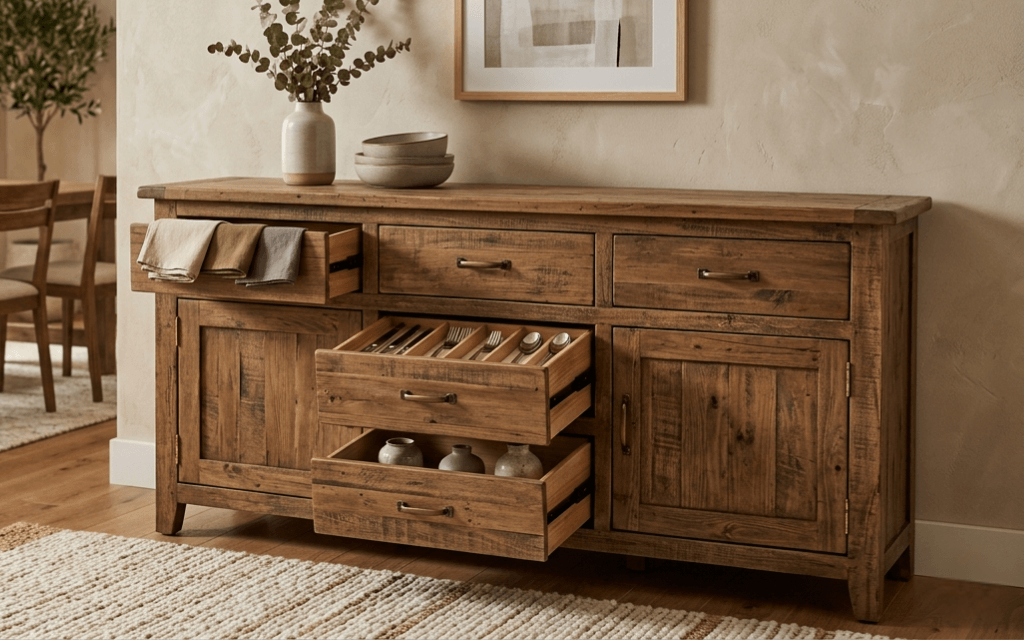
There's a specific kind of frustration that sets in once you've finally arranged your dining room just right — the right table, the right chairs, a rug you actually love — and then the sideboard you bought for storage quietly becomes the most chaotic surface in the house. Stacked placemats, half-burned candles, charging cables, a bottle of wine from two Christmases ago. The piece that was supposed to ground the room has turned into a landing strip for everything without a home.
The problem usually isn't the space. It's the furniture. Most sideboards look the part but don't actually work — a shelf behind a door, maybe a couple of shallow cubbies, and a flat top that invites clutter rather than resolving it. What you actually need is a rustic sideboard with drawers: a piece that combines the warm, handcrafted character of genuine solid wood with a genuinely useful drawer configuration that keeps everything categorized, concealed, and within reach.
This guide is designed to help you buy one confidently. We'll cover what separates a true rustic sideboard with drawers from a buffet, console, or cabinet — then go deep on the construction features that actually matter, the rooms where these pieces work best, and our curated picks from the Oak & Loom collection that balance craftsmanship with real, everyday practicality.
Related Guides from Oak & Loom
- Browse the Full Solid Wood Rustic Sideboards Collection →
- How to Choose the Right Wooden Sideboard for Your Home →
- How to Style a Wooden Sideboard →
- Top 5 Mistakes to Avoid When Buying a Sideboard →
What Is a Rustic Sideboard with Drawers?
A rustic sideboard with drawers is a low-profile, freestanding storage cabinet — typically 30 to 36 inches tall and anywhere from 48 to 72 inches wide — defined by two characteristics: a natural, wood-forward aesthetic that celebrates grain, texture, and handcraft, and a storage configuration built around functional drawer banks rather than relying solely on open shelving or cabinet doors alone.
The word "rustic" does real descriptive work here. It's not a vague design trend — it refers to specific material choices and finishing decisions: visible wood grain that hasn't been sanded into anonymity, matte or oil-rubbed finishes that let the wood breathe, hand-forged or blackened iron hardware, and construction methods that treat natural variation as an asset rather than a flaw to be corrected. A rustic sideboard looks like it was made by someone who understood the wood they were working with.
It's worth drawing clear lines between similar pieces, because the terminology gets muddied in product listings and showrooms alike:
Rustic Sideboard vs. Rustic Buffet with Drawers:
These terms are used almost interchangeably, and functionally the pieces are very similar. Historically, a buffet was taller and designed specifically for dining room service — laying out food, stacking plates, storing serving pieces. A sideboard tends to be shorter and more versatile in placement. In practice, if a piece has a horizontal silhouette, drawers, and enclosed cabinet storage, it works equally well as either. Many buyers searching for a rustic buffet with drawers end up purchasing what's technically a sideboard, and vice versa — the functional overlap is nearly complete.
Rustic Sideboard vs. Rustic Wood Cabinet with Drawers:
A standalone cabinet with drawers is typically a vertical piece — taller than it is wide, designed for bedroom or office storage against a single wall. A sideboard is horizontal and lower, meant to sit beneath window height and run along the longer walls of a room. A rustic wood cabinet with drawers serves different spatial functions even when the joinery and materials are identical.
Rustic Sideboard vs. Console Table:
Console tables are built for display, not storage. They're narrow, open-legged, and shallow — beautiful in an entryway for aesthetics, but not a serious storage solution. A sideboard delivers fully enclosed storage with real capacity and depth.
"The best rustic sideboards don't look like furniture designed to store things. They look like furniture built to last — that happens to store things beautifully."
— Oak & Loom Design Notes
Why Choose a Sideboard with Drawers? The Practical Case
Most people don't think carefully enough about drawers when furniture shopping. They look at the overall silhouette, the finish, whether it fits the room dimensionally — then assume storage is storage. It isn't.
Open shelving is beautiful in a showroom and difficult in daily life. Everything visible becomes part of your room's visual composition, which means everyday clutter — mail, remote controls, linens, candles, charging cables — has nowhere to go without becoming visual noise. Cabinet doors solve the visibility problem but create an access problem: when every storage space requires opening a door and rummaging through a pile, the path of least resistance is to leave things on top of the sideboard instead.
Drawers occupy a different category entirely. They conceal completely, they categorize naturally, and they offer near-instant access. As a sideboard storage solution, a well-configured drawer bank lets you assign a specific purpose to each compartment — linens in one, silverware in another, table accessories in a third — and maintain that organization effortlessly over time because the system itself makes order easy.
|
🗂️Categorized Storage |
🚪Complete Concealment Drawers close fully. Whatever you store — daily clutter, overflow items, seasonal accessories — disappears completely, keeping the room feeling intentional. |
🔄Multi-Room Versatility Good drawer depth works in the dining room, living room, entryway, or bedroom. The piece adapts to your needs rather than dictating them. |
🪵Curated Display Surface The top of a solid wood sideboard becomes a natural display space — lamps, art, plants, seasonal decor — elevated by the character of the piece beneath it. |
Beyond the practical, there's a spatial argument. A rustic sideboard with drawers contributes architecturally to a room. It grounds a wall, adds horizontal visual weight at a comfortable height, and creates the kind of anchor that makes a room feel composed rather than assembled. It earns its floor space in a way that most storage furniture doesn't.
Key Features to Look For in a Rustic Sideboard with Drawers
This is where most furniture purchases go wrong — not in choosing the wrong style, but in missing the construction and configuration details that determine whether a piece actually works in daily life. Here's what to examine before you commit.
Drawer Configuration & Depth
Drawer count is obvious — drawer depth is where buyers get surprised after delivery. Shallow drawers under four inches are primarily decorative, useful only for flatware or small objects. For a sideboard you plan to use seriously, look for an interior drawer depth of at least five to seven inches. Eight or more handles folded linens, wine accessories, and bulkier household overflow without compression or stacking.
Beyond depth, look for full-extension drawer slides — these allow you to pull a drawer completely out of its housing for full access to the back, which matters more than it sounds when you're reaching for something in a hurry. In quality solid wood sideboard drawers, you should also find dovetail joinery at the corners: the interlocking finger-joint construction that keeps drawer boxes square and strong through decades of daily use. It's one of the clearest signals that a piece was built to last rather than built to photograph well.
Combination of Drawers + Cabinets
The most versatile pieces — in our collection and across the market — are those that combine a dedicated drawer bank with enclosed cabinet storage. A well-designed sideboard with drawers and cabinets addresses two fundamentally different storage needs in a single piece: drawers handle categorized, frequently accessed items, while cabinet space absorbs larger, bulkier contents you access less often — serving bowls, wine bottles, board games, overflow textiles.
When evaluating this combination, pay close attention to the cabinet interior. Adjustable shelving is meaningfully better than fixed shelving — it adapts to what you actually store rather than what the manufacturer assumed you'd store. Soft-close hinges on cabinet doors are the detail that separates a piece that feels premium from one that merely looks it on a screen.
Material Quality: Solid Wood vs. Engineered
This is the most consequential decision in furniture buying, and the one most often obscured by vague product language. A wood sideboard with storage drawers described as "solid wood construction" should mean the carcass, drawer boxes, and fronts are made from genuine hardwood or softwood lumber — not particleboard or MDF wrapped in wood veneer, which is what "wood construction" often means in lower-price segments.
For rustic furniture, oak, pine, acacia, and reclaimed fir are the most appropriate choices. Oak is dense and durable with a pronounced grain that takes distressing and oil finishes beautifully. Pine is lighter and softer, with natural knotting and grain variation that leans organically into the rustic aesthetic. Reclaimed wood carries genuine history — nail holes, weathered color, inconsistent texture — that no manufacturing process can authentically replicate. Each develops a patina over time that makes the piece look better at ten years than it did at one.
Engineered wood products aren't unsuitable for all furniture applications, but they're not appropriate for drawer boxes in high-use pieces. MDF and particleboard are vulnerable to moisture swelling, and drawer boxes built from them will warp and eventually fail in humid environments. Solid wood drawer boxes — especially those with proper joinery — will outlast the rest of the piece.
Finish & Rustic Detailing
The finish is where a rustic sideboard's character lives. Wire-brushing opens the grain and creates tactile texture you can actually feel. Hand-applied oil or wax finishes penetrate the wood rather than sitting on top of it, which means they won't chip or peel — they simply deepen with age. Authentic hand-distressing creates worn corners and softened edges that suggest lived-in longevity rather than factory production.
What to avoid: high-gloss lacquer finishes on pieces marketed as rustic — they flatten the wood's natural character and work against the aesthetic entirely. Also watch for overly uniform color across the surface, which typically indicates veneer over engineered wood rather than genuine solid lumber with its natural variation.
Hardware & Long-Term Durability
Hardware is an underrated quality signal. On a well-made rustic sideboard, drawer pulls and cabinet knobs are typically hand-forged iron, cast brass, or blackened steel — materials with their own slight variation, weight, and honest character. They're fastened with machine screws into solid wood, not press-fit into particleboard. The difference in tactile quality when you open a drawer is immediate, and it stays immediate for decades.
Check weight ratings if provided. A solid wood carcass with properly joined rear panels and a solid wood back (rather than thin hardboard) is built to hold real weight — full sets of dinnerware, heavy serving pieces, stacked linens — without racking or shifting over time.
Best Places to Use a Rustic Sideboard with Drawers
One of the genuine advantages of a well-made rustic sideboard with drawers is its adaptability across rooms. Unlike a bookcase or media unit — both of which are built around a specific function — a sideboard's low profile and neutral utility make it at home in almost any space in the house.
|
🍽️Dining Room |
🛋️Living Room Use it as a media-adjacent storage piece or standalone accent. Drawers handle remotes, batteries, and accessories invisibly while the top displays art or plants. |
🚪Entryway Anchors an entry without the bulk of a wardrobe. Drawers manage keys, mail, gloves, and daily essentials — and a mirror above completes the vignette. |
🛏️Bedroom An elegant alternative to a traditional dresser where vertical height is limited. Deep drawers handle folded clothing and bedroom overflow neatly and quietly. |
Our Best Rustic Sideboards with Drawers from Oak & Loom
Every sideboard in our collection is built from 100% solid wood — no MDF carcasses, no veneer-wrapped particleboard, no shortcuts on joinery. Below are four pieces we'd specifically recommend for buyers prioritizing drawer storage, rustic character, and long-term craftsmanship. All currently ship free with a 10% discount already applied.
1. Orvencia Solid Rustic Wood Sideboard
$2,600.00 $2,340.00 (Save 10%)

- 100% solid wood construction — carcass, drawer fronts, and cabinet doors
- Combination of drawers and enclosed cabinet storage for layered organization
- Warm brown finish with visible grain — subtle variation in every piece
- Low-profile design suits dining rooms, living rooms, and entryways equally well
- Wide enough to function as a true rustic buffet with drawers for entertaining
Buy Orvencia Solid Rustic Wood Sideboard
2. Evorence Traditional Solid Wood Sideboard
$2,400.00 $2,160.00 (Save 10%)

For buyers who want the warmth of a traditional design without anything too ornate or trend-dependent, the Evorence lands in exactly the right register. Classically proportioned and built on genuinely solid wood throughout, it's the kind of piece that looks more considered over time rather than less. The traditional detailing makes it equally comfortable in a craftsman home, a farmhouse interior, or a transitional space that mixes old and new elements.
- Traditional proportions with clean, unfussy detailing — timeless rather than seasonal
- Solid wood throughout; no engineered components in load-bearing or drawer areas
- Generous drawer storage alongside enclosed cabinet sections for complete organization
- Finish that develops a natural patina over time — one of the best investments in the range
- Works as a long-term anchor piece for dining rooms or living spaces
Buy Evorence Traditional Solid Wood Sideboard
3. Mirevana Two-Tone Solid Wood Sideboard
$2,700.00 $2,430.00 (Save 10%)

The Mirevana is for the buyer who wants natural wood warmth without committing fully to a country or traditional look. The two-tone solid wood construction — contrasting lighter and darker wood tones across the same piece — gives it a contemporary edge that pairs beautifully with modern-organic, Scandinavian-influenced, or transitional interiors. As a wood sideboard with storage drawers, the configuration is thoughtfully proportioned: drawer depth and cabinet volume are balanced in a way that reflects how people actually use these pieces day-to-day.
- Two-tone solid wood construction — a genuinely distinctive look in this category
- Balanced drawer and cabinet layout designed around realistic daily storage habits
- Suits modern-organic, Scandi, and transitional interiors alongside rustic settings
- The tonal contrast is in the wood itself — not a painted or stained-over effect
- Strong choice for open-plan spaces where the piece is seen from multiple angles
Buy Mirevana Two-Tone Solid Wood Sideboard
Explore our compelte collection of rustic sideboards
How to Choose the Right Rustic Sideboard with Drawers
Before you finalize a choice, run through these five decision areas. They take under ten minutes and dramatically reduce the chance of a piece that looks right on screen but disappoints once it arrives.
| Decision Area | What to Consider | Practical Guidance |
| Size & Scale | Wall length, ceiling height, room proportions | A sideboard should span 50–75% of its wall. Leave 24–30 inches of clearance in front for comfortable daily access. Standard height (32–36") sits below most windows. |
| Storage Needs | What you're storing and how frequently you access it | Daily-access items (silverware, linens) → prioritize drawer depth and count. Bulk or seasonal items → prioritize cabinet volume. Write an actual list before browsing. |
| Interior Style Match | Existing furniture finishes, floor color, wall tone | Warm brown and honey tones work with most wood floors. Driftwood-gray finishes suit coastal and Scandi spaces. Two-tone pieces bridge rustic and modern without compromising either. |
| Wood & Construction | Solid vs. engineered, joinery quality, finish durability | Always confirm a solid wood carcass and solid wood drawer boxes. Ask about joinery — dovetail drawer corners and mortise-and-tenon frames are signs of genuine craft construction. |
| Long-Term Budget | Price vs. expected lifespan | A solid wood rustic sideboard with drawers bought once at $2,000–$2,500 typically outlasts two or three lower-priced replacements. Consider cost-per-year, not sticker price. |
A Note on Sizing
The most common sizing mistake is buying a piece that's technically within the room's footprint but visually undersized for its wall. As a working rule: for an 8-foot wall, you want a sideboard that's at least 5 feet wide. A 4-foot piece on an 8-foot wall looks like it's cowering. In smaller spaces — an entryway or a bedroom — a narrower piece (48 inches) with strong drawer depth delivers meaningful storage without overwhelming the room proportions.
For more detailed guidance and room-specific recommendations, our complete guide on how to choose a sideboard covers measurement, placement, and styling in depth.
Final Thoughts
A well-chosen rustic sideboard with drawers is one of the highest-value furniture investments you can make for a home. It organizes a room practically, anchors it visually, and — when it's built from genuine solid wood — grows more beautiful over time rather than less. That last part matters more than it sounds: furniture that ages gracefully means you stop shopping, stop replacing, and start actually living with pieces you're glad you bought.
The difference between a piece that delivers on that promise and one that doesn't usually comes down to three things: real solid wood construction, drawers designed by someone who thought about how people actually use them, and a finish that works with the wood's character rather than over it. Every piece in the Oak & Loom sideboard collection is built to meet those criteria — no particleboard cores, no veneer shortcuts, no finishes that age badly.
If you're still in research mode, our How to Choose a Sideboard That Matches Your Living Room Decor covers construction details in depth, and our Best Rustic Sideboards roundup narrows the field if you're ready for a more curated shortlist. When you're ready to shop, the full collection is waiting.
Oak & Loom · 100% Solid Wood · Handcrafted
Ready to Find Yours?
Browse our full collection of solid wood sideboards — built to order, shipped free, and backed by our craftsmanship commitment.
Share:
Wooden TV Stand Buying Guide: How to Choose the Right Size, Style & Storage (2026)
Solid Wood Sideboard: How to Choose the Right One for Your Home