
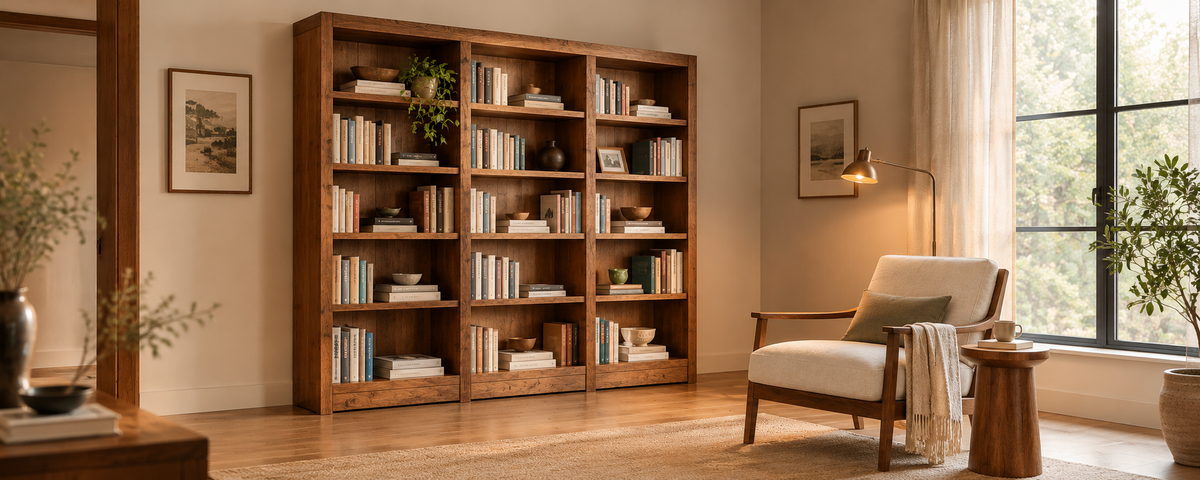
Most people furnishing a home library start and end with one decision: which bookcase looks good. But a library that protects your books - and stays comfortable to spend time in - depends on several choices working together: shelf depth, light exposure, humidity, seating placement, and how the room is lit for reading. Overlooking these details can lead to faded spines, poorly fitted books, or a beautiful room that nobody uses.
This guide walks through what actually matters when furnishing a home library, beyond the bookcase itself.
Quick Answer
A well-furnished home library needs shelving sized to your actual books. As a practical starting point, shelves around 10–12 inches deep suit many standard hardcovers, while 8–10 inches can work for many paperbacks. Oversized books may need deeper or dedicated storage. Position shelving away from prolonged direct sunlight and, where possible, areas prone to significant temperature or humidity fluctuations. Pair it with a reading chair and dedicated task lighting rather than relying on overhead light alone. Adjustable shelving can also accommodate a mixed collection more easily than fixed-height shelving.

Why This Matters
Books are more sensitive to their environment than most furniture buyers realize. Prolonged exposure to light can fade covers and spines and contribute to deterioration over time. Excessive humidity and unstable environmental conditions can contribute to paper distortion, mold growth, and deterioration. A bookcase placed in an unsuitable location, or a reading chair positioned under harsh overhead light, can reduce the comfort and functionality of an otherwise well-planned library. Getting the layout right from the start can help protect your collection and avoid unnecessary rearranging later.
The Key Question
Before choosing a shelving style or color palette, it helps to answer one question honestly: is this room primarily for display, for reading, or for both? A display-focused library can prioritize open shelving and glass-front cabinets that showcase the collection. A reading-focused space needs to prioritize seating, task lighting, and easy access over visual symmetry. Many home libraries need to support both functions - but identifying the primary purpose early can prevent furnishing decisions from working against each other later.
What Actually Matters
Shelf Depth and Spacing for Your Actual Books
Bookcases are often sized around what looks proportional in a showroom, not around the books people actually own. Many standard hardcover fiction and non-fiction books fit shelves around 10–12 inches deep, while many mass-market paperbacks can fit comfortably on shelves around 8–10 inches deep. Oversized art books, atlases, and reference volumes may exceed 12 inches and need either a dedicated deeper shelf or horizontal storage space.
Fixed-height shelving locks you into whatever spacing the manufacturer chose. Adjustable shelves - like those on Oak & Loom's Mirevana Modern Solid Wood Bookcase - let you reconfigure spacing as your collection changes, which becomes especially useful as the range of book sizes grows.
Quick Tip: Measure your five tallest books before buying a bookcase, rather than relying on the size of your average book. One oversized volume can make a fixed shelf impractical if there isn't enough vertical clearance.
Protecting Books from Light Exposure
According to the Library of Congress, books should have minimal exposure to all kinds of light and ideally no exposure to direct or intense light. Prolonged exposure can fade covers and spines and contribute to deterioration over time. This is one of the most commonly overlooked factors in home library placement: a bookcase positioned in a sunlit corner because it looks attractive can expose the collection to unnecessary light over time.
Closed cabinetry or glass-front display cases, like Oak & Loom's Wimberly Tall Glass Door Display Cabinet, can reduce dust exposure, but their ability to reduce UV exposure depends on the type of glass used. If sun exposure is unavoidable, check whether the glazing provides UV protection. Where possible, position shelving away from direct or intense light, and use curtains, blinds, or window shades to reduce exposure from nearby windows.
Climate Stability Matters More Than People Expect
The Library of Congress recommends a cool environment - 70°F or below - with relative humidity between 30% and 55% for most books, while also advising against frequent or extreme temperature and humidity swings. Basements, attics, and garages are specifically identified as unsuitable for safely storing valuable collections because of typically unsuitable environmental conditions and greater risks such as leaks and flooding.
Solid wood furniture also responds to changes in humidity, so extreme fluctuations can contribute to wood movement over time while affecting the books themselves. Keeping the room's temperature and humidity relatively stable helps protect both the furniture and the collection stored on it.

Seating and Where It Belongs
A library that's only shelving becomes a storage room. Even a single reading chair changes how the space functions - but placement matters more than the chair itself. Position seating where it can benefit from natural light without creating direct glare, and pair it with dedicated task lighting for evenings rather than relying on a single overhead fixture, which can create glare on glossy page surfaces and shadows across the page.
Leave enough clearance around a reading chair for a side table and for someone to walk past comfortably - a common mistake is pushing seating too close to shelving to save space, which makes browsing the shelves behind it awkward.
Task Lighting Deserves Its Own Decision
Reading lighting is frequently an afterthought bolted onto whatever ceiling fixture the room already had. A dedicated floor lamp or adjustable reading lamp positioned beside or slightly behind the shoulder of a reading chair can help reduce glare and shadows compared with overhead lighting alone, and it can be repositioned independently as furniture arrangements change.
Designer Tip: Warm-toned, dimmable task lighting can create a more comfortable reading environment for extended sessions than bright, cool-toned overhead lighting - and it can also serve as ambient lighting when the space isn't being used for reading.
Comparing Shelving Types for a Home Library
|
Feature |
Open Shelving |
Glass-Door Display Cabinet |
Closed Cabinet |
|
Light exposure |
Depends heavily on room placement |
Depends on glass type and room placement |
Lower direct exposure |
|
Dust exposure |
Highest |
Reduced |
Lowest |
|
Browsability |
Easiest to browse and reach |
Visible but requires opening doors |
Requires opening doors |
|
Best for |
Frequently used, rotating collections |
Display-focused collections |
Less frequently accessed collections |
|
Example |
Adjustable open bookcase |
Closed storage cabinet |
Common Mistakes
-
Choosing shelf depth based on appearance, not book size. A shallow, sleek bookcase can leave oversized books hanging over the edge or refusing to fit at all.
-
Placing shelving directly across from a window. Prolonged exposure to daylight can contribute to fading and deterioration over time. Interior walls or areas protected from direct light are generally better choices for valuable collections.
-
Relying on a single overhead light for reading. Overhead lighting can create glare and shadows that dedicated task lighting can help reduce.
-
Stacking books carelessly. Decorative horizontal stacks can become unstable or put unnecessary pressure on bindings. For most books, upright storage with adequate support is the simplest option; oversized volumes may be stored horizontally when appropriate.
-
Forgetting weight distribution on tall shelving. If you're filling shelves with dense hardcovers or oversized art books, it's worth understanding how much weight your shelving can safely carry - see our guide on how much weight a solid wood bookcase can hold.
Practical Checklist
-
Measure your tallest and deepest books before choosing shelf dimensions
-
Choose adjustable shelving if your collection includes mixed book sizes
-
Position shelving away from direct sunlight and areas prone to significant temperature or humidity fluctuations
-
Keep room temperature and humidity stable - avoid basements, attics, and other spaces with unsuitable environmental conditions for valuable collections
-
Add dedicated task lighting near any reading seat, not just overhead lighting
-
Leave clearance for a side table and walking space around seating
-
For tall, heavily loaded shelving, confirm it's anchored and within its weight capacity
Conclusion
A home library that holds up over time isn't just about finding a bookcase that fits the wall - it's about protecting what goes on it and making the room genuinely usable for reading. Shelf sizing, light exposure, climate stability, and where you put a reading chair all shape whether the space works as well in ten years as it does on delivery day.
If you're also weighing how much a shelf can safely hold or how to anchor tall furniture in the room, our guides on bookcase weight capacity and anchoring tall furniture safely go deeper on those specifics. For help choosing shelving sized to your space, our team is available through the contact page.
FAQs
How deep should bookshelves be for a home library?
Many standard hardcover books fit shelves around 10–12 inches deep, while many paperbacks can fit comfortably on shelves around 8–10 inches deep. Oversized art books and reference volumes may need deeper shelving or dedicated horizontal storage space.
Where should a bookcase be placed to protect books from damage?
Position shelving away from prolonged direct or intense light and, where possible, in an area with relatively stable temperature and humidity. Interior walls can be a practical choice when they provide better protection from environmental fluctuations. The Library of Congress recommends minimizing light exposure and maintaining suitable, stable storage conditions for books.
Do I need a glass-door cabinet to protect my books?
Not necessarily. Glass doors can reduce dust exposure, but their ability to reduce UV exposure depends on the type of glass used. If a cabinet is placed near a bright window, check whether its glazing provides UV protection. Open shelving positioned away from direct light can also be suitable for many home collections.
What's the best lighting for a home reading space?
Dedicated task lighting positioned beside or slightly behind the shoulder of a reading chair can provide more focused illumination than relying solely on an overhead fixture. Warm-toned, dimmable lighting can also create a more comfortable reading environment for extended sessions.
Share:
How to Choose Allergy-Friendly Furniture for Your Home