
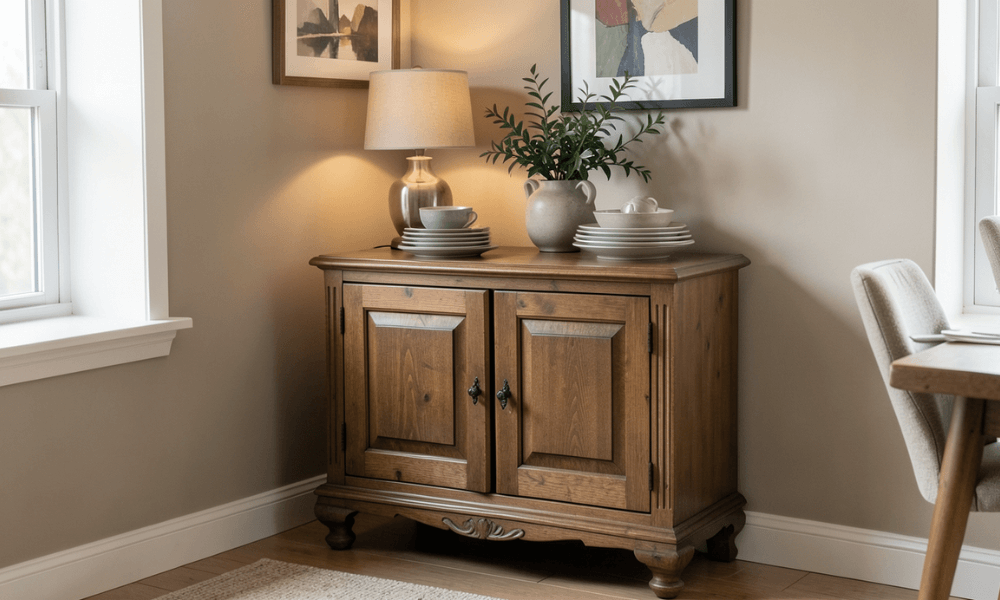
Finding a vintage small buffet cabinet that fits an apartment dining room sounds simple until you're standing in front of a beautiful piece at an antique market and realize it's 58 inches wide and 22 inches deep — which is roughly the size of your entire wall. This list skips the oversized options and focuses entirely on pieces proportioned for real small spaces.
Every pick here is under 48 inches wide, under 20 inches deep, and available through US retailers or well-established resale platforms.
What Makes a Buffet Cabinet "Apartment-Friendly"?
Before we get to specific picks, here's the filter we used:
- Width: 30–48 inches (anything over 48" starts crowding small rooms)
- Depth: 14–18 inches (allows standard 36-inch walkway clearance even in narrow rooms)
- Height: 28–36 inches (low enough to not visually dominate, high enough for comfortable serving)
- Style: Genuine vintage or vintage-inspired with authentic design details
- Availability: Available in the US with reliable shipping or pickup options
If you're unsure which size to buy, our full guide on vintage small buffet cabinet dimensions and styles walks through exactly how to measure your space.
Best Picks: Vintage Small Buffet Cabinets for Apartments
1. The Narrow MCM-Style Pick — 36 Inches Wide
Best for: True studio apartments and tight dining nooks
A 36-inch mid-century modern–inspired buffet with tapered legs, a two-door cabinet below, and a top drawer is one of the most space-efficient options for apartment living. The raised leg design creates visible floor space underneath, which makes smaller dining areas feel more open and less crowded.
What to look for:
- Solid frame construction
- Dovetail drawer joinery
- Legs that provide 6–8 inches of floor clearance
- Depth under 16 inches for narrow walkways
That floor clearance isn’t just aesthetic — it makes cleaning easier and visually reduces bulk in compact rooms.
Dimensions to target: 36"W x 16"D x 30"H
If you’re furnishing a studio under 600 sq. ft., this size range typically offers the best balance of storage and proportion.
2. The Farmhouse Vintage Pick — 40 Inches Wide
Best for: Small dining rooms in houses, townhomes, or larger apartments
A 40-inch farmhouse-style buffet provides meaningful storage without overwhelming a compact dining space. Two lower cabinet doors paired with two upper drawers offer a highly functional configuration for everyday use — ideal for storing table linens, serving ware, and flatware.
Lighter finishes such as antique white, cream, or muted sage help smaller dining rooms feel brighter and more expansive. Darker finishes can still work well but should be balanced with lighter walls and flooring.
What to look for:
- Solid wood frame (avoid fully engineered cabinet boxes)
- Mortise-and-tenon door joinery
- Beadboard or paneled door detailing for authentic farmhouse character
Dimensions to target: 40"W x 18"D x 34"H
For apartment dining rooms under 10 x 10 feet, this width usually fits comfortably along one wall without restricting circulation.
3. The Industrial Vintage Pick — 42 Inches Wide
Best for: Lofts, open-plan apartments, modern-industrial dining areas
Industrial vintage buffets often feature a distressed wood top paired with a metal frame or base. The open lower shelf design creates a lighter visual footprint compared to fully enclosed cabinets.
In open-concept layouts where the dining area flows directly into the living space, a 42-inch industrial-style buffet can also act as a subtle divider without creating a visual barrier.
What to look for:
- Solid or reclaimed wood top
- Welded steel or heavy-duty metal base (not hollow lightweight tubing)
- Adjustable shelving if open storage is included
Dimensions to target: 42"W x 16"D x 32"H
This size works especially well in apartments where the dining wall measures 5–6 feet wide.
4. The Compact Antique-Inspired Pick — Under 45 Inches Wide
Best for: Buyers who love old-world character in small spaces
Compact antique-inspired buffets often feature carved panels, aged brass hardware, and slightly distressed finishes that add warmth to an apartment dining area.
When selecting a vintage-inspired piece, focus on craftsmanship rather than just appearance.
What to check:
- Dovetail or finger-jointed drawers
- Solid back panels
- Durable interior shelving
- Quality hardware with proper weight
Authentic detailing elevates the piece from decorative to heirloom-quality furniture.
For a full breakdown of sizing and placement tips, see our guide on Vintage Small Buffet Cabinet Dimensions and Layout Planning.
Side-by-Side Comparison
| Style | Width | Depth | Price Range | Best Space |
|---|---|---|---|---|
| MCM Narrow | 36" | 16" | $180–$650 | Studio, tight nook |
| Farmhouse Painted | 40" | 18" | $400–$800 | Small dining room |
| Industrial Vintage | 42" | 16" | $300–$700 | Loft, open plan |
| Genuine Antique | Varies | Varies | $150–$600 | Any (measure first) |
| Budget Vintage-Style | 36–44" | 16–18" | $200–$300 | Renters, first apt |
Buying Tips Specific to US Apartments
Check your doorway clearance first
Standard US interior doorways are typically 32–36 inches wide. If you're ordering a 40-inch buffet cabinet, confirm the depth is under 18 inches and verify whether legs or shelves are removable. In tight stairwells or elevator buildings, a few inches can make the difference between smooth delivery and a logistical headache.
Understand delivery options before purchasing
For solid construction buffet cabinets, consider white glove delivery if available. This service includes inside placement and basic assembly, which is especially valuable in walk-up apartments or buildings without freight elevators.
Measure your placement wall carefully
In compact dining areas, leave at least 6–8 inches of breathing room on each side of the cabinet. This ensures the piece feels proportional rather than cramped.
If you're exploring different sizes and styles, browse our Buffet Cabinet Collection to filter options under 45 inches wide — ideal for apartments and small dining rooms.
For detailed layout guidance, see our article on Best Vintage Small Buffet Cabinets for Apartments.
And if you're deciding between storage styles, our comparison guide on Small Buffet Cabinet vs Console Table can help you choose the right fit.
Buffet Cabinet vs. Sideboard vs. Console Table - What Is the Difference?
Before you shop, it helps to understand that the furniture industry uses these terms inconsistently. Here is a clear breakdown:
| Furniture Type | What It Is |
| Buffet Cabinet | A storage cabinet originally designed for dining rooms, used to hold dishes, linens, and food for serving. Typically 33–36 inches high, 48–72 inches wide, with doors and/or drawers. Functionally identical to a sideboard in modern usage. |
| Sideboard | Essentially the same piece as a buffet. The word 'sideboard' tends to be used for pieces with a more storage-forward design; 'buffet' for pieces positioned near a dining table for serving. In practice, you can use either term and you will find the same type of furniture. |
| Credenza | A sideboard/buffet with legs (rather than a plinth base). The legs give it a lighter, mid-century modern aesthetic. Also common in office settings as a storage piece behind a desk. |
| Console Table | A narrower, shallower table (usually 12–15 inches deep) primarily designed for hallways or against walls. Usually open underneath with no storage doors or drawers. Not a functional substitute for a buffet in terms of storage capacity — but useful if storage is less of a priority than visual impact. |
Best Affordable Buffet Cabinets for Small Spaces - What to Look For
Finding a quality buffet that works in a small apartment requires balancing two competing demands: enough storage capacity to be useful, and compact enough dimensions not to overwhelm the space. Here are the key parameters to prioritise:
| Dimension / Feature | Guidance for Small Apartments |
| Width | Aim for 40–55 inches for small apartments. Under 48 inches reads as compact; over 60 inches starts to dominate smaller rooms. |
| Depth | 14–16 inches is the sweet spot for apartments. Deeper than 18 inches encroaches on walkway space in tight rooms. |
| Height | 30–36 inches. Lower pieces (30–33 inches) feel less imposing in small rooms with low ceilings. |
| Legs vs. Plinth | Legs create visual breathing room and make a piece feel lighter. In small spaces, a legged piece (credenza style) will read less heavy than a plinth-base buffet. |
| Finish | Lighter finishes (natural oak, light ash, whitewashed wood) make a small room feel larger than dark stains. |
Buffet Cabinet vs. Console Table - Which Is Right for a Small Apartment?
This is one of the most common decisions apartment dwellers face. The right choice comes down to your priorities:
| Choose a Buffet Cabinet if... | Choose a Console Table if... |
| You need genuine storage — dishes, glassware, table linens, alcohol, serving equipment | You need visual impact more than storage — a landing spot for keys, a lamp, and a decorative piece or two |
| Your apartment dining area lacks a dedicated storage solution | Your hallway or living room needs a narrow wall piece that does not project far into the room |
| You want a piece that pulls double duty in a combined living/dining area | You prefer an open, airy look with nothing hidden away |
| You entertain occasionally and need somewhere to stage food and drinks for serving | You have adequate storage elsewhere (kitchen cabinets, built-ins) and this is purely aesthetic |
How to Measure for a Buffet Cabinet in a Small Apartment
Before buying, take these three measurements and bring them when you shop (or note them before browsing online):
- Wall width: Measure the wall space you have available. Leave at least 4–6 inches on each side of the buffet to avoid a cramped look.
- Clearance depth: Measure from the wall outward. Ensure the buffet depth (usually 14–18 inches) plus 36 inches of walkway clearance (minimum for comfortable movement) fits your room.
-
Ceiling height: For rooms under 8 ft, avoid tall hutches or displays on top of the buffet — keep the visual height of the piece to under 40 inches.
A useful trick: cut paper to the footprint dimensions of the buffet you are considering and place it on the floor. This instantly shows whether the piece will feel proportional or overwhelming.
FAQs
Q: What size buffet cabinet works in a small apartment?
A: For a small apartment, look for a buffet in the 40–55 inch width range, with a depth of no more than 16 inches. Anything wider than 60 inches risks dominating a small dining area. Height of 30–34 inches works well in rooms with standard or lower ceilings. If possible, choose a piece on legs rather than a solid plinth base — the exposed legs create visual lightness and make the room feel larger.
Q: Is a buffet cabinet the same as a sideboard?
A: In modern furniture retail, yes — the two terms describe the same category of furniture. Both refer to a low, long storage cabinet typically placed in a dining room. Some manufacturers distinguish them by describing buffets as serving pieces and sideboards as storage pieces, but this distinction is not consistently applied. Shop both terms and you will find largely the same type of furniture.
Q: Can a buffet cabinet double as a TV stand?
A: Yes, and this is increasingly common, especially in small open-plan apartments. A buffet cabinet at 33–36 inches high will position a TV at a comfortable viewing height. Ensure the buffet is wide enough to accommodate your TV stand width (a 55-inch TV typically needs a surface of at least 48 inches). Cable management is the main challenge — look for a buffet with a cable cutout at the back, or drill one if needed.
Q: What is the difference between a vintage and a rustic buffet?
A: Vintage refers to a design aesthetic or actual age — a piece styled to evoke a particular era (1920s art deco, 1950s mid-century, 1970s retro) or genuinely sourced from that period. Rustic refers to a natural, weathered, or raw-wood aesthetic regardless of era. A vintage buffet might be sleek and lacquered; a rustic buffet will have visible grain, raw edges, and a more natural feel. Many 'vintage-inspired' buffets sold today blend both aesthetics — a mid-century silhouette in a natural wood finish.
Q: What should I look for in an affordable buffet cabinet that will actually last?
A: Focus on the carcass material and the joinery. An affordable buffet with solid wood fronts and engineered wood carcass is a reasonable compromise — the visible surfaces age well while the structure stays stable. Avoid pieces where the entire construction is particle board, especially at joints. Check that drawers use metal runners (not plastic), that hinges have soft-close dampeners (a marker of quality hardware), and that the back panel is secured firmly and not just stapled on. A good-quality affordable buffet at $350–$600 should serve you for 10+ years with basic care.
Q: Is a credenza the same as a buffet?
A: Functionally, yes. A credenza is a low storage cabinet — the main distinction traditionally is that credenzas have legs while buffets/sideboards may sit on a solid plinth. In modern usage the terms are used interchangeably. Credenza also appears frequently in office contexts (a storage piece behind a desk), while buffet is more commonly used in dining room contexts. If you see both terms on a retailer's website, you will likely find the same types of pieces in each category.
Q: What's the difference between a vintage buffet and a vintage sideboard?
A: The terms are interchangeable in today's US market. Both refer to horizontal storage cabinets for dining rooms. Traditionally, "buffet" implied a serving surface and "sideboard" implied a storage piece, but the distinction is rarely observed in modern retail.
Q: Are vintage-style new buffet cabinets worth buying?
A: Yes, if the frame is solid wood. Reproduction vintage pieces from quality brands hold up well and often offer better proportions for modern apartments than genuine antiques, which were built for larger homes.
Share:
Small Buffet Cabinet vs Console Table: Which Is Better for Small Spaces?
Vintage Small Buffet Cabinet: Complete Buying & Styling Guide for Small Spaces