
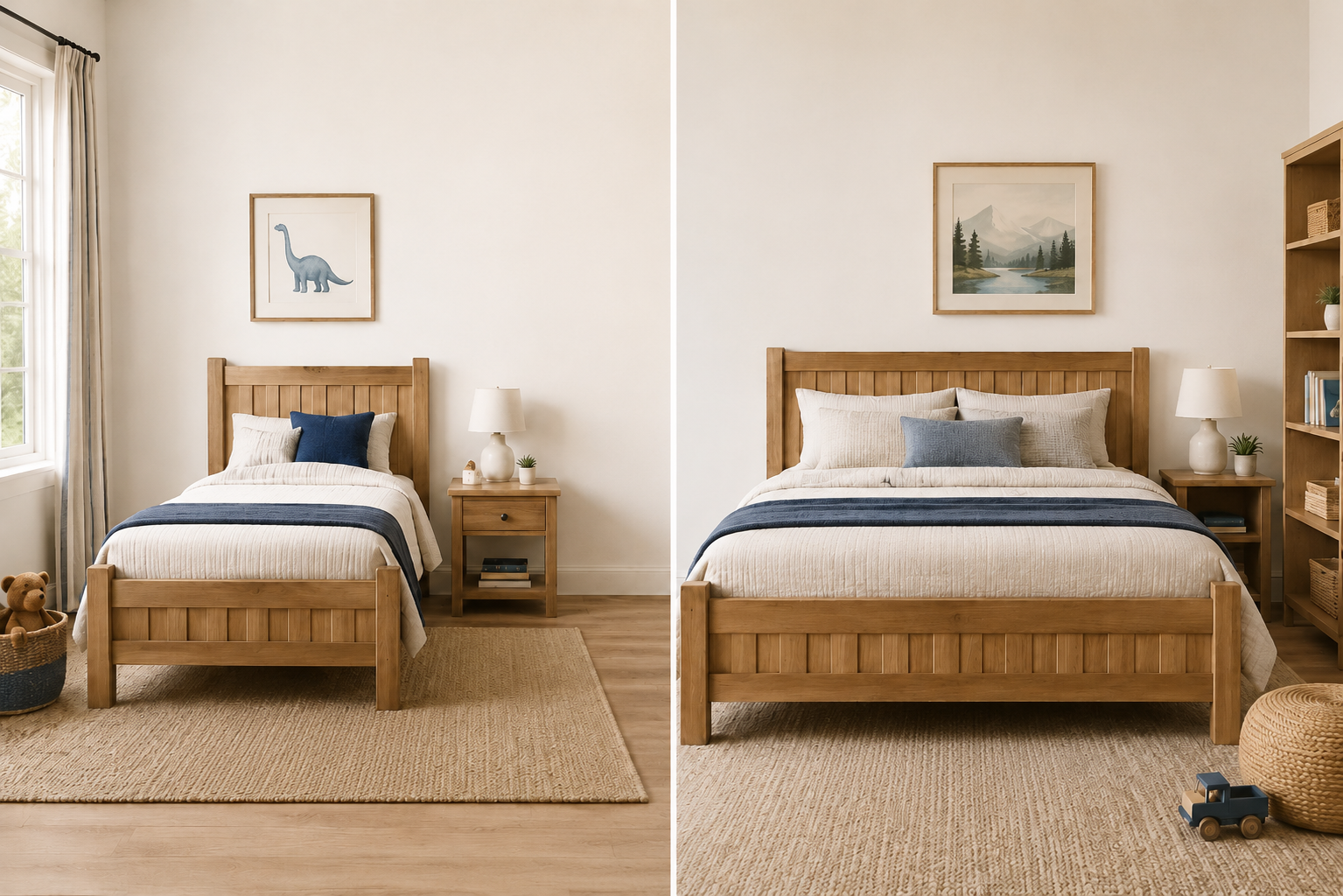
It is one of the most common furniture decisions US parents make - and one that many families revisit sooner than expected.
You buy a twin bed for your seven-year-old. A few years later, they have grown, their needs have changed, and the bed suddenly feels smaller than it once did. Now you're considering a full-size upgrade and wondering whether a different choice from the start might have saved time, money, and hassle.
The twin vs full bed frame decision for a child's room is not complicated - but it does require understanding a few key factors, including your child's age, your room's dimensions, and how long you want the bed to serve them before another upgrade becomes necessary.
This guide compares twin and full bed frames in practical terms, including exact dimensions, recommended age ranges, room-size requirements, long-term costs, and the situations where each option makes the most sense.
If you're also evaluating bed frame materials and long-term durability, explore Oak & Loom's solid wood bed collection as you read.
"The most expensive child's bed frame is often the one that needs replacing sooner than expected. Choosing the right size from the start can help families avoid unnecessary upgrades and create a bedroom that works for years to come."
Quick Answer: Twin vs Full Bed Frame for a Child's Room
For many children under age 8, a twin bed frame provides plenty of sleeping space while preserving valuable floor area for play, storage, and everyday activities. For older children-or for younger children whose rooms can comfortably accommodate a larger bed-a full bed frame is often the better long-term investment.
A full bed frame costs more upfront and requires additional floor space, but it can remain comfortable through the teen years, reducing or eliminating the need for a future size upgrade. The best choice ultimately depends on your child's age, room dimensions, budget, and how long you expect the bed to serve them.
Twin vs Full Bed Frame - Exact Dimensions Every US Parent Needs
Before comparing twin and full bed frames in any other way, it's helpful to understand the dimensions. The size difference affects not only sleeping comfort but also how much usable floor space remains in your child's room.
|
Measurement |
Twin Bed |
Full Bed |
|
Width |
38 inches |
54 inches |
|
Length |
75 inches |
75 inches |
|
Width Difference |
- |
16 inches wider |
|
Length Difference |
Same |
Same length |
|
Floor Footprint |
~20 sq ft |
~28.5 sq ft |
|
Typical Minimum Room Size* |
~70 sq ft |
~100 sq ft |
|
Recommended Room Size |
90+ sq ft |
120+ sq ft |
Actual room-size requirements vary depending on furniture placement, door swing, closet access, and desired walking clearance.
The key insight: a twin and full bed are the same length-75 inches. The primary difference is width, with a full bed providing 16 additional inches of sleeping space.
This distinction helps clarify several common questions. A child who is tall for their age does not necessarily need a full bed for additional length, since both sizes are equally long. However, they may benefit from the extra width a full bed provides as they grow.
Similarly, when a child moves from a twin to a full bed, they are not gaining length-they are gaining sleeping width. That extra space can make the bed feel more comfortable for active sleepers and can provide additional room for bedtime reading, storytime, or a parent sitting beside the child when needed.
Twin Bed Frame - Who It Is Right For
A twin bed frame is often the right choice for a child's room in the following situations:
Children Under 7 or 8 Years Old
For many younger children, a twin bed provides more than enough sleeping space while leaving valuable floor area available for play, storage, and everyday activities. The smaller footprint can make a child's room feel more open and functional, especially during the early elementary years.
A quality solid wood twin bed frame can comfortably serve many children for several years before additional sleeping space becomes desirable. For families who expect to update the bedroom as their child grows, starting with a twin can be a practical approach.
Small Children's Rooms
Room size is often the most important factor in the twin vs full bed frame decision. Because a twin bed occupies significantly less floor space than a full bed, it is generally easier to fit into smaller bedrooms while maintaining comfortable walking paths and furniture placement.
In children's rooms measuring approximately 80 to 95 square feet-a common size in many apartments, townhomes, and older homes-a twin bed often provides a better balance between sleeping space and usable floor area. While a full bed can work in some smaller rooms, careful planning is usually required to maintain adequate clearance around the bed and other furniture.
Room clearance guideline: Aim for at least 24 inches of clear floor space on the primary access side of the bed and at the foot of the bed whenever possible. Measuring the room before choosing a bed size can help avoid layout challenges later.
Budget-Conscious First Beds
In most furniture collections, twin bed frames and twin mattresses cost less than their full-size equivalents. For parents furnishing a child's room on a defined budget, a twin bed can reduce upfront costs while still providing a comfortable sleeping space for many years.
Families who anticipate a future bedroom redesign or size upgrade may find that a twin bed offers the most practical balance between affordability and functionality during the early years.
Marlborough Canning Headboard Solid Wood Bed
Solid acacia with open slatted headboard - clean, durable, and proportionally ideal for children's rooms across US homes.

Full Bed Frame - Who It Is Right For
A full bed frame is often the best choice for families who are planning for the long term and have enough room to accommodate the larger footprint.
Older Children and Growing Families
As children move through late elementary school, middle school, and the teen years, many families find that the additional width of a full bed becomes increasingly valuable. The extra 16 inches of sleeping space can provide greater comfort for active sleepers and more room for reading, relaxing, or spending time on the bed beyond sleep.
For parents who prefer to invest in a bed that can remain useful through adolescence and beyond, a full bed may reduce the likelihood of needing a future size upgrade.
Bedrooms With Adequate Space
A full bed works best in rooms that can comfortably accommodate its larger footprint while maintaining adequate walking clearance and furniture placement. In many homes, bedrooms of approximately 120 square feet or larger can accommodate a full bed without feeling crowded, though actual suitability depends on the room layout and other furnishings.
When space allows, the additional width of a full bed can improve long-term comfort without significantly changing the overall function of the room.
Families Who Prefer to Buy Once
One of the strongest arguments for choosing a full bed is longevity. Many parents prefer purchasing a bed that can adapt to their child's changing needs rather than planning for a future size upgrade.
While a full bed typically costs more upfront than a twin, it may remain suitable through the teen years and even into adulthood. For families who prioritize long-term use and have the available space, a full bed can be a practical investment that reduces the likelihood of replacing the bed later.
Caldera Rustic Hand-Carved Solid Wood Bed
Hand-carved solid wood in distressed white finish - warm, character-rich bedroom anchor for children's rooms that grows with them.
Twin vs Full Bed Frame - The Complete Side-by-Side Comparison
|
Factor |
Twin Bed Frame |
Full Bed Frame |
|
Width |
38 inches |
54 inches |
|
Length |
75 inches |
75 inches |
|
Additional Width |
- |
16 inches wider |
|
Typical Age Range |
Younger children; suitable for many ages depending on needs |
Older children, teens, and adults |
|
Typical Room Size |
Smaller bedrooms |
Medium to larger bedrooms |
|
Recommended Room Size |
90+ sq ft |
120+ sq ft |
|
Sleeps One Child Comfortably |
Yes |
Yes, with more room to spread out |
|
Parent Can Sit Beside Child |
Limited space |
More comfortable |
|
Sleepovers |
Limited space |
Better suited for occasional sharing |
|
Suitable for Teen Years |
Depends on personal preference |
Often preferred |
|
Suitable for Adults |
Can feel narrow for some adults |
Standard adult sleeping size |
|
Bedding Availability in the US |
Excellent |
Excellent |
|
Upfront Cost |
Lower |
Higher |
|
Floor Space Required |
Less |
More |
|
Potential Need for Future Upgrade |
Higher likelihood |
Lower likelihood |
|
Long-Term Flexibility |
Good |
Excellent |
Long-Term Cost Considerations - Twin vs Full for a Child's Room
One factor many parents overlook when comparing twin and full bed frames is the possibility of a future size upgrade.
Scenario A: Start With a Twin, Upgrade Later
Some families purchase a twin bed during the early childhood years and later transition to a full bed as their child grows. In this scenario, costs may include:
-
An initial twin bed frame and mattress
-
A future full bed frame
-
A future full-size mattress
-
Potential delivery, assembly, or disposal costs
Scenario B: Purchase a Full Bed From the Start
Other families choose a full bed immediately, even for younger children. While the upfront investment is higher, the bed may remain suitable through the teen years and beyond, potentially eliminating the need for a future size upgrade.
Which Option Costs Less?
The answer depends on several factors, including:
-
The quality and price of the bed frame
-
Mattress selection
-
Whether the family eventually upgrades bed sizes
-
How long the child remains in the room
-
Whether the original bed is repurposed, sold, or passed down
For families who expect to move from a twin to a full bed later, purchasing a full bed from the start may reduce total spending over time. However, for families with limited space or changing needs, a twin bed can still be a practical and cost-effective choice.
The most important takeaway is that bed size should be evaluated not only for today's needs but also for how the room and the child are likely to change over the coming years.
Room Size Guide - How to Know if Your Child's Room Can Fit a Full Bed
Before committing to a full bed frame, take a few measurements to ensure the room will remain comfortable and functional once the bed is in place.
Step 1: Measure the Room
Measure the room's width and length in inches, including any areas affected by doors, closets, or built-in furniture.
Step 2: Account for the Bed Footprint
A standard full bed measures approximately 54 inches wide by 75 inches long. Subtract those dimensions from your available floor space to estimate the remaining clearance around the bed.
Step 3: Check Walking Clearance
As a general guideline, aim for:
-
At least 24 inches of clearance on the primary access side of the bed
-
At least 18 inches of clearance on the opposite side
-
At least 24 inches of clearance at the foot of the bed
-
Comfortable clearance between the bed and doors, closets, and other furniture
Step 4: Consider the Entire Room Layout
Remember that the bed is only one part of the room. Dressers, desks, toy storage, and closet access all affect how spacious the room feels in everyday use.
If the room can comfortably accommodate a full bed while maintaining good circulation and furniture access, a full bed may be a practical long-term choice. If the layout feels crowded or limits movement, a twin bed may provide a better balance between sleeping space and overall room functionality.
Milbridge Traditional Carved Solid Wood Bed
Traditional carved solid wood - a timeless bedroom anchor that grows with your child through every stage of childhood.
Why Solid Wood Matters for Children's Bed Frames
The twin vs full bed frame decision is important, but size is only part of the equation. The material and construction quality of the bed frame play a major role in how well it holds up over years of everyday use.
Children Put Bed Frames Through More Wear and Tear
Children often use their beds for more than sleeping. Reading, playing, climbing, lounging, and everyday activity can place additional stress on a bed frame over time. As a result, durability becomes especially important when choosing furniture intended to last through childhood and adolescence.
Solid Wood vs. Engineered Wood
Many bed frames are made from engineered wood products such as MDF, particleboard, or composite materials. These options can be affordable and suitable for some households, but they may be more susceptible to dents, moisture damage, or wear at connection points over time-particularly under heavy daily use.
Solid wood bed frames are generally valued for their strength, repairability, and longevity. Because the structural components are made from natural hardwood rather than compressed wood fibers, they often withstand years of use with fewer signs of wear.
Construction quality matters just as much as material selection. Features such as durable joinery, reinforced support systems, and quality hardware can have a significant impact on how stable and long-lasting a bed frame remains.
Thinking Long Term
For families looking to purchase a bed frame that can transition from childhood to the teen years-or even serve as guest-room furniture later-a well-constructed solid wood bed frame can be a worthwhile investment.
While the upfront cost is often higher than engineered wood alternatives, many buyers value the durability, timeless appearance, and long service life that quality solid wood furniture can provide.
For a deeper look at furniture construction and what to evaluate before purchasing, read: How to Identify Quality Joinery - The Hidden Sign of Great Furniture.
Twin vs Full Bed Frame - Special Considerations for US Families
Sleepovers and Guest Sleeping
One practical consideration in the twin vs full bed frame decision is how the bed may be used beyond everyday sleep.
A twin bed comfortably accommodates one child and works well for most day-to-day needs. However, for families who regularly host sleepovers, a full bed can provide additional space for occasional sharing. While neither size is designed as a permanent sleeping arrangement for two children, the extra width of a full bed may make sleepovers more comfortable.
Children With Disabilities or Special Needs
For children with mobility challenges, sensory processing differences, or other needs that affect sleep, bed size should be evaluated alongside safety, accessibility, and caregiver requirements.
In some situations, the additional width of a full bed may provide more room for repositioning, nighttime assistance, adaptive equipment, or increased comfort. However, the ideal bed size varies by child and circumstance. Parents and caregivers should consider the child's specific needs, room layout, and any recommendations from healthcare or accessibility professionals when selecting a bed.
Transitional Bedrooms - When the Room Becomes a Teen's Room
Many parents choose a bed size not only for their child's current needs but also for how the room will function in the future.
A full bed often transitions easily into a teen bedroom, providing additional sleeping space as children grow and their needs change. While many teenagers continue to use twin beds comfortably, others appreciate the extra width of a full bed for reading, studying, relaxing, and everyday use.
For families with adequate room space, choosing a full bed from the start may reduce the likelihood of a future size upgrade and help the bedroom remain functional through multiple stages of childhood and adolescence.
Blue Ridge Solid Wood Platform Bed
Clean contemporary solid acacia - the timeless design that works in a young child's room, a teen's room, and beyond.
The Twin vs Full Bed Frame Decision - A Simple Framework for US Parents
If you're still deciding between a twin and full bed frame, these four questions can help narrow down the best option for your child's room.
Question 1: How Old Is Your Child?
-
Under 8 years old → A twin bed is often sufficient and leaves more floor space available for play and other activities.
-
8 years and older → A full bed may offer greater long-term comfort and reduce the likelihood of needing a future size upgrade.
Question 2: How Large Is the Room?
-
Smaller bedrooms → A twin bed is typically easier to accommodate while maintaining comfortable walking space.
-
Rooms with adequate clearance for a full bed → A full bed can provide additional sleeping space without significantly affecting functionality.
Question 3: How Long Do You Want the Bed to Last?
-
Planning to update the bedroom as your child grows → A twin bed may be a practical starting point.
-
Prefer a bed that can remain useful through the teen years → A full bed may be worth considering from the beginning.
Question 4: What Is Your Budget Today?
-
Looking to minimize upfront costs → A twin bed generally requires a lower initial investment.
-
Comfortable investing more now for long-term flexibility → A full bed may reduce the likelihood of a future size upgrade.
A Simple Rule of Thumb
If floor space is limited, a twin bed is often the practical choice. If the room can comfortably accommodate a larger bed and you're thinking long term, a full bed may provide greater flexibility as your child grows.
Conclusion
The twin vs full bed frame decision ultimately comes down to three practical factors: your child's age, your room's dimensions, and how long you want the bed to remain useful.
For younger children and smaller bedrooms, a twin bed often provides an excellent balance of comfort, functionality, and floor space. For families with larger rooms and a long-term mindset, a full bed can offer additional flexibility as children grow into their teen years.
Whatever size you choose, construction quality matters. A well-built bed frame made from durable materials is more likely to provide years of reliable use than a lower-quality alternative. When comparing options, pay attention not only to size, but also to materials, joinery, support systems, and overall craftsmanship.
At Oak & Loom, every bed frame in our collection is crafted from 100% kiln-dried hardwood and designed with long-term durability in mind. Whether you're furnishing a young child's room, a teen bedroom, or a guest space, choosing a quality bed frame can help ensure the investment continues to serve your family for years to come.
"The right bed frame for your child's room isn't simply the one that fits today-it's the one that continues to fit your family's needs as your child grows."
→ Browse all solid wood bed frames - free US shipping
→ Questions about sizing for your child's room? Contact our team for guidance.
Frequently Asked Questions
Q1. Should I get a twin or full bed for my child?
For many younger children, a twin bed provides plenty of sleeping space while preserving valuable floor area for play and other activities. A full bed may be a better option for older children or for families who want a bed that can remain comfortable through the teen years. The best choice depends on your child's age, room size, budget, and long-term plans for the space.
Q2. What is the difference between a twin and full bed frame for a child's room?
A twin bed frame measures 38 inches wide by 75 inches long. A full bed frame measures 54 inches wide by 75 inches long. The primary difference is width—a full bed provides 16 additional inches of sleeping space while maintaining the same length. Both sizes comfortably accommodate one child, but a full bed offers more room for growing children, bedtime reading, and occasional sleepovers.
Q3. What size room do I need for a full bed frame in a child's room?
Many families find that a full bed works best in rooms with enough space to maintain comfortable walking clearance around the bed and other furniture. As a general guideline, aim for approximately 24 inches of clearance on the primary access side and at the foot of the bed whenever possible. Room layout, door placement, and furniture arrangement can be just as important as square footage.
Q4. Is a full bed too big for a child?
No. A full bed is not too large from a sleeping perspective and can be used comfortably by children of many ages. The primary consideration is whether the room has enough space to accommodate the larger footprint while maintaining a functional layout.
Q5. Why should I consider a solid wood bed frame for my child?
Many parents choose solid wood bed frames because of their durability, repairability, and long service life. Construction quality also plays an important role. Features such as sturdy joinery, quality hardware, and strong support systems can help a bed frame remain stable and comfortable through years of everyday use.
For a complete guide to construction quality, read: How to Identify Quality Joinery.
Q6. Does Oak & Loom offer solid wood bed frames with free US shipping?
Oak & Loom offers a collection of solid wood bed frames crafted from kiln-dried hardwood and designed for long-term durability. Free shipping is available across the contiguous United States. Browse the complete collection or contact the Oak & Loom team for guidance on selecting the right size and style for your space.

Share:
Solid Wood Armoire vs Built-In Closet: Which Is Better for Your Bedroom?
Low Profile Bed vs High Profile Bed: Pros, Cons & Which One Suits Your Bedroom