
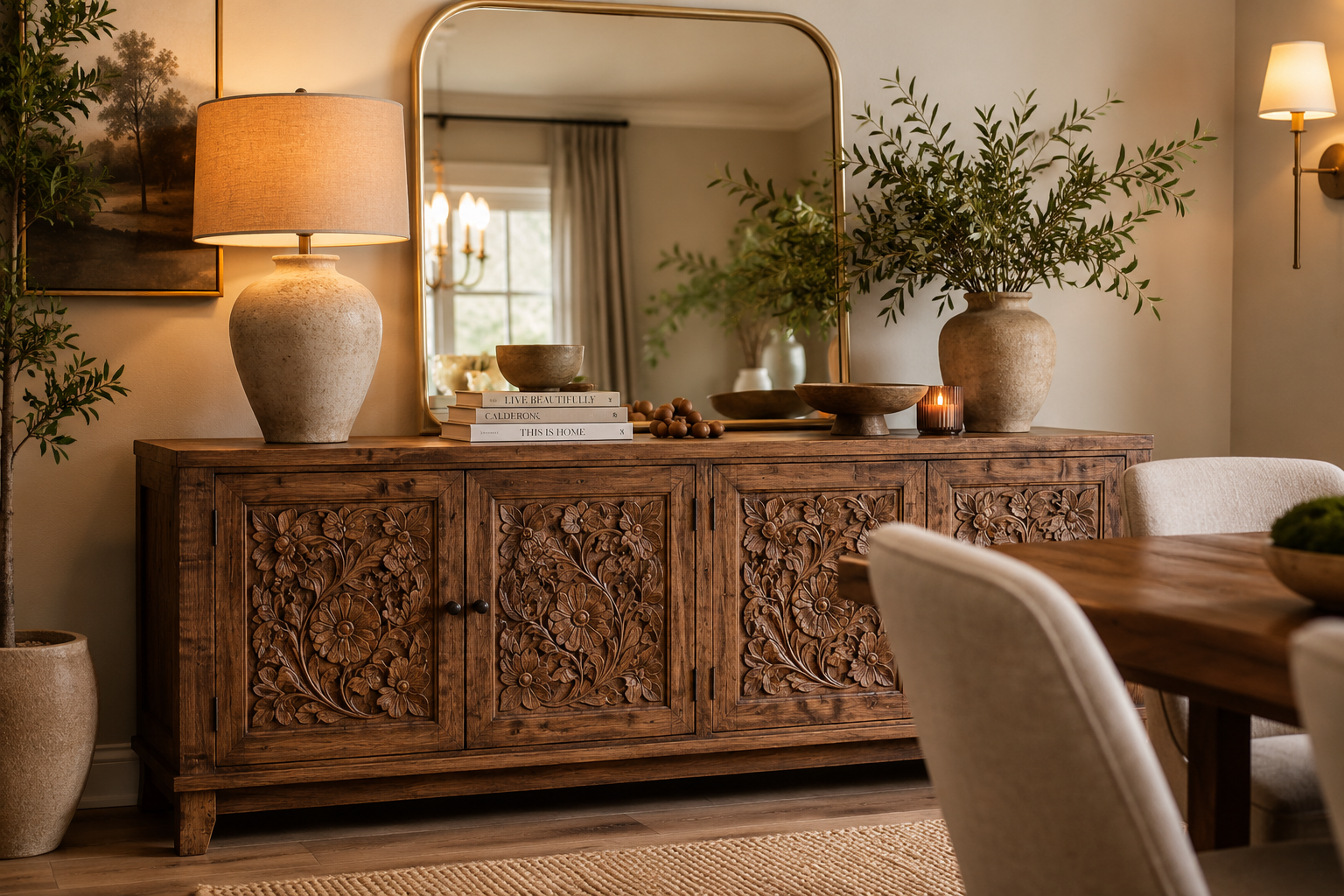
A solid wood sideboard is the most versatile piece of furniture in any dining room. It stores what the table cannot hold, serves what the kitchen is too far to reach, and anchors the dining room wall with a visual weight and warmth that no other piece replicates.
But most US homeowners - even those who chose their sideboard carefully and love the piece - end up with a surface that looks either completely bare or haphazardly cluttered. A candle here. A bowl there. A photo that was placed temporarily and never moved. The sideboard looks like it is waiting to be styled rather than styled.
This guide changes that.
These 10 dining room sideboard styling ideas are drawn from the principles of interior styling that work specifically on solid wood sideboards in American dining rooms - what goes on top, how much of it, how to arrange it, and why each approach creates the finished, intentional look that makes a sideboard feel like the room was designed around it.
Browse Oak & Loom's solid wood sideboards and buffets - free shipping across the contiguous United States - alongside these ideas for the most useful reference while you style.
"A styled sideboard does not look decorated. It looks considered - as if everything on it was placed by someone who knew exactly why it belonged there."
Quick Answer: What to Put on Top of a Sideboard
The most effective sideboard styling follows the rule of three: one tall element (a lamp or large vase), one medium element (a bowl, tray, or decorative object), and one low element (books, candles, or a small plant). Complete the look with a mirror or artwork above the sideboard to create visual balance and height. Leave 30–40% of the surface empty-the negative space is an essential part of the design.
Why Styling a Solid Wood Sideboard Is Different From Styling Other Furniture
A sideboard is not a shelf. It is not a console table. It occupies a unique position in the dining room-typically against the longest wall and at roughly the same height as the dining table-giving it a different visual role from any other furniture piece in the room.
A sideboard is usually viewed from a seated position at the dining table. This means a styling arrangement that looks appealing when you're standing nearby may not have the same visual impact from across the room. Effective sideboard styling considers both perspectives, creating a composition that feels balanced and intentional from every angle.
A solid wood sideboard also brings something that painted, lacquered, or manufactured furniture cannot: the material itself is part of the design. The natural wood grain, the warmth of the finish, and the craftsmanship of the doors all contribute to the overall aesthetic. The styling should complement these details rather than compete with them.
The 10 ideas that follow are designed to enhance the natural beauty of a solid wood sideboard, helping it become a focal point that feels both functional and intentionally styled.
Idea 1 - The Lamp and Mirror Classic
This is the most reliable sideboard styling approach in any American dining room - and the reason it appears in virtually every interior design publication is that it works every time.
The setup: A table lamp on one side of the sideboard surface, a mirror hung above and centered on the wall, and a small arrangement on the other side of the surface to balance the lamp's visual weight.
Why it works: The lamp creates warm ambient light in the dining room - a secondary light source that complements overhead lighting and makes the room feel more welcoming. The mirror doubles the apparent depth of the sideboard wall, making the dining room feel larger. The asymmetry between the tall lamp and the lower arrangement on the opposite side creates dynamic tension that makes the composition feel lively rather than static.
What to place on the non-lamp side: A small stack of art or design books, a ceramic bowl, or a low plant arrangement. The rule: the non-lamp side should be visually lighter - lower, simpler - than the lamp side.
With a solid wood sideboard: Choose a lamp with a natural linen or paper shade rather than a white synthetic shade. The warmth of natural materials complements solid wood grain rather than washing it out.

Idea 2 - The Gallery Wall Anchor
Instead of a single mirror above the sideboard, create a gallery wall that uses the sideboard as its anchor - a curated arrangement of frames, objects, and art that treats the sideboard and the wall above it as a single compositional unit.
The setup: Arrange 4 to 7 framed pieces-a mix of prints, photographs, and one or two three-dimensional objects, such as a small shelf or decorative wall accent-above the sideboard. Treat the wall space from the sideboard surface to approximately 18 inches above it as one cohesive composition. For the most balanced look, aim for the gallery wall to span roughly two-thirds to three-quarters of the sideboard's width.
Why it works: A gallery wall above a sideboard creates the densest, most personal expression of the dining room's aesthetic. It tells the story of the household in a way that a single mirror or single artwork cannot. The sideboard grounds the gallery - giving the wall arrangement a literal base that prevents it from floating.
What to place on the surface: Keep the sideboard surface simple when a gallery wall is above it. The wall is doing the visual work - the surface needs to support, not compete. A single tray with three objects, or two identical vessels on either end with open space between them.
With a solid wood sideboard: The gallery wall works best when at least one element references the sideboard's material - a frame in a warm wood tone, a wooden object, or a piece of art that includes earth tones related to the wood's finish.
Idea 3 - Seasonal Styling That Changes Four Times a Year
The best-styled sideboards in American dining rooms are not styled once and left. They are adapted seasonally - not dramatically redesigned, but refreshed with small changes that make the room feel current and alive throughout the year.
How seasonal styling works:
Spring/Summer: Lighter elements, fresh botanicals, ceramic vessels in neutral tones, a linen runner on the surface in warm white.
Autumn: Warmer tones, dried botanicals, amber glass candles, a deeper-toned ceramic or wooden bowl as the centerpiece.
Winter/Holidays: Candles at multiple heights, evergreen or dried floral arrangements, one or two seasonal accent pieces alongside the permanent styling.
What stays constant: The lamp (if used), the mirror or artwork above, and the sideboard itself. Seasonal changes happen to the smaller objects - the vessels, botanicals, candles, and textural accents - not to the permanent composition.
This approach keeps the dining room sideboard feeling intentional and current without requiring a complete restyle each season. Refreshing just three or four styling pieces each season can make the dining room feel noticeably different throughout the year—with very little time, effort, or expense.

Idea 4 - The Tray Method for Effortlessly Organized Surfaces
The tray is the most underused styling tool in American dining room sideboard design - and the one that most immediately transforms a surface from cluttered to curated.
The setup: Place one or two large trays on the sideboard surface. Everything that goes on the sideboard surface goes into a tray. Nothing sits directly on the wood surface outside the tray.
Why it works: A tray creates an instant visual boundary that contains and organizes objects that would otherwise look scattered. The same five objects that look randomly placed on an open surface look deliberately curated when arranged inside a tray. The tray also protects the solid wood surface from scratches, watermarks, and accumulated surface damage - practical and aesthetic simultaneously.
What goes in the tray: A candle in the center, a small ceramic vessel on one side, one object of personal significance (a small sculpture, a meaningful stone, a decorative object from travel) on the other. Never more than three to four items per tray.
With a solid wood sideboard: Choose trays in natural materials - woven rattan, unfinished wood, slate, or leather. These materials complement solid wood grain rather than interrupting it the way plastic, chrome, or highly polished surfaces do.
Idea 5 - Tall Vases With Dried or Fresh Botanicals
A tall vase - 18 to 24 inches - filled with dried pampas grass, fresh branches, or structural dried florals is one of the most effective single sideboard styling elements available to US homeowners. It creates vertical height, introduces organic texture, and fills the visual space above the sideboard surface in a way that neither a lamp nor artwork replicates.
The setup: One tall ceramic or glass vase, placed slightly off-center - not centered on the sideboard, which looks too symmetrical and static. Fill with dried pampas, eucalyptus branches, dried cotton stems, or large-scale dried flowers. Place one complementary smaller object on the opposite side for balance.
Why it works: Botanical elements introduce organic unpredictability into the dining room-the gentle movement of dried pampas, the irregular silhouette of eucalyptus branches-that manufactured objects cannot replicate. Against a solid wood sideboard, the natural organic quality of botanicals reinforces the material story the wood is already telling. It also adds vertical interest and texture that neither a lamp nor wall art can achieve on its own.
Maintenance note for US homeowners: Dried botanicals require almost no maintenance - occasional light dusting. Fresh arrangements need replacement every 10 to 14 days. For most US dining rooms, dried botanicals in a well-chosen arrangement are the more practical long-term choice.

Idea 6 - The Art Ledge With Layered Frames
Instead of hanging art above the sideboard, lean it against the wall on the surface itself - and layer multiple pieces at different depths to create a casual, gallery-like composition that feels collected rather than decorated.
The setup: Two or three frames of different sizes, leaned against the wall on the sideboard surface, arranged at slight overlapping angles. Mix frame materials - one wood-toned frame, one metal, one unframed print held with clips. Layer depth by placing a larger piece at the back, a medium piece in front and slightly to one side, and a small object or additional frame at the front corner.
Why it works: Leaned art creates visual immediacy - it looks like it was placed thoughtfully but could be changed tomorrow. In American dining rooms where the aesthetic is evolving or where homeowners enjoy switching art seasonally, leaned art accommodates change far more easily than hung pieces. The layered depth also creates a sense of composition that a single centered hung artwork does not.
What to add on the surface: Keep the surface elements extremely simple when using leaned art - a single candle or small vessel beside the arrangement. The art provides all the visual complexity the composition needs.
Idea 7 - The Dining Room Buffet Setup (That Works Every Day)
The sideboard was originally designed as a buffet - a serving station for meals and gatherings. The most practical and beautiful sideboard styling for American dining rooms treats the surface as a permanent, beautiful buffet setup that is ready for use at any moment.
The setup: A wooden serving board or marble slab in the center of the surface - the permanent serving element. Beside it, a ceramic oil bottle or vinegar carafe. A small stack of linen napkins in a napkin ring or napkin holder. A candle on one side.
Why it works: Every styling element serves a purpose, making the sideboard feel both beautiful and practical. The serving board, linens, and ceramic pieces are ready to use while also creating a thoughtfully styled display. This approach works particularly well for US homeowners who use the dining room regularly and want a sideboard that looks intentional without requiring constant styling attention.
With a solid wood sideboard: The warmth of the wood surface against natural serving materials - ceramic, linen, wood serving boards - creates a material harmony that looks immediately intentional. For dining room sideboard styling in farmhouse, traditional, or organic modern US homes, this is the most coherent approach available.
Idea 8 - Odd Numbers and Asymmetry
Interior designers often prefer styling with odd numbers of objects because they naturally create a more relaxed and visually interesting composition than perfectly symmetrical groupings. While even-numbered arrangements can work in some settings, groups of three, five, or seven typically create a greater sense of movement and balance on a sideboard.
Why odd numbers work: An even number of objects - two candlesticks, four books, six objects arranged symmetrically - creates perfect balance that reads as static and slightly institutional. An odd number of objects creates the slight tension and visual movement that makes a composition feel alive. Three objects with varied heights, five objects in an asymmetric arrangement, seven pieces in a collected gallery - all of these create dynamic compositions that two or four cannot.
The sideboard application: Choose three primary styling elements - one tall, one medium, one low. Arrange them at three different heights with the tallest slightly off-center. Add secondary elements in odd numbers - one tray with three objects inside, two small plants flanking one central piece.
With a solid wood sideboard: The organic, varied nature of wood grain responds naturally to asymmetric styling. A perfectly symmetrical arrangement on a piece of furniture that has organic material variation creates a visual tension between the surface and the objects. Asymmetry works with the wood rather than against it.
Idea 9 - The Statement Sideboard That Styles Itself
The most beautiful sideboard styling is sometimes no styling at all - or nearly none.
A carved solid wood sideboard - particularly a piece like the Manhattan Rustic Handcarved Sideboard or the Vernado Rustic Wood 4-Door Sideboard, where the surface carving is itself a complex visual composition - may need nothing more than one or two supporting elements to look fully styled.
The setup for a carved sideboard: One large vessel on one end - a tall ceramic or simple glass vase, unadorned. One small candle on the other end. Nothing between them except the carved surface of the wood itself.
Why this works: A carved solid wood sideboard is already fully designed. The artisan who cut the floral or geometric pattern into the door panels, the distressed finish that gives each piece unique character, the grain that runs through every element - this is the design work. Additional styling elements that compete with this visual complexity make the sideboard look cluttered. Elements that simply frame it - one vessel, one candle - allow the piece itself to be the focal point.
This approach works best with a statement sideboard. A simple contemporary sideboard with clean lines often benefits from additional styling to introduce warmth, texture, and visual interest. A carved, distressed, or heavily detailed solid wood sideboard, however, naturally becomes the focal point and requires only minimal decorative accents.

Idea 10 - The Edit: What to Remove
The tenth and final sideboard styling idea is the most important - and the one US homeowners most consistently resist: ruthless editing.
Most sideboard surfaces in American dining rooms are not under-styled. They are over-styled. Too many objects, too many heights, too many materials competing simultaneously. The result is a surface that looks like a collection of things rather than a composed arrangement.
The editing process:
Remove everything from the sideboard surface. Lay it all on the dining table.
Place only the one object you love most back on the sideboard. Pause for a moment and assess how it looks before adding anything else.
Add the second object you love most. Look at the composition.
Continue adding one object at a time, stopping after each addition to assess whether the composition improved or became more complicated.
Stop the moment adding the next object makes the composition look busier rather than better.
That moment - when adding one more object would reduce the composition's quality - is the correct amount of styling for your specific sideboard. It may be three objects. It may be six. But it is almost never the twelve that were there before.
The negative space rule: A well-styled solid wood sideboard leaves 30 to 40 percent of its surface empty. The empty wood surface - the grain visible, the finish catching the light - is not wasted space. It is the breathing room that makes every other element on the surface read more clearly.

The 5 Most Common Sideboard Styling Mistakes US Homeowners Make
Even with good intentions and carefully chosen décor, many US homeowners make one or more of these common sideboard styling mistakes. Avoiding them can instantly make your dining room feel more balanced, intentional, and professionally styled.
Mistake 1 - Centering everything. A perfectly centered arrangement can feel overly formal or predictable. Instead, position your tallest styling element slightly off-center and balance it with lower objects on the opposite side to create a composition that feels relaxed, natural, and intentionally styled.
Mistake 2 - All objects the same height. A collection of objects at the same height creates a flat, horizontal band of visual noise. Vary heights dramatically - tall, medium, low - to create movement and depth.
Mistake 3 - Too many materials. Three or more competing materials on one surface - chrome, ceramic, glass, wood, fabric - create visual confusion. Choose one or two material themes and stay within them.
Mistake 4 - Ignoring the wall above. The wall above the sideboard is part of the composition. A beautiful sideboard with a blank wall above it looks unfinished. A mirror, artwork, or gallery wall completes the composition vertically.
Mistake 5 - Never changing anything. A sideboard styled identically in January and July looks forgotten rather than designed. One seasonal refresh - swapping three to four objects - keeps the dining room feeling alive and cared for through the year.
Conclusion
A solid wood sideboard is one of the most beautiful and versatile pieces of furniture in any American dining room-but it's also one of the easiest to overstyle or understyle. Its natural wood grain, generous surface, and prominent placement make it a focal point that deserves thoughtful styling. When balanced well, it can bring warmth, character, and functionality to the entire room.
The 10 ideas in this guide provide a starting framework - not a formula. Every solid wood sideboard is different, every dining room is different, and every US homeowner's sense of what looks right is different. But the principles beneath these ideas are consistent: odd numbers, varied heights, quality over quantity, negative space as design, and seasonal change to keep the composition alive.
At Oak & Loom, we believe great styling begins with well-crafted furniture. Every solid wood sideboard in our collection is made from 100% genuine hardwood and designed to showcase the natural beauty of the wood grain, expert craftsmanship, and lasting durability. Whether your style is contemporary, rustic, traditional, or industrial, a quality sideboard provides the perfect foundation for creating a dining room that feels both functional and beautifully curated.
"A beautifully styled sideboard does not announce itself. It simply makes the room feel better - more considered, more personal, more like a place where things were chosen rather than placed."
→ Browse solid wood sideboards
→ Questions? Contact our team:
Frequently Asked Questions
What should I put on top of a solid wood sideboard?
The most effective solid wood sideboard styling follows the rule of three: one tall element (a lamp, tall vase, or large botanical arrangement), one medium element (a ceramic bowl, decorative object, or tray), and one low element (books, candles, or a small plant). Leave 30–40% of the surface empty so the natural wood grain and finish remain part of the overall design rather than being hidden by décor.
Should the sideboard surface be symmetrical or asymmetrical?
Asymmetrical arrangements are generally more visually interesting for dining room sideboards because they create a sense of balance and movement. Position the tallest styling element slightly off-center and vary the height of the remaining objects to create a composition that feels natural and intentional. Groups of three, five, or seven objects often work especially well, although even-numbered arrangements can also be effective in more formal spaces.
How do I style a sideboard in a small dining room?
In a small US dining room, sideboard styling should be more restrained than in a larger space. Choose fewer, larger objects rather than many small ones - a large vessel and one other element reads more clearly in a small room than six small objects competing for attention. Use a mirror above the sideboard rather than a gallery wall - a mirror expands the apparent depth of the room. Keep the surface at 50 percent empty to maintain visual breathing room in a space that is already limited.
What should hang above a sideboard in a dining room?
A large mirror, a statement artwork, or a thoughtfully arranged gallery wall are all excellent choices above a dining room sideboard. For the most balanced look, the wall décor should generally span about two-thirds to three-quarters of the sideboard's width, with the bottom edge positioned approximately 6–8 inches above the surface. This creates a cohesive connection between the furniture and the wall above it.
How do I style a carved solid wood sideboard without making it look cluttered?
A carved solid wood sideboard - like the Manhattan Rustic Handcarved or Vernado Rustic 4-Door - needs minimal styling because the surface carving is already the visual content. Place one tall vessel on one end and one small candle or object on the other. Leave everything in between empty. The carved surface of the wood, the distressed finish, the handcraft visible in every detail- these are the design. Additional objects should frame the piece, not compete with it.
How often should I restyle a dining room sideboard?
A full restyle is unnecessary - and often counterproductive. Instead, make small seasonal adjustments: swap three to four objects four times a year to keep the composition feeling current and alive. In spring and summer, move toward lighter materials, fresh botanicals, and brighter textures. In autumn and winter, introduce warmer tones, darker materials, and candlelight. The permanent elements - lamp, mirror or artwork above, and the sideboard itself - stay constant while these small seasonal changes make the dining room feel refreshed through the year.

Share:
How to Choose the Perfect Wardrobe for a Small Bedroom - Complete Buyer's Guide
The Complete Guide to Mixing Wood Tones Without Making Your Home Look Busy