
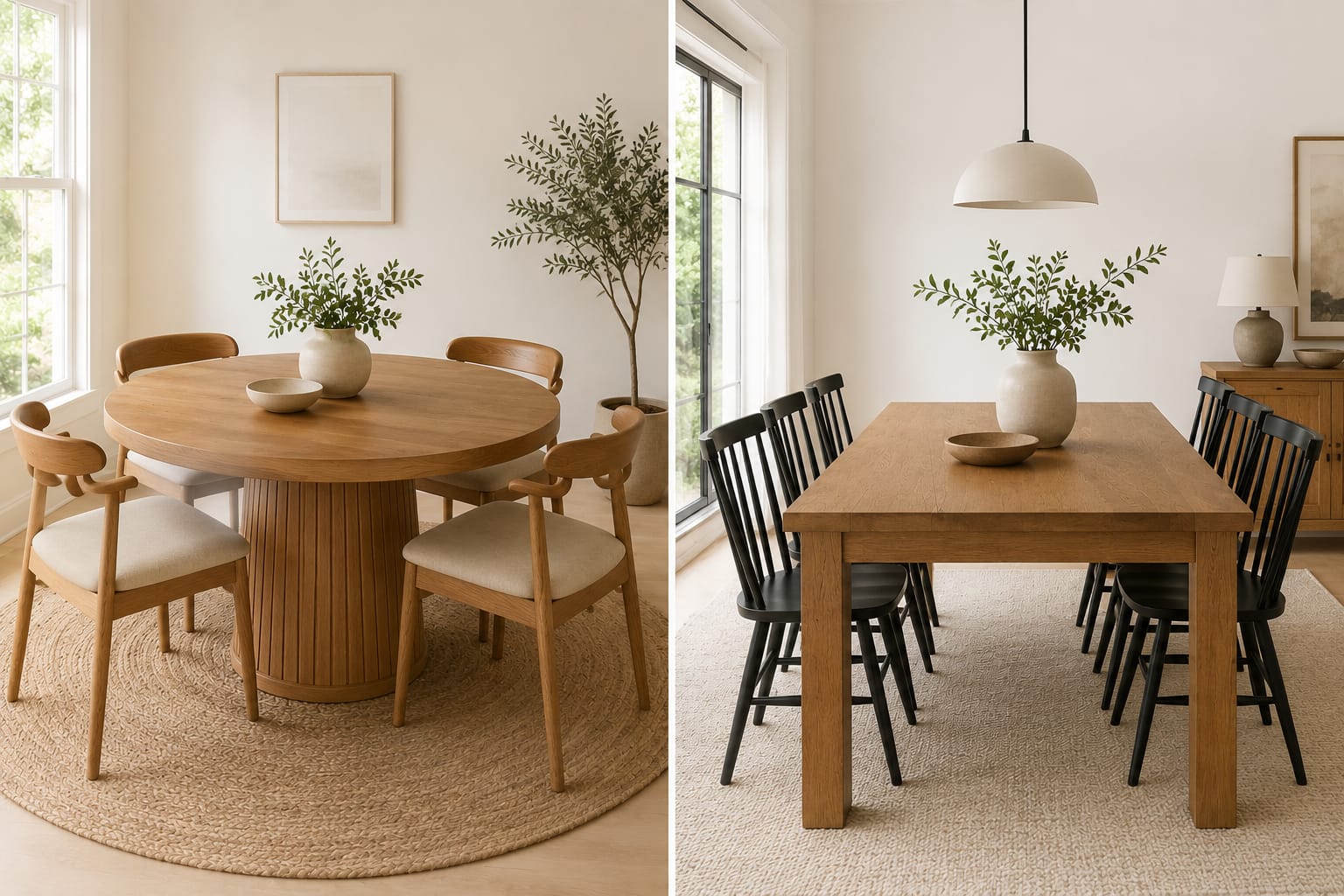
One of the first decisions US homeowners make when furnishing a dining room is choosing the right dining table shape-and it's also one of the easiest to get wrong.
Not because the decision is complicated, but because many people choose a table based on how it looks in a photo rather than how it fits and functions in their own home. They buy a round dining table because it looked beautiful on Instagram, only to discover it seats two fewer people than they need. Others choose a rectangular table because it seems like the practical option, then realize its corners constantly get in the way in a room that's too narrow for its length.
Choosing between a round and rectangular dining table isn't primarily an aesthetic decision-it's a spatial one. Getting the shape right determines whether your dining room feels comfortable, balanced, and easy to use or becomes a source of daily frustration.
This guide gives US homeowners an honest comparison of round and rectangular dining tables, covering standard dimensions, room size requirements, seating capacity, design considerations, and a simple decision framework to help you choose the right shape for your space.
As you read, explore Oak & Loom's collection of solid wood dining tables and dining sets, all available with free shipping across the contiguous United States.
"The shape of your dining table is the shape of every conversation you have around it. Choose the one that fits your room, your family, and the way you truly live."
Quick Answer: Round or Rectangular Dining Table?
Choose a round dining table if your dining room is square or compact (under 120 sq ft), you have a smaller household (2–4 people), or conversation and intimacy are your top priorities. Choose a rectangular dining table if your dining room is longer and larger (120+ sq ft), you need maximum seating capacity, or you frequently host family and friends. For most US households, a rectangular table seats more people in the same amount of floor space, while a round table creates a more intimate and conversational dining experience.
Why the Round vs. Rectangular Dining Table Decision Matters More Than Most US Buyers Think
Most US homeowners spend significant time choosing a dining table's material, finish, and style-but relatively little time thinking about its shape. In reality, that's often backwards.
The shape of your dining table determines how many people it seats, how balanced the room feels, and how comfortably everyone can see and talk to one another. The right shape makes conversation feel natural, while the wrong one can make even a beautiful dining room feel awkward to use.
A dining table in the wrong shape for a room may technically fit, but it rarely feels completely right. The room can look beautiful in photographs yet function awkwardly in everyday life. Seating capacity may seem adequate on paper but feel uncomfortable in practice. When the table's shape doesn't suit the room, the entire space feels slightly out of balance-something that styling alone can't fix.
Choosing the right shape solves those problems from the start. It creates a better foundation for every other dining room decision, from the table's material and finish to your chairs, sideboard, lighting, and overall layout.
Round Dining Tables - Complete Profile for US Homeowners
What a Round Dining Table Does to a Room
A round dining table offers three key advantages that rectangular tables can't fully replicate.
1. Creates a More Inclusive Dining Experience
A round dining table eliminates hierarchy because there is no designated head of the table. Every seat is equally positioned, allowing everyone to see and speak with one another more comfortably. For US families who value relaxed, inclusive gatherings, this layout naturally encourages conversation and helps everyone feel equally involved.
2. Makes Compact Rooms Feel More Spacious
Without sharp corners or long straight edges, a round dining table creates a greater sense of openness. In square or compact dining rooms, it leaves more usable floor space around the table and makes it easier to move through the room. This is one reason round tables are often recommended for smaller dining areas and open-plan homes.
3. Encourages Better Conversation
Everyone sits slightly angled toward the center, making eye contact and conversation feel more natural. Instead of speaking across a long table, guests are closer together, creating a warmer and more intimate dining experience. For households where shared meals are an important part of daily life, this layout often feels more comfortable than a rectangular alternative.
Round Dining Table Dimensions and Seating - US Standard Sizes
|
Diameter |
Comfortable Seating |
Minimum Room Size |
|
36 inches |
2–3 people |
8 ft × 8 ft |
|
42–48 inches |
4 people |
9 ft × 9 ft |
|
54 inches |
4–6 people |
10 ft × 10 ft |
|
60 inches |
6 people |
11 ft × 11 ft |
|
72 inches |
6–8 people |
12 ft × 12 ft |
Pro Tip: Leave at least 36 inches of clearance between the edge of the table and the nearest wall, doorway, or piece of furniture. This gives everyone enough room to pull out chairs comfortably and walk behind seated guests without feeling cramped.
Where Round Dining Tables Work Best in US Homes
Square dining rooms: A round dining table is the most proportionate choice for a square room. Its circular shape complements the room's equal dimensions, creating a balanced layout where every element feels naturally connected.
Small and compact dining rooms: In US homes with dining areas under 120 square feet—including apartments, smaller single-family homes, and many open-plan layouts—a round table makes better use of the available space. Without corners extending into walkways, it creates a more open feel and reduces awkward, unused areas.
Open-plan living and dining areas: A round dining table works especially well in open-concept homes because it creates a visual focal point that looks balanced from every angle. Since it doesn't follow a single directional axis, it fits naturally within shared living spaces and allows for smoother traffic flow.
Households of 2–4 people: For couples, small families, or homeowners who primarily use the dining table for everyday meals, a 48- to 54-inch round table offers comfortable seating without overwhelming the room. It provides enough space for daily use while maintaining a warm, intimate dining experience.
Rectangular Dining Tables - Complete Profile for US Homeowners
What a Rectangular Dining Table Does to a Room
A rectangular dining table offers three key advantages, especially in larger dining rooms and homes that regularly host family and guests.
1. Maximizes Seating Capacity
A rectangular dining table seats more people within the same amount of floor space than most round tables. Its longer shape provides additional seating along both sides and allows extra chairs to be added at the ends when needed, making it the most practical choice for larger households and frequent entertaining.
2. Complements Rectangular Rooms
A rectangular table naturally follows the proportions of a rectangular dining room, creating a strong visual axis that helps organize the entire space. Instead of competing with the room's layout, it works with its geometry to create a balanced and well-proportioned design.
3. Adapts Easily for Everyday Meals and Entertaining
Rectangular dining tables are equally suited to everyday family dinners and larger gatherings. Many designs allow additional seating at each end, making it easy to accommodate extra guests without changing the overall layout. Some models are also available with extension leaves for even greater flexibility.
Rectangular Dining Table Dimensions and Seating - US Standard Sizes
|
Length |
Comfortable Seating |
Minimum Room Size |
|
60 inches (5 ft) |
4–6 people |
9 ft × 12 ft |
|
72 inches (6 ft) |
6–8 people |
9 ft × 13.5 ft |
|
84 inches (7 ft) |
8–10 people |
9 ft × 15 ft |
|
96 inches (8 ft) |
10–12 people |
9 ft × 17 ft |
Pro Tip: Leave at least 36 inches of clearance between every edge of the table and the nearest wall, cabinet, or piece of furniture. If your dining room includes a busy walkway-such as a path between the kitchen and living area-aim for 42 to 48 inches of clearance to allow people to move comfortably behind seated guests.
Where Rectangular Dining Tables Work Best in US Homes
Rectangular dining rooms: A rectangular dining table is the most natural choice for a rectangular room. Its longer shape follows the room's proportions, creating a balanced layout that feels intentional and makes the best use of the available space.
Larger US dining rooms (120+ sq ft): In dining rooms with plenty of clearance on all sides, a rectangular table offers its biggest advantage-greater seating capacity. With more room to accommodate its length, it provides ample space for both everyday family meals and larger gatherings.
Households that entertain frequently: For US homeowners who regularly host dinner parties, holiday celebrations, or family get-togethers, a rectangular dining table offers excellent flexibility. It seats more people than a round table of a similar footprint and allows additional chairs to be placed at the ends when needed.
Formal dining rooms: Rectangular dining tables naturally complement traditional and formal dining spaces. Their defined head positions and elongated shape create a classic, structured look that suits formal entertaining and timeless American interior styles.

Round vs Rectangular Dining Table - Complete Side-by-Side Comparison
|
Factor |
Round Dining Table |
Rectangular Dining Table |
|
Best room shape |
Square or compact rooms |
Rectangular or long rooms |
|
Best room size |
Under 120 sq ft |
120+ sq ft |
|
Seating efficiency |
Moderate |
High |
|
Maximum seating (similar footprint) |
Lower |
Higher |
|
Conversation |
Excellent – everyone faces the center |
Good – best for smaller groups seated together |
|
Table hierarchy |
None – every seat feels equal |
Defined head and end positions |
|
Traffic flow |
Excellent – no corners to navigate |
Good – requires more clearance around corners |
|
Visual impact |
Soft focal point for compact spaces |
Strong visual anchor for larger rooms |
|
Extension options |
Available on some models |
Widely available and more common |
|
Works well with benches |
Less practical |
Excellent |
|
Best for |
Couples, small families, square rooms, everyday dining |
Larger families, entertaining, formal dining |
The Decision Framework - 5 Questions That Determine the Right Shape
Question 1: What shape is your dining room?
This is the single most important factor when choosing between a round and rectangular dining table. Square or nearly square dining rooms are generally better suited to round tables, while rectangular dining rooms work best with rectangular tables that follow the room's longer dimension.
Measure your dining room's length and width. If the room is more than 20% longer than it is wide (roughly a 1.2:1 ratio or greater), a rectangular table will usually feel more balanced. If the room is closer to a square, a round table is often the better fit.
Question 2: How much space do you have?
Before choosing any table size or shape, apply the 36-inch clearance rule. For example, a 60-inch round table typically requires a minimum 9 ft × 9 ft room, while a 72-inch rectangular table works best in a room measuring at least 9 ft × 13.5 ft.
If your room doesn't provide enough clearance for the rectangular table size you want, a slightly smaller round table may offer a more comfortable and practical layout without sacrificing everyday usability.
Question 3: How many people do you need to seat regularly?
For everyday meals with 2–6 people, a round dining table provides comfortable, conversation-friendly seating. If your household regularly seats six or more people, or you frequently entertain guests, a rectangular table offers greater seating capacity and flexibility.
Question 4: What kind of dining experience do you want?
This is one of the most overlooked questions. If your dining table is primarily a place for conversation, family time, and relaxed gatherings, a round table naturally creates a more intimate atmosphere. If your priority is accommodating larger groups and maximizing seating for everyday meals or entertaining, a rectangular table is usually the better choice.
Question 5: How does traffic move through the room?
In open-plan homes or dining rooms connected to kitchens and living areas, traffic flow matters just as much as seating capacity. Round dining tables make it easier to move around the room because they have no corners. Rectangular tables, especially in narrower spaces, require a little more clearance and can create tighter walkways if the room isn't sized appropriately.
Room-Specific Recommendations for US Homeowners
The Small US Apartment Dining Area (Under 90 sq ft)
In compact US apartments-particularly in cities like New York, Chicago, San Francisco, and Boston, where dining areas are often part of an open-plan living space rather than a dedicated room-a 42- to 48-inch round dining table is usually the best choice. It comfortably seats up to four people, takes up less visual space than a comparable rectangular table, eliminates sharp corners, and creates a balanced focal point without overwhelming the room.

The Standard US Suburban Dining Room (120–180 sq ft)
This is the most common dining room size in American single-family homes-and one where both round and rectangular dining tables can work well. The best choice depends on your room's shape and seating needs. In a rectangular room of this size, a 72-inch rectangular dining table is a practical and versatile option. In a square room, a 54- to 60-inch round dining table creates a more balanced layout while comfortably seating everyday family meals.
The Large US Master Dining Room or Open-Plan Great Room (200+ sq ft)
In larger American homes with spacious dining rooms or open-plan great rooms, an 84- to 96-inch rectangular dining table provides the seating capacity, visual presence, and strong focal point these spaces need. While a round table can work in larger rooms, it may appear visually smaller unless its size is carefully matched to the scale of the space.
The Family Dining Room With a Bench
For US families looking for maximum seating flexibility-especially those with children-
a rectangular dining table paired with a bench on one or both sides is often the most practical solution. Benches accommodate more people within the same length and make it easier to seat children of different ages. While benches can be used with some round tables, they work far more naturally with rectangular designs because the straight bench aligns with the table's long edges. For most family dining rooms, a rectangular table is the more practical choice.

The Aesthetic Dimension - When Style Should Influence Your Choice
Once you've answered the practical questions about room size, seating, and layout, aesthetics become the deciding factor. For many US homeowners, the right dining table isn't just about function-it's also about creating a space that reflects their preferred interior design style.
When Round Tables Work Best
Japandi and minimalist dining rooms: A round dining table has no dominant direction, creating a calm and balanced presence within the room. Its soft silhouette complements interiors that prioritize simplicity, clean lines, and visual harmony.
Farmhouse and rustic dining rooms: A round farmhouse table naturally encourages gathering and conversation, creating a warm, welcoming atmosphere. It captures the relaxed, communal feeling that makes farmhouse interiors so inviting.
Contemporary and Scandinavian-inspired dining rooms: The clean curves of a round table complement the soft, organic shapes commonly found in contemporary and Scandinavian interiors. The result is a dining space that feels open, modern, and visually balanced.
When Rectangular Tables Work Best
Traditional and formal dining rooms: A rectangular dining table creates a classic, structured appearance with clearly defined seating positions. Its proportions naturally suit formal dining spaces and traditional American interiors.
Mid-century modern dining rooms: The long, horizontal lines of mid-century furniture pair naturally with rectangular dining tables. Oak & Loom's Newcastle Rattan Legs Dining Table, with its warm wood tones and clean proportions, is a great example of this timeless aesthetic.
Industrial and loft-style dining rooms: The strong linear form of a rectangular table complements exposed beams, brick walls, metal accents, and other architectural features commonly found in industrial-style homes, helping anchor the space visually
Making the Decision - A Simple Framework
If you're still deciding between a round and rectangular dining table, use this simple framework to narrow down your choice:
-
Start with your room shape:
Square or nearly square room? → Lean toward a round dining table.
Rectangular room? → A rectangular dining table is usually the better fit. -
Apply the clearance rule:
If the table size you want doesn't leave at least 36 inches of clearance around it, choose a smaller size or consider a round table that fits the room more comfortably. -
Think about your household:
2–4 people for everyday meals? → A round table offers comfortable, conversation-friendly seating.
5+ people or frequent entertaining? → A rectangular table provides greater seating capacity and flexibility. -
Consider how you use the space:
If shared meals and conversation are your priority, a round table creates a more intimate setting. If you regularly host guests or need maximum seating, a rectangular table is the more practical option. -
Still undecided?
A rectangular dining table is often the more versatile choice because it adapts well to both everyday family meals and larger gatherings. However, if your dining room is compact or nearly square, a round table will usually provide a more comfortable layout and better traffic flow.
Conclusion
Choosing between a round and rectangular dining table is one of the most important layout decisions you'll make in a dining room. The right choice isn't simply the one that looks best-it is the one that fits your room, seats your household comfortably, and supports the way you actually live and entertain.
In square, compact, and many open-plan dining areas, a round dining table creates a balanced, conversation-friendly gathering space that often feels more comfortable than a rectangular alternative in the same room. In standard and larger dining rooms, a rectangular table offers the seating capacity, visual structure, and flexibility that make it the practical choice for many American households.
At Oak & Loom, our dining tables and dining sets are crafted from 100% solid hardwood, including acacia, mango, and teak, and built to become the centerpiece of everyday meals, family gatherings, and celebrations for years to come. Every table includes free shipping across the contiguous United States.
Get the shape right, and everything else in the room becomes easier.
"The best dining table for your home is not the one that looks most beautiful in a showroom. It's the one that makes every meal in your space feel like a gathering worth having."
Ready to choose the right dining table for your home? Browse Oak & Loom's collection of solid wood dining tables with free shipping across the contiguous United States, or contact our team for personalized sizing and layout guidance.
Frequently Asked Questions
Q1. Is a round or rectangular dining table better for a small dining room?
For small US dining rooms-typically under 120 square feet-a round dining table is usually the better choice. Round tables have no corners to navigate around, create smoother traffic flow, and often make compact spaces feel more open. A 48-inch round dining table comfortably seats four people and typically requires a minimum room size of 9 ft × 9 ft, making it a practical option for apartments, breakfast nooks, and smaller dining areas.
Q2. How do I know what size dining table fits my room?
Follow the 36-inch clearance rule: measure your dining room and subtract 72 inches (36 inches on each side) from both the length and width to estimate the maximum table size your space can comfortably accommodate. For example, in a 12 ft × 10 ft room, the largest recommended rectangular table is approximately 78 inches × 48 inches, while a round table should generally be no larger than 48 inches in diameter. Before purchasing, outline the table's dimensions on the floor with painter's tape to visualize the fit and ensure comfortable movement around the room.
Q3. Does a round dining table seat fewer people than a rectangular dining table?
In rooms of a similar size, yes. A 60-inch round dining table typically seats up to six people, while a 72-inch rectangular dining table usually seats six to eight people. Because rectangular tables make better use of their longer shape, they generally provide greater seating capacity within a similar amount of floor space. If you frequently host family gatherings or dinner parties, a rectangular table is often the more practical choice.
Q4. What shape dining table is best for an open-plan living and dining room?
A round dining table often works well in open-plan homes because it creates a balanced focal point that looks good from every angle and allows for smoother traffic flow. However, if your dining area is long and rectangular or you need additional seating, a rectangular dining table can help define the space while providing greater capacity for everyday meals and entertaining.
Q5. Can you mix a round dining table with rectangular furniture in the same room?
Yes. A round dining table pairs beautifully with rectangular furniture such as sideboards, buffets, and area rugs. In fact, combining different shapes creates visual contrast and gives the room a more intentional, designer-inspired look. The key is maintaining balanced proportions and leaving enough space for comfortable movement around the table.
Q6. Does Oak & Loom offer solid wood dining tables in both round and rectangular shapes with free US shipping?
Oak & Loom currently offers a curated collection of solid wood rectangular dining tables, including the Livingston, Newcastle, and Bloomington collections. Crafted from 100% solid hardwood, including acacia and mango, each table is designed for lasting durability and timeless style. Every order includes free shipping across the contiguous United States. If you need help selecting the right size for your dining room, our team is happy to provide personalized guidance.
Share:
The Complete Guide to Mixing Wood Tones Without Making Your Home Look Busy
How to Protect Solid Wood Furniture During Summer Humidity and Heat