
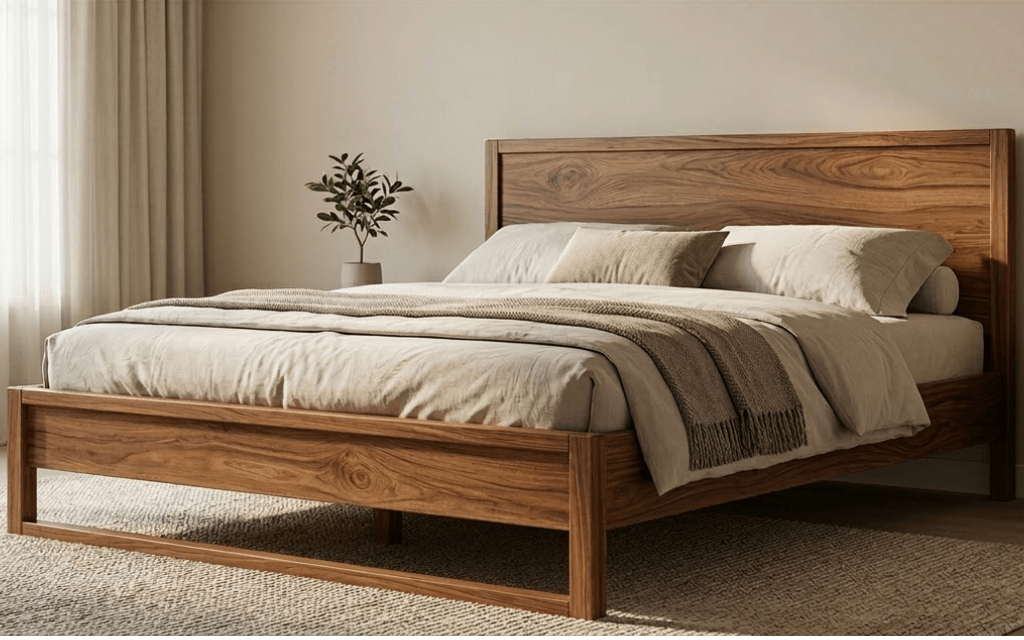
The queen bed is the most popular mattress size in the world — and for good reason. It's versatile enough for single sleepers who like space, practical for couples in mid-size rooms, and fits comfortably in the majority of master bedrooms without overwhelming them. But the size of your mattress is only half the equation. The solid wood queen bed frame you choose will define how long that setup lasts, how it looks, and how confidently it supports you night after night.
Buyers are increasingly choosing solid wood furniture over cheap flat-pack alternatives — and the reasons are straightforward. Hardwood frames don't wobble, creak, or collapse under weight the way MDF-based designs do. They age gracefully, can be refinished, and carry a warmth and character that no synthetic material can replicate.
That said, not every wooden queen bed frame is built the same. Wood species, joinery methods, slat systems, and headboard design all play a significant role in how a frame performs over time. This guide walks you through every factor you need to consider — so when you invest in a solid wood queen bed frame, you do so with total confidence.
Why Choose a Solid Wood Queen Bed Frame?
A hardwood bed frame isn't just a purchase — it's a decision about how you want to live with your furniture. Here's why solid wood consistently wins over every alternative:
- Durability: Solid hardwood resists the everyday stress of use — shifting, loading, and environmental changes — far better than particle board or MDF, which can swell, warp, or collapse within a few years.
- Structural Strength: A well-jointed hardwood frame provides genuine rigidity. There's no flex, no creak, and no progressive weakening from repeated use.
- Longevity: Quality solid wood bed frames last 20 to 50 years. The average flat-pack frame lasts 5 to 10. Over time, solid wood is the more economical choice.
- Natural Aesthetics: Every piece of hardwood carries a unique grain pattern. The warmth and visual depth of real wood cannot be faked by veneer or printed film.
- Repairability: Surface scratches and wear can be sanded back and refinished. With engineered wood, damage is almost always permanent.
Solid Wood vs Engineered Wood Bed Frames
| Feature | Solid Wood | Engineered Wood (MDF / Plywood) |
| Durability | Excellent — decades of reliable use | Moderate — prone to swelling and cracking |
| Weight Capacity | High: 600–1,200 lbs | Lower: 300–550 lbs typically |
| Repairability | Yes — sand, re-oil, or refinish | Limited — surface damage is permanent |
| Eco-Friendliness | High (if responsibly sourced) | Lower — synthetic resins and adhesives used |
| Lifespan | 20–50+ years | 5–12 years |
| Aesthetics | Natural grain, genuine warmth | Lower — synthetic resins and adhesives used |
| Price Range | Mid to premium | Budget to mid-range |
Standard Queen Bed Dimensions Explained
Before you shop for a wood bed frame queen size, it's essential to understand the actual footprint you're working with — including the frame, clearance space, and how it sits within your room. Getting this wrong is one of the most common and costly bedroom mistakes.
Queen Bed Dimension Reference
| Dimension | Measurement | Notes |
| Standard Queen Mattress | 60" W × 80" L | The most common queen size in North America |
| California Queen Mattress | 60" W × 84" L | 4 inches longer — less widely available |
| Bed Frame (with rails) | 62–65" W × 82–86" L | Frames add 1–3" on each side of the mattress |
| Minimum Room Size | 10' × 10' | Workable but tight — limited furniture options |
| Recommended Room Size | 12' × 12' or larger | Comfortable layout with nightstands and walkway |
| Side Clearance (each side) | 24–30" minimum | Required for comfortable movement and egress |
| Foot of Bed Clearance | 24" minimum | More if a dresser or TV sits opposite the bed |
Understanding queen bed dimensions is especially important if you're buying a frame with a statement headboard, which can add 8–12 inches to the overall depth of the piece against the wall. Always measure your room and mark out the footprint with tape before ordering.
Best Types of Wood for Queen Bed Frames
The wood species is the single biggest factor in your frame's long-term performance, aesthetics, and value. Here are the four most popular options for a solid wood queen bed frame — each with distinct strengths.
Mango Wood Queen Bed
Mango wood has earned its place as one of the most compelling choices in the handcrafted wooden beds market. It's harvested from mango fruit trees at the end of their productive life — meaning no trees are cut purely for timber — giving it strong eco-credentials alongside genuine hardness.
- Durability: Scores around 1,070 on the Janka hardness scale — harder than walnut, comparable to cherry
- Grain Pattern: Striking natural variation with gold, honey, and dark brown tones, occasional olive and pink streaks
- Weight: Medium-heavy — sturdy without being unwieldy to assemble or move
- Cost Category: Mid-range — premium aesthetics at an accessible price point
Acacia Wood Queen Bed
Acacia is prized for its exceptional density and natural resistance to moisture and insects. An acacia durable bed frame carries a deep, rich tone and a premium feel that holds up exceptionally well in humid environments.
- Durability: Very high — one of the hardest commercially available furniture woods
- Grain Pattern: Tight, swirling grain with deep walnut-like tones and natural lustre
- Weight: Heavy — provides exceptional stability and a planted, solid feel
- Cost Category: Mid to premium — reflects the wood's density and sourcing complexity
Sheesham Wood Queen Bed
Also known as Indian Rosewood, Sheesham has been the foundation of artisan furniture-making in South Asia for centuries. Its natural oils make it self-resistant to warping — an important quality in a hardwood bed frame expected to last for decades.
- Durability: Excellent — naturally oily wood that holds joinery well and resists splitting
- Grain Pattern: Rich, interlocked grain in warm honey to dark espresso tones with occasional figuring
- Weight: Heavy — very stable once assembled
- Cost Category: Mid-range — widely available and well-established in the handcrafted market
Oak Wood Queen Bed
Oak is the benchmark hardwood in European and American fine furniture. An oak wood bed frame queen size brings a heritage quality that feels genuinely substantial — and it takes stain and finish beautifully for a customised look.
- Durability: Outstanding — among the hardest and most dimensionally stable furniture woods available
- Grain Pattern: Distinctive open grain with cathedral or straight patterns; accepts light and dark stains equally well
- Weight: Heavy — very rigid and permanent-feeling once built
- Cost Category: Premium — the most expensive of the four but justifies the investment over decades
Wood Type Quick Comparison
| Wood Type | Hardness | Best For |
| Mango Wood | High (1,070 Janka) | Eco-conscious buyers, statement grain, great value |
| Acacia Wood | Very High | Moisture-prone rooms, maximum durability |
| Sheesham Wood | High | Traditional warmth, natural warp-resistance |
| Oak Wood | Very High | Heritage aesthetics, premium finish, long term |
Queen Platform Beds vs Traditional Bed Frames
One of the first structural decisions you'll make is whether to choose a solid wood queen platform bed or a traditional raised frame designed to work with a box spring. Both are valid — the right choice depends on your mattress type and aesthetic preferences.
A queen size platform bed features either a solid base or closely spaced slats that carry the mattress directly. No box spring is needed, the profile is lower, and the design typically suits modern and Scandinavian interiors. A traditional frame uses wider-spaced slats intended to sit on a box spring foundation — which adds height and a more classic, formal bedroom profile.
Platform Bed vs Traditional Box Spring Frame
| Feature | Queen Size Platform Bed (Solid Wood) | Traditional Frame + Box Spring |
| Box Spring Required? | No — mattress sits on slats or base directly | Yes — box spring adds ~6–8" of height |
| Total Bed Height | Low profile: 14–20" floor to top of mattress | Taller: 24–32" with box spring added |
| Best Mattress Type | Memory foam, latex, hybrid | Innerspring, traditional coil mattress |
| Stability | Excellent — rigid, uniform support | Good — dependent on box spring condition |
| Modern Aesthetic | Yes — clean sightlines, minimal silhouette | Traditional — taller, more formal look |
| Extra Cost | None — one self-contained purchase | Box spring adds $100–300+ to total cost |
| Airflow | Good (slat gaps allow circulation) | Better (elevated height improves airflow) |
For most buyers using a solid wood queen platform bed with a modern foam or hybrid mattress, the platform design is the practical and stylish default. It eliminates redundant costs and keeps the bedroom profile clean and contemporary.
Popular Styles of Wooden Queen Bed Frames
A wooden queen bed frame comes in a wider range of design languages than most buyers expect. Here's a breakdown of the most popular styles and what interior aesthetic each one suits:
- Modern Minimalist: Clean lines, low profile, and a simple panel or slatted headboard. Natural oil or light wax finishes let the wood grain speak for itself. Best matched with white or neutral linen.
- Rustic Farmhouse: Chunky, visible joinery, a substantial headboard with character marks or live edges, and darker stains. Pairs well with woven textiles, exposed brick, and wrought-iron hardware.
- Mid-Century Modern: Tapered legs, walnut or mango in a warm mid-tone stain, and a restrained headboard with gentle curves or horizontal slats. Suits rooms with warm lighting and vintage accessories.
- Upholstered Headboard: Some wooden queen frames pair a solid hardwood base with a padded fabric or leather headboard panel — combining the durability of a hardwood bed frame with the comfort of an upholstered back for reading or watching TV in bed.
- Storage Beds: Drawers integrated into the base are increasingly popular in smaller bedrooms. A solid wood storage queen bed frame provides both a sleeping platform and meaningful under-bed storage — without sacrificing build quality.
How to Choose the Best Solid Wood Queen Bed Frame
Finding the best queen bed frame solid wood for your specific bedroom comes down to evaluating these key factors honestly before you purchase:
- Wood Species: Match your priority — mango for eco-value and character, sheesham for warmth and warp-resistance, acacia for maximum durability, oak for heritage quality
- Room Size: Confirm you have at least 10' × 10' — ideally 12' × 12' — with 24–30" clearance on each side of the frame
- Mattress Compatibility: Platform beds suit foam and hybrid mattresses; traditional frames with wider slats are better for innerspring mattresses
- Headboard Design: Panel for minimalism, slatted for visual lightness, upholstered for comfort, storage-panel for functionality
- Storage Options: Under-bed drawers or a storage headboard are worth considering if your bedroom lacks wardrobe or closet space
- Assembly & Joinery: Look for mortise-and-tenon, dowel, or bolt joinery rather than cam locks or staples — a sign of genuine craftsmanship
- Centre Support Rail: Non-negotiable on a queen — confirm a centre rail with a floor leg is included to prevent mattress sag
- Finish: Look for VOC-free, non-toxic oils or wax finishes — especially important in a sleeping environment
Weight Capacity and Slat Support Guide
The structural performance of your bed depends on three things: the wood quality, the slat system, and the central support. Here's what to look for in each area.
- Centre Support Rail: Every queen frame must have a central rail with at least one floor leg. Without it, the middle of the mattress will sag within months — regardless of how good the outer frame is.
- Number of Slats: A queen frame should have a minimum of 10–12 slats. 14–16 is ideal. More slats mean more even weight distribution and less stress on individual slats.
- Slat Material — Hardwood vs Plywood: Solid hardwood slats (typically beech or pine) are significantly more durable than plywood. Plywood slats can flex, crack, and fail under sustained weight — especially for heavier occupants.
- Slat Spacing: Gaps between slats should not exceed 3 inches. Wider gaps are a common cause of mattress warranty voids — always check the specification.
- Weight Capacity: A well-built solid wood queen frame with a centre rail and hardwood slats should support 700–1,100 lbs. Always check the manufacturer's stated figure and look for third-party test certification where possible.
Slat System Performance at a Glance
| Slat Type | Recommended Count (Queen) | Approx. Weight Capacity |
| Solid Hardwood Slats | 14–16 slats | 700–1,100 lbs |
| Plywood Slats | 10–14 slats | 450–700 lbs |
| Sprung Slats | 12–16 slats | 550–850 lbs (improved mattress comfort) |
| Solid Board Base | N/A (continuous base) | 1,000 lbs+ |
Styling a Bedroom Around a Queen Size Solid Wood Bed
A wood bed frame queen size is one of the most adaptable centrepiece pieces in home furnishing. Here are four styling directions that work especially well with solid hardwood:
Modern Bedroom
Pair a low-profile mango or acacia platform bed with crisp white bedding, geometric cushions, and a slim pendant light. Keep the palette neutral — white, charcoal, warm grey — and let the wood grain provide all the warmth. Matching hardwood nightstands from the same collection create a polished, intentional look.
Minimalist Bedroom
Minimalism isn't just about removing objects — it's about deliberate choices. A solid oak or mango frame with a simple slatted headboard, a single linen duvet in oatmeal or ivory, and one statement plant in a ceramic pot. No clutter. No noise. The grain of the wood becomes the feature.
Rustic Bedroom
A sheesham or reclaimed wood queen frame with a substantial panel headboard, chunky knit throw, layered linen pillows in warm earth tones, and a jute or wool rug. Iron wall sconces and a wooden ceiling beam (real or decorative) complete the aesthetic. For complementary pieces, explore the Bedside Styling Guide.
Luxury Bedroom
A dark-stained acacia or oak queen frame with an upholstered headboard in deep velvet or textured linen. Dress the bed in hotel-style white bedding with fine contrast stitching. Add soft, directional bedside lighting, a statement mirror, and a large-format rug. The result feels curated rather than decorated.
Where to Buy a High-Quality Solid Wood Queen Bed Frame
With so many retailers selling furniture described as "solid wood", it's important to scrutinise what you're actually buying. True solid wood furniture uses the same wood throughout the piece — not a veneer applied to a particle board core. Always request full material specifications before purchasing.
Oak & Loom is a handcrafted solid wood furniture brand built on traditional joinery and responsibly sourced hardwood. Their queen bed frames stand out in several important ways:
- Kiln-Dried Hardwood: All timber is kiln-dried before use to remove residual moisture — preventing warping, splitting, and seasonal movement after the frame is in your home
- Premium Joinery: Mortise-and-tenon and hardwood dowel construction throughout — not cam locks or stapled joints that loosen over time
- Handcrafted Construction: Each piece is individually finished by hand rather than mass-produced on an assembly line — visible in the surface quality and consistency of the finish
- Long Lifespan: Frames are built to be a permanent fixture in your bedroom, not replaced in five years — backed by quality guarantees that mass-market brands rarely offer
Browse the full Wooden Beds collection to explore available hardwood queen frames. For context on sizing up, the King Bed Guide covers everything you need to know about the next size up. The Full Wooden Bed Frame Guide provides a comprehensive overview across all sizes and construction types.
Frequently Asked Questions
What is the standard queen bed size?
A standard US queen mattress measures 60 inches wide by 80 inches long. This is the most widely produced mattress size in North America. When you add a solid wood bed frame with rails, the overall footprint typically extends to around 62–65 inches wide and 82–86 inches long. A California Queen measures 60" × 84" — four inches longer but no wider, suited to taller sleepers.
How long does a solid wood queen bed frame last?
A properly built solid wood queen bed frame from a quality hardwood — mango, acacia, sheesham, or oak — should last 20 to 50 years with basic care. This vastly outperforms MDF or particle board frames, which typically deteriorate within 5–10 years. Periodic cleaning and re-oiling of the wood surface will extend the lifespan further and keep the finish looking fresh.
Is mango wood good for bed frames?
Yes — mango wood is an excellent choice for bed frames. It scores around 1,070 on the Janka hardness scale, making it genuinely hard and durable for long-term use. It's also one of the most sustainable hardwood options available, as mango trees are harvested at the end of their fruit-bearing life rather than being grown specifically for timber. A quality mango wood queen bed will comfortably last 20+ years and carries striking grain patterns that make each piece unique.
Do queen platform beds require a box spring?
No. A queen size platform bed is specifically engineered to support a mattress directly on its slat system or solid base — no box spring required. Adding one is unnecessary and will raise the bed height more than most buyers want. Always verify that your mattress type is compatible with a platform base (most modern foam, latex, and hybrid mattresses are) and check that slat spacing doesn't exceed 3 inches to avoid voiding the mattress warranty.
How much weight can a solid wood queen bed frame support?
A well-constructed solid wood queen bed frame with a centre support rail and solid hardwood slats should support 700 to 1,100 lbs — including the mattress, bedding, and all occupants. Frames with plywood slats and no centre rail typically handle 400–600 lbs before showing structural stress. If you or your partner are heavier, specifically look for frames rated to 900 lbs or above and confirm the centre rail includes a steel-reinforced leg for maximum load distribution.
What is the difference between a queen and a king bed frame?
A standard queen frame is typically 62–65" wide — roughly 16–18 inches narrower than a standard king (which accommodates a 76" mattress). For couples who want more personal sleeping space, a king is the natural upgrade. The King Bed Guide covers king sizing, wood options, and platform vs traditional frames in full detail.
What finish should I look for on a solid wood bed frame?
In a sleeping environment, VOC-free, non-toxic finishes are strongly preferred. Look for natural oil or wax finishes that allow the wood to breathe and develop a patina over time. Avoid high-gloss polyurethane on bedroom furniture where possible — it can off-gas in an enclosed space and tends to show wear lines more visibly. Most quality handcrafted brands, including Oak & Loom, use food-safe, water-based or natural oil finishes as standard.
Can a solid wood bed frame be repaired if damaged?
Yes — this is one of the most underappreciated advantages of solid wood furniture. Surface scratches, dents, and minor gouges can be sanded back and refinished at home with a fine-grit sandpaper and a matching wood oil or wax. For structural repairs — a loose joint, a cracked rail — a furniture maker or carpenter can carry out professional restoration. The same damage on an MDF or veneer frame would typically mean replacement.
Final Thoughts
A solid wood queen bed frame is one of the most rewarding investments you can make in your bedroom. When you choose real hardwood over engineered alternatives, you're not just buying furniture — you're buying decades of reliable performance, a piece that genuinely improves with age, and a foundation for a bedroom that feels considered rather than assembled.
The key decisions are straightforward once you understand what to look for: choose a wood species that matches your priority (value, durability, aesthetics, or sustainability), confirm your room has adequate clearance for a queen size platform bed or traditional frame, and verify that the construction includes a centre support rail, hardwood slats, and quality joinery before you commit.
For those who want handcrafted wooden beds built to stand the test of time, browse the Wooden Beds collection from Oak & Loom — where every frame is made from kiln-dried hardwood and finished by hand. Your bed is where every day ends and every morning begins. It should be built to last as long as you plan to keep it.
Share:
Solid Wood King Bed Frame: Complete Buyer's Guide 2026
Wooden TV Stand Buying Guide: How to Choose the Right Size, Style & Storage (2026)